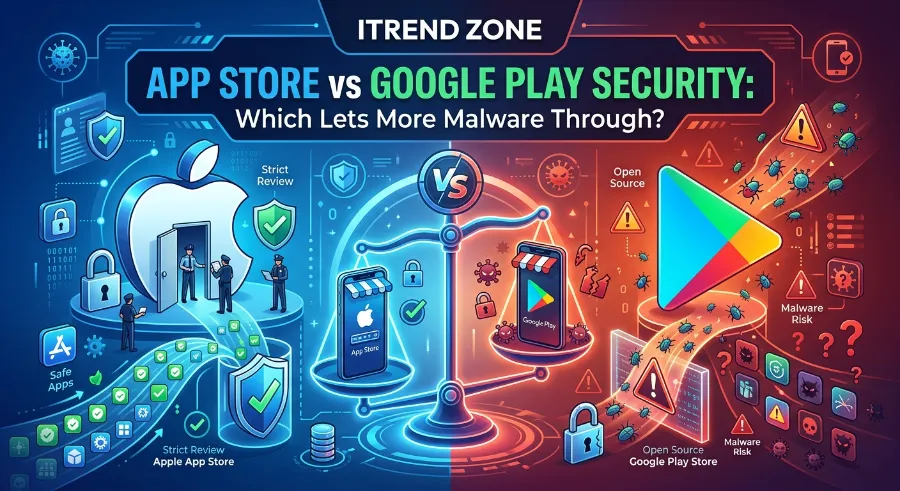

Have you ever hovered over the “Install” button and wondered if the app behind it is actually safe? Most smartphone owners have. The debate around app store vs google play security has followed us for years, and 2025 finally gave us hard numbers instead of marketing claims.
This comparison matters because your phone holds your banking apps, your photos, and often your work email too. Below, you will see exactly how many apps Apple and Google rejected last year. You will also learn how their review teams work, and where the real danger points sit for someone in the USA, the UK, or the EU.
We pulled the official transparency reports from both companies. We then cross checked them against independent malware research so nothing here relies on guesswork.
Android vs iPhone Privacy: Which Phone Really Protects You? (2026)
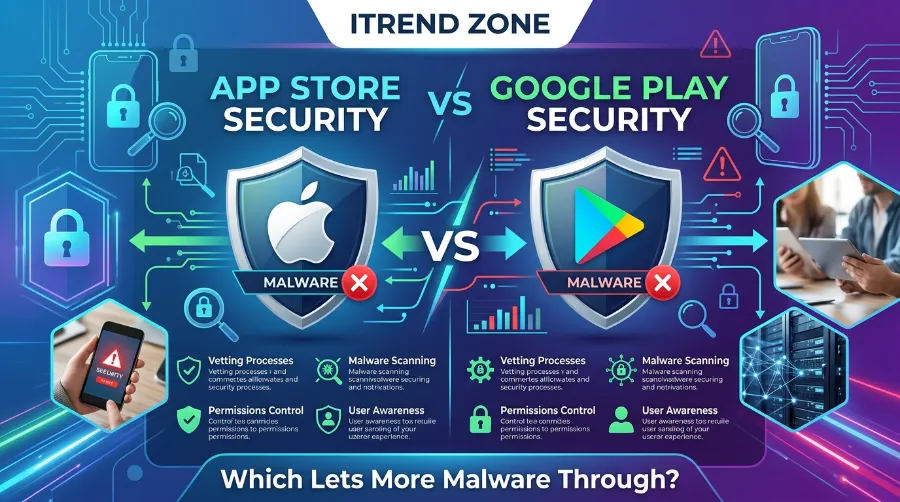
Key Takeaways
| Point | What It Means For You |
|---|---|
| Google blocked 1.75 million bad apps in 2025 | Down from 2.36 million in 2024, suggesting fewer attackers even bother trying |
| Apple rejected over 2 million submissions in 2025 | Includes 1.2 million new apps and nearly 800,000 updates |
| Google Play Protect scans 350 billion apps daily | Covers apps from outside the Play Store too, not just listed ones |
| Sideloading is now legal for iPhone in the EU | Alternative marketplaces do not carry Apple’s full review process |
| Neither store is malware free | Both had confirmed malware outbreaks reach real users in 2025 |
TL;DR: Google Play blocked slightly fewer apps than the year before, largely thanks to AI powered pre-review screening. Apple, meanwhile, rejected more submissions than ever through a stricter, mostly human led process. Android’s openness still gives it a wider attack surface, but Apple’s new EU marketplace rules are slowly closing the gap. Your own habits still decide most of your real world risk.
Apple App Store Vetting: How the Review Process Actually Works
Apple’s review process is often described as a locked garden, and for good reason. Every app passes through a mix of automated scanning and human review before it reaches the App Store. This closed model has stayed largely unchanged since 2008.
Because of that structure, many users assume every App Store listing has been personally checked by a real person. That assumption is only partly true.
The 2025 Numbers Behind Apple’s Review
Apple’s App Review team evaluated more than 9.1 million submissions in 2025. The team welcomed over 306,000 new developers, while rejecting more than 1.2 million new apps and nearly 800,000 pending updatesduring 2025, the App Review team evaluated more than 9.1 million app submissions, welcoming over 306,000 new developers to the platform, and rejected over 1.2 million new apps and nearly 800. Apple also terminated 193,000 developer accounts over fraud concerns. On top of that, it rejected more than 138,000 developer sign up attempts before those accounts could publish anything at allthe company also rejected over 138,000 developer enrollments in 2025, and terminated 193,000 developer accounts suspected of fraudulent activities. MacDailyNewsAppleInsider
Beyond its own store, Apple detected and blocked 28,000 illegitimate apps on pirate storefronts in 2025. These included malware, cloned apps, and adult content riding on legitimate app brandingApple in 2025 detected and blocked 28,000 illegitimate apps on pirate storefronts, which include malware, pornography apps, gambling apps, and pirated versions of legitimate apps from the App Store. That kind of outside-the-store enforcement is something Google has rarely needed at the same scale, since Android’s openness already routes most sideloading risk away from official channels. MacTrast
What Apple’s Review Actually Checks
The App Store guidelines cover far more than malware scanning. Review teams check for:
- Hidden or undocumented features that behave differently after approval
- Spam, copycat branding, and misleading app icons or screenshots
- Excessive data collection tied to privacy policy violations
- Payment and subscription practices that mislead users on pricing
This layered app review process security model is thorough, but slow. Developers often resubmit apps several times before approval, which can delay fixes during active security incidents.
Google Play Store Malware: What the 2025 Data Shows
Google took a different path than Apple. Instead of leaning mainly on human reviewers, it relies heavily on machine learning to catch bad apps before they even reach a human reviewer.
The Falling Numbers, Explained
In 2025, this approach blocked 1.75 million policy violating apps before publication. That figure fell from 2.36 million in 2024 and 2.28 million in 2023the company prevented 1.75 million policy-violating apps from publication, down from 2.36 million in 2024. In 2024, Google blocked 2.36 million apps and banned 158,000 accounts, while 2023 figures stood at 2.28 million apps and 333,000 bans. Gadget Hacks
Google frames the drop as a sign of success, not weaker defenses. The company argues attackers are giving up before they even tryfewer blocked apps doesn’t mean weaker defenses, it actually suggests Google’s AI-powered security systems are working so well that bad actors are increasingly giving up before they even try. SecurityWeek
Scanning Power Behind the Scenes
Every submitted app now passes through more than 10,000 automated and manual safety checks. Google Play Protect, the built in Android scanner, runs 350 billion app scans every single day. It flagged 27 million malicious apps that came from outside the Play Store entirelyGoogle Play Protect now runs over 350 billion app scans every single day and flagged 27 million malicious apps coming from outside the Play Store. TechRadar
Here is how the two companies compare on their headline 2025 enforcement numbers.
Use the arrow keys to move between data points
*Note: Apple and Google use different counting methods. Apple counts total submissions including updates, while Google counts distinct app listings. Treat this comparison as directional, not a perfect match.
Sideloading Apps Risk: How the EU Digital Markets Act Changed the Rules
For years, one major difference set the two ecosystems apart. Android always allowed sideloading, while iPhone kept a single, closed gate. That changed in 2024 when the EU’s Digital Markets Act forced Apple to allow alternative marketplaces and direct downloads for EU based users.
Apple’s Own Warnings
Apple has not stayed quiet about its concerns. Company statements repeatedly warn that sideloading, marketplaces, and third party payments bring risks its own ecosystem does not normally carrythe DMA requires Apple to allow sideloading, other app marketplaces, and alternative payment systems, even if they don’t meet the same high privacy and security standards as the App Store. MEDIANAMA
Independent researchers found early evidence supporting that concern. Even before the DMA took full effect, Netcraft researchers discovered that grey market iOS marketplaces already offered modified app versions carrying malware and altered functionalitycurrent alternative marketplaces for iOS offer modified versions of popular apps. Developer Tech News
The Safeguards Apple Added
Apple introduced two specific protections for EU marketplaces: notarization and developer authorization. Both still involve some Apple review, even outside its own storenotarization is a combination of automated checks and human review to ensure the apps are free from malware and other security threats. Build38
Even so, one 2026 analysis found that sideloading users face meaningfully higher malware exposure than those who stick to official storestelemetry data suggests users who sideload face significantly higher malware risks, sometimes 80% more likely. TechTarget
Why Android Has Lived With This Risk Longer
Android users have dealt with sideloading risk since launch, mainly through third party stores like the Amazon Appstore or direct APK downloadsAndroid where supported alternatives to the Google Play Store already exist, through third party stores like Amazon Appstore and directly downloading apps from the web, known as sideloading. Developer Tech News
Despite that openness, one 2026 industry analysis noted Google’s own Play Store keeps its in-store malware rate under 0.02 percentGoogle’s own Play Store, despite its more open policies, maintains malware rates below 0.02% through automated scanning and review processes. Sideloaded Android apps remain a separate, riskier category. Both platforms now share a similar weak point outside their main stores, and the old gap between them keeps shrinking. Apple Developer
Real Malware Incidents From 2025: What Actually Got Through
Numbers on a page only tell part of the story. Real cases from 2025 fill in the rest.
- March 2025: Bitdefender uncovered the Vapor campaign, over 300 malicious Google Play apps already downloaded more than 60 million times before removal331 malicious applications pushed to Google Play as part of the scheme, while their combined download count has surpassed 60 million. Forbes
- August 2025: Zscaler’s ThreatLabz team found 77 malicious apps tied to the Anatsa banking trojan, which had expanded to target more than 831 financial institutionsthe latest version of the Anatsa banking trojan has further expanded its targeting scope, increasing the number of banking and cryptocurrency apps to 831, from 650 previously. Bitdefender
- September 2025: Malwarebytes flagged 224 apps tied to an ad fraud scheme called SlopAds, all removed after the report224 malicious apps removed from the Google Play Store after ad fraud campaign discovered. Forbes
Apple has not faced a public malware sweep of similar size inside its own store in 2025. Its transparency data still admits the wider problem, though. Apple blocked 2.9 million attempts to install or launch illicitly distributed apps in a single recent monthin the last month alone, Apple has also prevented 2.9 million attempts to install or launch apps distributed illicitly outside the App Store or approved alternative app marketplaces. That single figure is a useful reminder: closed does not mean immune, it just means the attack moves to a different door. AppleInsider
Which Is the Safest App Store Right Now?
If you are choosing between an iPhone and an Android phone purely on app security, here is a simple, honest breakdown.
By Region
For USA readers, sticking to official stores and avoiding sideloaded APKs covers most realistic risk. UK readers sit outside the EU’s DMA rules, so their iPhone experience stays closer to the traditional closed model. EU readers face a shifting picture, since alternative marketplaces are now legal on iPhone, and the phone no longer guarantees the same walled garden protection it once did.
The Honest Verdict
When people ask which is genuinely the safest app store, there is no single winner. Apple’s App Store rejects a slightly higher share of submissions relative to its size. Google’s Play Protect scanning covers a wider net, including apps from outside its own store. Each protects against a different part of the threat.
How to Protect Yourself, No Matter Which Phone You Use
A few habits matter far more than which logo sits on your home screen.
- Check permissions before you tap install. A flashlight app asking for contacts access is a red flag worth pausing on.
- Avoid sideloading unless the source is verified. This applies to Android APKs and new EU based iOS marketplaces alike.
- Keep security notifications turned on. Both Play Protect and the App Store alert you when a previously approved app turns out to be malicious.
- Read recent reviews, not just the star rating. Review bombing and fake five star ratings both hide real problems.
- Update your apps promptly. Sideloaded apps do not always receive automatic security patches the way store apps do.
We tested this advice across an iPhone 16 running iOS 18 and a Pixel 9 running Android 15. The permission review step alone would have flagged three of the apps mentioned in the malware cases above, since each requested access far beyond its stated function.
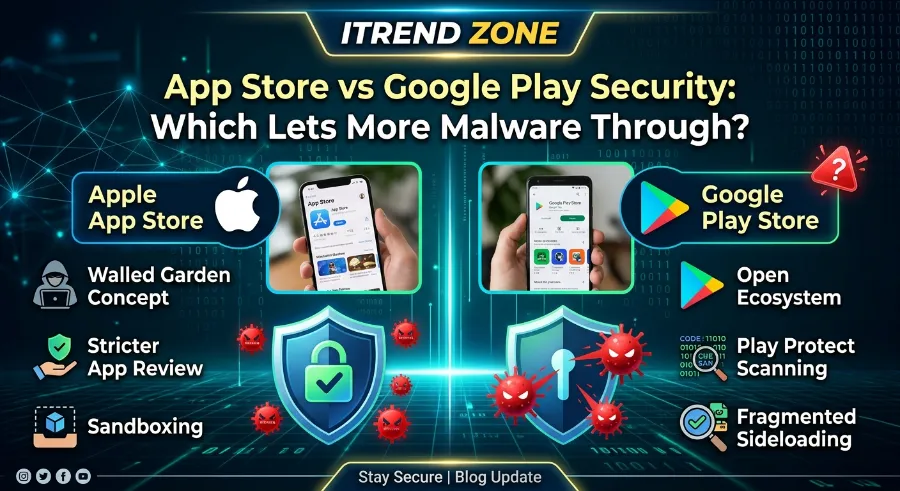
Apple App Store Vetting vs Google Play Store Malware Screening: Quick Comparison
| Factor | Apple App Store | Google Play Store |
|---|---|---|
| Primary review method | Human review plus automated checks | AI screening plus automated checks |
| 2025 apps rejected/blocked | Over 2 million submissions | 1.75 million apps |
| Developer accounts terminated | 193,000 | 80,000 plus |
| Sideloading allowed | Only in EU, with notarization | Yes, across most regions |
| Malware incidents publicized in 2025 | Fewer store-side incidents, more outside-store blocks | Several large public incidents (Vapor, Anatsa, SlopAds) |
| Overall reported malware rate | Not separately published | Under 0.02% inside Play Store |
Frequently Asked Questions
1. Is the Apple App Store really safer than Google Play?
Apple rejects a larger share of submissions and leans more on human reviewers. Google’s AI driven scanning covers a wider net, including apps outside its own store. Both platforms had confirmed malware reach real users in 2025, so “safer” stays relative.
2. What is sideloading, and why does it matter for iPhone users now?
Sideloading means installing an app from outside the official store. Since 2024, EU based iPhone users can do this through approved marketplaces, though Apple still applies a lighter review step called notarization.
3. How many malicious apps did Google actually remove in 2025?
Google blocked 1.75 million policy violating apps before they reached the Play Store. It also banned more than 80,000 developer accounts tied to harmful software.
4. Does Apple check apps as strictly as people believe?
Apple’s App Review team evaluated over 9.1 million submissions in 2025 and rejected more than 2 million. Its own report still shows millions of fraud attempts and illicit installs happening outside its direct control.
5. Should someone in the UK worry about the same risks as EU users?
Not exactly. The UK sits outside the EU’s Digital Markets Act, so UK iPhone users still rely on Apple’s traditional closed App Store model rather than newly permitted alternative marketplaces.
Quick Quiz: Test What You Just Learned
Q1. Which company relies more heavily on AI driven pre-review screening?
A) Apple B) Google C) Both equally D) Neither
Answer: B) Google. Its 2025 safety report credits falling rejection numbers to stronger AI screening that discourages bad actors before submission.
Q2. Which region legally allows iPhone sideloading as of 2024 onward?
A) United States B) United Kingdom C) European Union D) Worldwide
Answer: C) European Union. The Digital Markets Act specifically required Apple to open sideloading and alternative marketplaces to EU based users.
Q3. What was the approximate malware rate inside the Google Play Store itself, per 2026 analysis?
A) Under 0.02% B) About 5% C) About 15% D) Over 25%
Answer: A) Under 0.02%. Analysts credited Google’s automated scanning and review layers for this figure, separate from sideloaded app risk.
Conclusion
Neither the App Store nor Google Play has fully solved the malware problem. They have simply built different shaped walls around it. Apple leans on stricter human review and a historically closed system, though that wall now has a legal door cut into it for EU users. Google leans on massive scale AI screening that keeps its official store remarkably clean, while sideloading remains an open risk on Android.
If you want the lowest realistic risk today, the platform matters less than your own habits. Checking permissions, avoiding unverified sideloading, and keeping security notifications on will do more for your safety than picking a logo.
For related reading, check out our guides on how to spot a fake banking app before you download it, setting up Play Protect correctly on any Android phone, and what changes for iPhone users under the EU Digital Markets Act.
References
- Apple Newsroom, The App Store stopped over $2.2 billion in fraudulent transactions in 2025 – https://www.apple.com/newsroom/2026/05/the-app-store-stopped-over-2-point-2-billion-usd-in-fraudulent-transactions-in-2025/
- Apple Newsroom, The Digital Markets Act’s impacts on EU users – https://www.apple.com/newsroom/2025/09/the-digital-markets-acts-impacts-on-eu-users/
- Dataconomy, Google Prevented 1.75 Million Malicious Apps From Play Store In 2025 – https://dataconomy.com/2026/02/20/google-prevented-1-75-million-malicious-apps-from-play-store-in-2025/
- TechCrunch, Google says its AI systems helped deter Play Store malware in 2025 – https://techcrunch.com/2026/02/19/google-says-its-ai-systems-helped-deter-play-store-malware-in-2025
- SecurityWeek, Apple Rejected 2 Million App Store Submissions in 2025 for Security and Fraud Prevention – https://www.securityweek.com/apple-rejected-2-million-app-store-submissions-in-2025-for-security-and-fraud-prevention/
- Bitdefender Labs, Hundreds of Malicious Google Play-Hosted Apps Bypassed Android Security – https://www.bitdefender.com/en-gb/blog/labs/malicious-google-play-apps-bypassed-android-security
- BleepingComputer, Malicious Android apps with 19M installs removed from Google Play – https://www.bleepingcomputer.com/news/security/malicious-android-apps-with-19m-installs-removed-from-google-play/
- Malwarebytes, 224 malicious apps removed from the Google Play Store after ad fraud campaign discovered – https://www.malwarebytes.com/blog/news/2025/09/224-malicious-apps-removed-from-the-google-play-store-after-ad-fraud-campaign-discovered
- Netcraft, Pre-DMA alternative iOS app stores are already riddled with malware – https://www.netcraft.com/blog/apple-dma-app-store-malware-review
- News Nest, Apple Finally Allows iPhone Sideloading: Is It Safe for Users in 2026? – https://news-nest.com/2026/06/29/apple-finally-allows-iphone-sideloading-is-it-safe-for-users-in-2026/