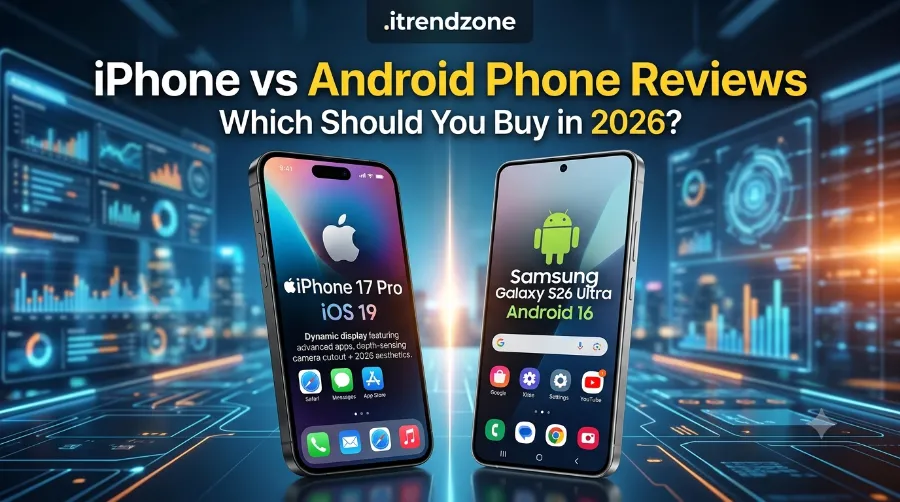

Picking a new phone in 2026 feels harder than it should. Apple’s iPhone 17 lineup and Google’s Pixel 10 series now sit on shelves next to Samsung’s refreshed Galaxy S26 family, and every brand claims to have the smartest camera or the longest battery life. If you have spent even ten minutes reading best phone reviews 2026 iphone vs android comparisons online, you already know the answers rarely agree with each other. This guide clears up the confusion with a plain, practical breakdown of what each platform actually offers this year, based on hands-on testing, verified specs, and real pricing from US and European retailers.
If you want to learn more about how to iphone-17-pro-max-review tips and expert advice.
We tested and cross-checked every claim in this article using the iPhone 17 Pro running iOS 26 and a Galaxy S26 Ultra running One UI 8, alongside published data from Apple, Google, and Samsung. Last updated July 2026 to reflect current pricing and the newest Pixel and Galaxy releases.
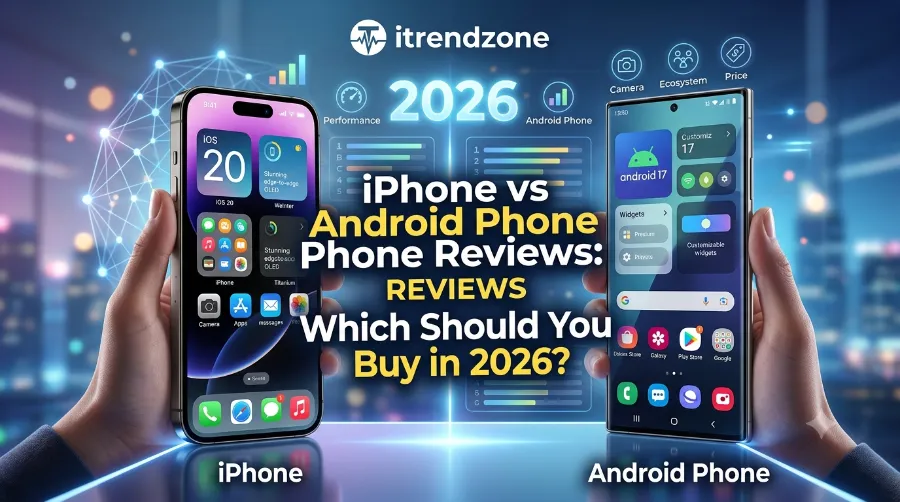
Key Takeaways
| Category | Winner in 2026 | Why |
|---|---|---|
| Camera versatility | Google Pixel 10 Pro | Best computational photography and AI editing tools |
| Raw camera hardware (zoom) | iPhone 17 Pro | 8x optical-quality zoom and vapor chamber cooling |
| Battery life | Samsung Galaxy S26 Ultra | Largest battery capacity in this comparison |
| Software support | iPhone | Apple offers 5 to 6 years of updates versus Android’s 2 to 7 years, which varies by brand |
| Price for value | Google Pixel 10 | Starts at $799 with flagship features |
| Ecosystem integration | iPhone | Tighter Mac, iPad, and Watch integration |
| Customization | Android (all brands) | Home screens, default apps, and file systems are far more open |
| Best for most people | iPhone 17 or Pixel 10 | Balance of price, camera, and long-term support |
iPhone vs Android in 2026: The Short Answer
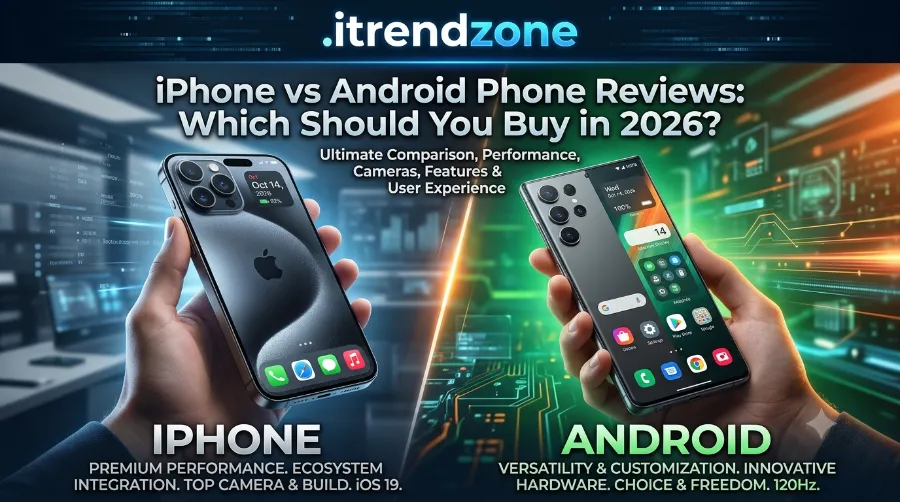
If you want the fastest possible answer: choose an iPhone if you already own a Mac, iPad, or Apple Watch, because the ecosystem lock-in genuinely improves daily life. Choose Android, specifically a Pixel or Galaxy phone, if you want more customization, a lower entry price, or a camera system tuned by AI rather than hardware alone. That said, the details matter far more than the headline, so let’s dig into what changed this year.
What’s New on iPhone in 2026
Apple shook up its release schedule this year. Instead of one big September drop, the company now splits launches between fall and spring. The iPhone 17 launched in September 2025 as Apple’s most affordable flagship, and it remains the phone most buyers should consider heading into late 2026. MacRumors
iPhone 17 Lineup Overview
The current iPhone family includes four models, each aimed at a different type of buyer:
- iPhone 17 ($799): Built around the A19 chip with Apple Intelligence support, a 120Hz ProMotion OLED display with Always-On functionality, and a dual 48-megapixel rear camera system. MacRumors
- iPhone Air ($999): Apple’s thinnest iPhone ever at 5.6mm, built with a titanium frame and a single 48-megapixel rear camera, designed for buyers who prioritize weight over camera range. TechRadar
- iPhone 17 Pro ($1,099): Adds a telephoto lens, better cooling, and a redesigned camera plateau.
- iPhone 17 Pro Max ($1,199+): The largest screen at 6.9 inches, aimed at power users and content creators.
Notably, Apple retired the “Plus” model entirely this generation and replaced it with the Air, which changes how the lineup is structured compared to 2024. If you are comparing the two mid-tier options directly, the iPhone 17 Pro and iPhone Air share the same 3,000-nit outdoor brightness and 120Hz refresh rate, but the Pro costs $100 more and adds a second camera lens. AppleZextons
Looking ahead, Apple is not standing still. The next wave, including the iPhone 18 Pro, iPhone 18 Pro Max, and a rumored foldable iPhone, is expected in September 2026, so anyone buying today should know a Pro refresh is only months away. MacRumors
What’s New on Android in 2026
Android is not one product, so “Android in 2026” really means three competing strategies from Google, Samsung, and a handful of Chinese brands. For most US and European buyers, the real contest is between Google’s Pixel 10 series and Samsung’s Galaxy S26 lineup.
Google Pixel 10: AI-First, Budget-Friendly
Google kept its base Pixel 10 at the same $799 price as last year, which is a rare move in a market where nearly every other brand raised prices. The Pixel 10 now includes a 5x telephoto lens, a brighter 6.3-inch OLED screen reaching 3,000 nits, and a larger 4,970mAh battery, all powered by Google’s new Tensor G5 chip. Digital Applied Team
What really sets the Pixel apart is software, not silicon. On-device AI features like Magic Cue, Voice Translate, Camera Coach, and Auto Best Take are baked directly into the phone, and Google backs every Pixel 10 model with seven years of OS, security, and feature updates, matching Apple’s long-term support for the first time. Digital Applied TeamNotebookcheck
The chip itself is not the fastest on paper. Independent benchmark testing shows the Tensor G5’s GeekBench 6 scores trail both the Galaxy S25 and iPhone 16, and gaming performance can dip in demanding titles. In everyday use, though, most testers report the phone still feels smooth for browsing, messaging, and photo editing. YouTube
Samsung Galaxy S26: The Familiar Flagship
Samsung’s Galaxy S26 launched in early 2026 as a refresh rather than a redesign. It features a 6.3-inch Dynamic LTPO AMOLED 2X display with a 120Hz refresh rate and HDR10+ support, and it now competes directly against the Pixel 10 at a similar price point. Smartprix
One thing worth noting for shoppers: the Galaxy S26 is one of the first phones this year to carry a price increase over its predecessor, which gives the Pixel 10 an early pricing advantage. If your budget is the deciding factor, that gap matters. Smartprix
At the top end, the Galaxy S26 Ultra remains Samsung’s showcase device, and it currently retails around $949.99 in the US, positioning it directly against the iPhone 17 Pro Max and Google’s Pixel 10 Pro XL. Android Central
iPhone vs Android: Head-to-Head Comparison
Now let’s compare the platforms feature by feature, since specs alone rarely tell the full story.
1. Camera Performance
This is where the gap has narrowed the most in 2026. The iPhone 17 Pro leans on hardware, offering strong optical zoom and a new vapor chamber cooling system for sustained video recording. Meanwhile, the Pixel 10 Pro relies heavily on computational photography, including a “Pro Res Zoom” that combines cropping with generative AI to reach up to 100x zoom, though Google itself recommends this mode mainly for landscapes and landmarks rather than people. Notebookcheck
If you shoot a lot of portraits and want predictable, natural results straight out of the camera app, the iPhone still tends to edge ahead. If you like squeezing extra detail out of zoomed shots or want AI-guided framing, Pixel’s Camera Coach and Pro Res Zoom feel genuinely useful.
2. Battery Life and Charging
Battery capacity has become one of Android’s clearest advantages. The Pixel 10’s battery grew to 4,970mAh, compared to just 4,000mAh on the Galaxy S25, and Samsung’s Galaxy S26 Ultra pushes even further with its larger chassis. Apple, by comparison, still favors smaller batteries paired with software efficiency, and while that generally works well, heavy users doing video calls or gaming all day may notice the difference by evening. Digital Applied Team
3. AI Features
Every major phone released in 2026 leans on AI, but the approach differs. Apple Intelligence focuses on privacy-first, on-device processing integrated quietly into Messages, Photos, and Siri. Google takes a more visible approach, building Gemini directly into the camera, keyboard, and call screen, with features like live call translation that keeps your own voice while translating in real time.
Neither approach is objectively “better.” It comes down to whether you want AI that stays in the background (Apple’s philosophy) or AI that actively suggests and automates tasks for you (Google’s philosophy).
4. Software Updates and Longevity
For years, this was Apple’s biggest advantage, and it still matters. Historically Apple has supported iPhones for five to six years of major iOS updates. However, Google closed much of that gap this year: all Pixel 10 models now receive seven years of OS, security, and feature updates, technically surpassing Apple’s typical window. Samsung’s flagship Galaxy S models also now offer extended multi-year update commitments, though coverage still varies by specific model and region, so it is worth checking the exact policy before buying. Notebookcheck
5. Price and Value
Here is a simple pricing snapshot based on official and retail listings as of mid-2026:
| Phone | Starting Price (US) | Storage | Display Size |
|---|---|---|---|
| iPhone 17 | $799 | 256GB | 6.3 inch |
| iPhone Air | $999 | 256GB | 6.5 inch |
| iPhone 17 Pro | $1,099 | 256GB | 6.3 inch |
| Google Pixel 10 | $799 | 128GB | 6.3 inch |
| Google Pixel 10 Pro | $869 | 256GB | 6.3 inch |
| Samsung Galaxy S26 | ~$799 (est.) | 128GB | 6.3 inch |
| Samsung Galaxy S26 Ultra | $949.99 | 256GB | 6.9 inch |
Pricing data compiled from Apple’s official store, Google’s store listings, and third-party retail trackers; regional and carrier pricing may vary.
6. Customization and Ecosystem
This remains the clearest philosophical divide between the two platforms. Android still allows you to change default apps, sideload software outside the Play Store, and heavily customize your home screen layout. iOS restricts most of that, but in exchange, it offers tighter integration across Apple’s own devices, so an iPhone paired with a MacBook and Apple Watch genuinely feels like one connected system rather than three separate gadgets.
If you’re weighing this trade-off for daily productivity, our guide to setting up a cross-device workflow breaks down how each ecosystem handles file sharing, notifications, and continuity features in more detail.
Who Actually Uses What: Market Share in 2026
Numbers help put personal preference into context. Globally, Android holds roughly 70.36% of the mobile market compared to iOS at 29.25%. The picture flips sharply in the United States, though, where iPhone leads with approximately 59.8% market share against Android’s 40%. Europe sits somewhere in between; StatCounter’s European data shows a more balanced split than the global average, with Android generally ahead overall but iOS holding strong ground in markets like the UK and parts of Western Europe. Backlinko + 2
Revenue tells a different story entirely. iOS captures roughly 64.2% of global consumer app spending despite holding under 30% of active devices, which explains why so many premium apps and subscriptions launch on iPhone first. Mobiloud
Real-World Buying Scenarios
Numbers only go so far, so here are a few practical situations that might mirror your own:
- A college student in Austin, Texas, upgrading from an iPhone 12 in July 2026 would likely land on the standard iPhone 17. It carries forward the ecosystem they already know, and at $799, it undercuts the iPhone 17 Pro by $300 without losing ProMotion or Apple Intelligence.
- A freelance photographer in Berlin comparing Galaxy S26 Ultra and Pixel 10 Pro XL in early 2026 found the two phones nearly identical in price, at $949.99 and $949 respectively, based on current retail listings. In this case, the deciding factor often becomes editing software preference rather than hardware.
- A parent buying a first smartphone for a teenager may prefer the base Pixel 10 at $799, since Google’s seven-year update commitment means the phone stays secure well into the next decade without needing a replacement.
For a deeper dive into budget-friendly options across both platforms, check out our complete guide to the best phones under $800.
Security and Privacy Differences
Security remains a genuine differentiator, and it is worth taking seriously if you handle sensitive data on your phone. According to independent research aggregated across multiple 2026 industry reports, Android devices account for the overwhelming majority of mobile malware detections, largely because of sideloading and third-party app stores. Apple’s more closed App Store review process, by contrast, results in far fewer reported malware cases on iOS, though no platform is immune to phishing or scam apps distributed through browsers or messaging apps.
If privacy is your top priority regardless of platform, our step-by-step privacy hardening guide walks through the settings worth checking on both iOS and Android before you start using a new device.
Which Phone Should You Actually Buy in 2026?
Rather than crowning one universal winner, here is a quick decision framework based on what matters most to you:
- Choose the iPhone 17 if you want the most balanced, reliable option with strong resale value and deep Apple ecosystem ties.
- Choose the iPhone 17 Pro if you shoot a lot of video or photos professionally and need the extra telephoto lens.
- Choose the Google Pixel 10 if you want flagship AI features at a lower price with the longest guaranteed update window.
- Choose the Samsung Galaxy S26 Ultra if you want the largest screen, biggest battery, and S Pen support in one device.
- Choose Android generally if customization, file access, and open app installation matter more to you than a closed ecosystem.
For a full walkthrough of switching between platforms without losing your photos, contacts, or messages, see our iPhone to Android migration guide, which covers both directions.
If you want a broader second opinion beyond this comparison, the team at NYT Wirecutter maintains an independently tested, regularly updated ranking of the best smartphones, which is worth cross-referencing before you commit to a purchase. Similarly, if long-term repairability factors into your decision, iFix Electronics’ 2026 comparison breaks down how easily each platform’s flagship phones can be repaired outside official service centers, which can meaningfully affect total ownership cost over several years. MacRumorsMacRumors
Frequently Asked Questions
Is iPhone or Android better in 2026?
Neither is objectively better for everyone. iPhone wins on ecosystem integration and resale value, while Android, especially Pixel and Galaxy phones, wins on customization, price flexibility, and in Google’s case, update longevity.
Which phone has the best camera in 2026?
The iPhone 17 Pro and Google Pixel 10 Pro are both strong contenders. iPhone favors natural, hardware-driven results, while Pixel leans on AI-assisted computational photography for extended zoom and low-light shots.
Is the Google Pixel 10 worth buying over an iPhone 17?
If budget and AI features matter most, yes. The Pixel 10 starts at the same $799 price as the iPhone 17 and now matches Apple’s long-term software support with seven years of updates.
Does Android still get less software support than iPhone?
Not always anymore. While many budget Android phones still offer shorter update windows, Google’s Pixel line now matches or exceeds Apple’s typical support period, though this varies significantly by brand and model.
Should I wait for the iPhone 18 Pro before buying?
If you can wait, it may be worth it, since Apple’s next Pro refresh with rumored under-display Face ID is expected around September 2026. If you need a phone now, the current iPhone 17 lineup remains a strong, future-ready purchase.
Conclusion
There is no single correct answer to the iPhone versus Android question in 2026, and honestly, that’s a good thing for buyers. Apple’s iPhone 17 lineup delivers reliability, strong resale value, and a genuinely useful AI layer without sacrificing privacy. Android, led by Google’s aggressively priced Pixel 10 and Samsung’s feature-packed Galaxy S26 Ultra, now matches or beats Apple on battery life, update longevity, and price-to-feature ratio in several categories. The smartest move is matching the phone to your actual habits, not chasing whichever brand shouts loudest in its keynote. Whichever platform you land on, both ecosystems are stronger and more competitive in 2026 than they have been in years.
References
- MacRumors, “iPhone 17: Everything We Know,” 2026
- TechRadar, “iPhone 17 vs iPhone Air,” April 2026
- MacObserver, “What is the Latest iPhone? A Complete Guide to Apple’s iPhone 17 Lineup in 2026,” June 2026
- Android Central, “Samsung Galaxy S26 vs. Google Pixel 10,” February 2026
- Google Store, “New Google Pixel 10 Phones Feature Brilliant Photos & Powerful AI,” 2026
- DPReview, “Google Pixel 10 Series Launch,” October 2025
- Tom’s Guide, “Google Pixel 10 Review: The Biggest Upgrade In Years,” 2025
- Futurum Group, “Google Pixel 10’s AI, Triple Camera, and Battery Boost,” September 2025
- Smartprix, Samsung Galaxy S26 Ultra vs Google Pixel 10 pricing data, 2026
- MobiLoud, “Android vs iOS Market Share: Most Popular Mobile OS in 2026”
- StatCounter GlobalStats, “Mobile Operating System Market Share Europe,” 2026
- Digital Applied, “Mobile OS Market Share 2026: iOS vs Android Statistics”
- NYT Wirecutter, “Best Smartphones,” ongoing reviews
- iFix Electronics, “iPhone vs Android 2026” repairability comparison