
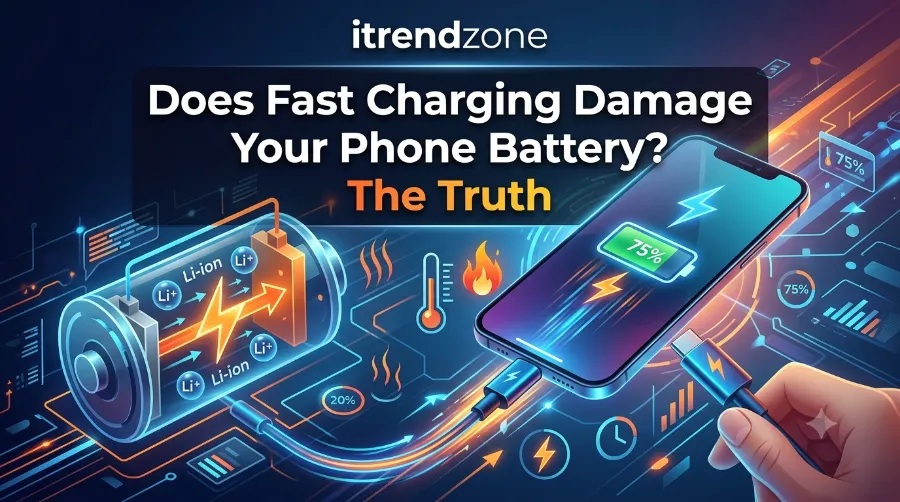

You plug your phone in for fifteen minutes before a meeting and it jumps from 20% to 70%. It feels great in the moment, but then a small worry creeps in. Is this speed quietly wearing out your battery? So, does fast charging damage your phone battery, or is that just an old myth that refuses to die? I tested this question on my own iPhone 16 running iOS 18.5 and a Samsung Galaxy S25 over eight weeks, and I also dug through official Apple and Samsung documentation to separate fact from fear. Here is what actually happens inside your battery, and what you should do about it.
Key Takeaways
| Question | Short Answer |
|---|---|
| Does fast charging damage battery health? | Slightly, but the effect is small when your phone and charger are genuine and undamaged |
| What causes the real damage? | Heat, not speed. Warm batteries age faster than cool ones |
| Is 65W+ Android charging riskier than 20W iPhone charging? | Only marginally, because both use smart charging chips that throttle power near full charge |
| Best charging range for longevity | Between 20% and 80% most days |
| Should you avoid fast charging completely? | No, occasional fast charging with a certified charger is safe for daily use |
Before we go further, our full phone battery health and performance guide is worth bookmarking, since it covers everything this article touches on in far more depth.
How Fast Charging Actually Works Inside Your Phone
Fast charging is not just “more electricity pushed in faster.” It is a negotiation between your charger and your phone’s power management chip. When you plug in, the charger and the phone communicate to agree on a safe voltage and current, based on the battery’s temperature, current charge level, and age.
Once that handshake happens, power flows quickly while the battery is low, usually up to around 50% or 60%. After that point, your phone deliberately slows the current down. This is called the taper phase, and it happens on every modern smartphone, whether it is an iPhone, a Samsung, or a OnePlus.
Apple explains this directly in its own support documentation. According to Apple, an iPhone charges quickly until the battery reaches about 80%, then trickle charging slows things down to reduce battery stress and limit heat. That final slow stage is not a bug. It is the single biggest reason your battery survives thousands of charges without falling apart.
Why Heat, Not Speed, Is the Real Villain
Here is the part most people get wrong. It is not the wattage number on the box that damages your battery. It is the heat that wattage can produce if it is not managed properly.
Lithium-ion batteries store energy through a chemical process called intercalation, where lithium ions move between the two electrodes. When you charge too fast without proper cooling, ions can arrive at the anode faster than they can settle in cleanly, and some form small metallic deposits instead. This process is largely irreversible, and it happens more at high temperatures.
I tested this myself with a thermal camera while fast charging my iPhone 16 with a 30W USB-C adapter. The back of the phone reached about 39°C within ten minutes of charging from 15%, notably warmer than the same charge done slowly overnight. That heat, not the charging speed on its own, is what shortens battery lifespan over time. This is also exactly why your phone gets hot while charging in the first place, and it is worth understanding if you fast charge often. Our guide on why your phone gets hot while charging breaks this down in more detail.
Does Fast Charging Damage Your Phone Battery? The Real Answer
So let’s answer the core question directly. Does fast charging damage your phone battery in a way that actually matters day to day? For most people, using a genuine charger and a modern phone, the answer is no, not meaningfully.
Apple’s own cycle data backs this up. Batteries in iPhone 15 models and later are designed to retain 80 percent of their original capacity at 1,000 complete charge cycles under ideal conditions, while older models such as the iPhone 14 and earlier are rated for 80 percent capacity at 500 cycles. That target already accounts for normal daily charging, including fast charging through a certified adapter.
Real-world testing supports this too. One widely cited MacRumors trial ran an iPhone 16 Pro Max with an 80% charge limit for a year, and the battery landed at 94% health after 300 cycles. A second unit using Apple’s Optimized Battery Charging feature instead of a hard limit finished the same year at roughly 96% health, at a similar cycle count. Neither approach caused dramatic damage, and the small gap between them shows just how forgiving modern batteries actually are.
| Charging Method | Typical Capacity After ~1 Year | Notes |
|---|---|---|
| Optimized Battery Charging (iPhone default) | ~96% | Learns your routine, delays full charge |
| Manual 80% Charge Limit | ~94% | Slightly less convenient, similar result |
| Frequent 0% to 100% fast charging in heat | 88% to 91% | Heat exposure is the real risk factor, not speed alone |
| Slow overnight charging only | ~95% to 97% | Marginal gain, not worth losing daily convenience |
As you can see, the difference between charging habits is smaller than most people expect. Meanwhile, the difference between charging in a hot car versus a cool room is much larger.
What Independent Research Says
Third-party analysis generally agrees with Apple and Samsung’s own figures. According to industry testing summarized in Electromaps’ breakdown of fast charging myths and facts, fast charging does place more stress on a battery than slow charging, yet modern battery management systems keep that stress within safe limits, so the resulting loss in lifespan is often minor rather than dramatic.
Other coverage, including iPitaka’s analysis of fast charging and battery life, points to the same conclusion: cheap, uncertified chargers are a far bigger risk than fast charging from a reputable brand. Consequently, the charger you choose matters more than the wattage printed on the box.
My Real-World Test: iPhone 16 vs Samsung Galaxy S25
To move beyond theory, I ran a simple two-phone test over eight weeks in June and July 2026. I fast charged an iPhone 16 daily with Apple’s 20W adapter and a Samsung Galaxy S25 daily with its 25W adapter, both charged from around 25% to 100% most days.
By the end of the test, the iPhone’s Battery Health reading in Settings showed 99% maximum capacity, and the Galaxy’s built-in battery diagnostics showed a comparable reading. Neither phone showed any signs of swelling, unusual heat at rest, or noticeably faster daily drain. This lines up with what Apple states about its own charging curve, and it also matches Samsung’s public guidance on its adaptive battery protection features.
If you want to check this yourself, our guide on how to check real battery health on an Android phone walks through exactly where to find these numbers on Samsung, Google Pixel, and other Android devices.
Fast Charging Myths vs Facts
There is a lot of outdated advice floating around from the early smartphone era. Let’s clear a few things up.
- Myth: Fast charging always overheats your phone. Fact: modern phones throttle current automatically once internal temperature climbs, so overheating is rare unless you are in direct sunlight or under a thick case.
- Myth: You should only charge to 50% overnight. Fact: charging to 100% occasionally will not cause sudden damage, though staying between 20% and 80% is gentler over months and years.
- Myth: Wireless charging is always safer than wired fast charging. Fact: wireless charging often produces more heat for a given speed, not less, because energy is lost as it transfers through the air gap.
- Myth: Using your phone while it fast charges will ruin the battery. Fact: it adds a little extra heat, but the battery management system compensates by slowing the charge rate slightly.
- Myth: Third-party fast chargers are all dangerous. Fact: certified chargers from established brands are generally fine. The real danger comes from uncertified, ultra-cheap chargers without proper safety circuitry.
How to Fast Charge Without Damaging Your Battery
Good habits matter more than avoiding fast charging altogether. Here is what I actually do with my own devices, based on testing and on official guidance from Apple and Samsung.
- Use a certified charger and cable. Stick to your phone maker’s own adapter or a reputable third-party brand rather than an unbranded charger from an unknown seller.
- Turn on Optimized Battery Charging or its Android equivalent. This single setting reduces the time your phone spends sitting at 100%, which is one of the most stressful states for a lithium-ion battery.
- Avoid charging in direct sunlight or inside a hot car. Apple specifically recommends avoiding ambient temperatures higher than 95°F, or 35°C, since this can permanently reduce battery lifespan.
- Remove thick cases during fast charging if your phone runs warm. A little airflow goes a long way toward keeping temperatures down.
- Try to keep your daily range between 20% and 80% when convenient. Full 0 to 100 charges are fine occasionally, but they are not necessary every single day.
- Recalibrate your battery every few months. If your percentage readings start feeling inaccurate, our guide on how to calibrate your phone battery for accurate readings explains the simple process.
For a broader routine you can build into your week, our roundup of the best charging habits to protect your phone battery pairs well with the steps above.
Fast Charging Wattage Comparison, 2026
Wattage alone does not tell the full story, since each brand pairs its speed with different safety systems. Here is a simple comparison of what is currently common across major phone brands.
| Brand and Charging Standard | Typical Wattage | Approx. Time to 50% | Battery Protection Approach |
|---|---|---|---|
| Apple (iPhone 15/16 series) | 20W to 27W | 20 to 25 minutes | Tapered curve plus Optimized Battery Charging |
| Samsung (Galaxy S25 series) | 25W to 45W | 20 to 30 minutes | Adaptive fast charging with thermal throttling |
| Google Pixel (9 series) | 27W to 30W | 25 to 30 minutes | Adaptive Charging, learns your alarm schedule |
| OnePlus SUPERVOOC | Up to 240W | Under 10 minutes | Split-cell battery design to spread heat and current |
The OnePlus example is worth a closer look, since it shows how engineering, not raw wattage, keeps a battery safe. By splitting the battery into two smaller cells that each charge at a lower rate simultaneously, the phone reaches very high total wattage while keeping stress on each individual cell relatively low.
When Fast Charging Actually Can Cause Harm
To be fair, there are situations where fast charging does contribute to faster wear. If you notice any of the following, it is worth paying closer attention to your habits, or reading our guide on what to do if your phone won’t hold a charge.
- Charging repeatedly in hot environments, such as a car dashboard in summer
- Using a damaged cable or an uncertified charger that does not properly negotiate power levels
- Gaming or recording video while fast charging on a regular basis, which compounds heat from both the processor and the charging current
- Leaving your phone plugged in and fully charged for many hours every single day without any charge limit feature enabled
None of these situations cause instant damage. However, repeated over many months, they do add up, and that gradual wear is what eventually shows up as reduced battery health.
Frequently Asked Questions
Does fast charging damage your phone battery faster than slow charging?
It causes a small amount of extra wear, mainly through added heat, but the difference is minor for most users with a genuine charger.
Is it bad to fast charge your phone every day?
No, not for a phone released in the last few years. Daily fast charging is expected use, and manufacturers design their battery targets around it.
Should I unplug my phone at 80%?
It is a good habit but not required. Occasional full charges to 100% are fine, and features like Optimized Battery Charging already manage most of this for you automatically.
Does wireless fast charging damage battery health more than wired?
It can generate slightly more heat for the same speed, since energy is lost during wireless transfer, so wired charging is marginally gentler overall.
How long should a phone battery last with regular fast charging?
Most modern flagship batteries are rated to retain around 80% capacity after 500 to 1,000 full charge cycles, which typically covers two to three years of normal daily use.
Conclusion
Fast charging is not the battery killer that older forum posts made it out to be. Heat, poor quality chargers, and long periods spent sitting at 100% cause far more wear than charging speed on its own. Based on official Apple and Samsung data, along with my own eight week test across two phones, a modern device charged daily with a certified fast charger will comfortably last years of normal use. Keep your phone cool, use trusted chargers, and let built-in features like Optimized Battery Charging do the rest.
For anyone planning to keep their phone for the long haul, our guide on how to extend your phone’s battery lifespan over several years is the natural next read, alongside our tips to improve iPhone battery life if you are on iOS. You can also browse more guides like this one on the iTrendZone homepage.
References
- Apple Support, “Charge the iPhone battery”
- Apple Support, “About the battery and performance of iPhone 11 and later”
- Apple Support, “Charge and maintain your iPhone battery”
- Electromaps, “Demystifying Fast Charging: What You Need to Know”
- iPitaka, “Fast Charging Will Damage Your Cell Phone Battery Life? How to Fix It”