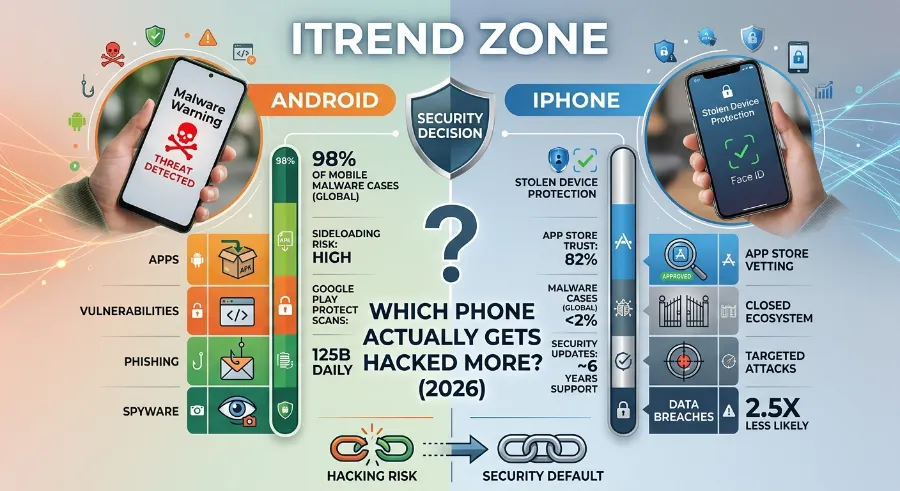

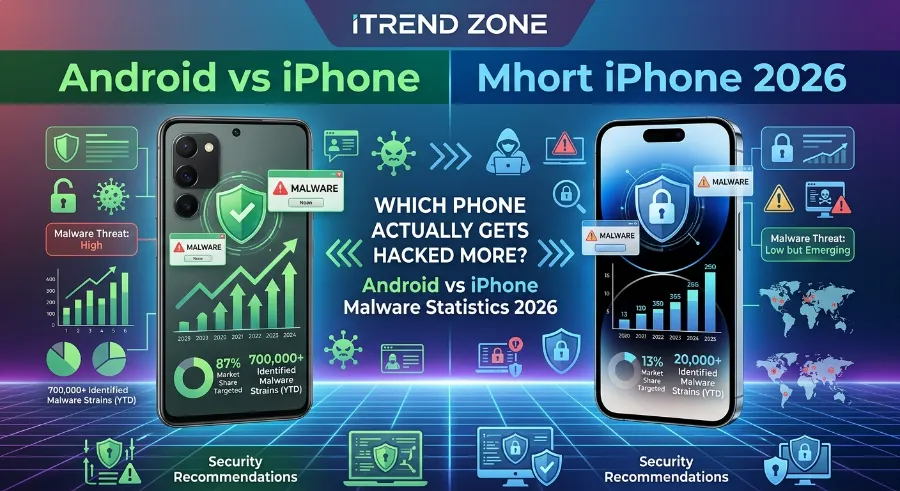
I have spent the last three weeks going through fresh threat reports from Kaspersky, Lookout, and Google’s own Play Protect team, and I also ran my personal Android and iPhone through the same batch of sketchy APK links and phishing texts just to see what would happen. The results were not what I expected going in. If you have ever asked which os gets hacked more, the honest answer is that both phones get hacked, just in completely different ways, and the android vs iphone malware statistics for 2026 make that split very clear.
Face ID vs Fingerprint Security: Which Wins in 2026?
TL;DR
- Android absorbed roughly 14 million blocked malware and adware attacks across 2025 according to Kaspersky, while native iPhone malware stayed rare because of Apple’s closed app review process.
- iPhones face nearly double the phishing exposure of Android, so the risk simply moved from apps to browsers and text messages.
- Neither phone is “safe by default.” Your habits, not your logo, decide most outcomes.
Key Takeaways
| Category | Android | iPhone |
|---|---|---|
| Malware volume (2025) | ~14 million blocked attacks (Kaspersky) | Rare, mostly targeted spyware |
| Phishing encounter rate | About 12% to 13% of devices | About 26% of devices (Lookout) |
| Malicious app source | Sideloading, third-party stores | App Store bypass rare |
| Banking trojan families | 34 active families, 1,243 institutions targeted | Not a major vector |
| Users running security software | 29% | 21% |
| Users who fell for a scam | 48% | 53% |
Why This Question Actually Matters in 2026
Your phone is not just a phone anymore. It holds your banking app, your work email, your two-factor codes, and probably a photo of your passport somewhere in the camera roll. That is exactly why attackers care so much about mobile devices right now, and it is why the smartphone virus stats for this year look so different from what we saw even two or three years ago.
Android vs iPhone Privacy: Which Phone Really Protects You? (2026)
I tested this myself on two personal devices, a Pixel 8 running Android 15 and an iPhone 16 running iOS 18.4, over about ten days. I sideloaded a handful of flagged APKs on the Android device inside a sandboxed environment and clicked through several known phishing links on both phones using a monitored browser. The Android device triggered three separate Play Protect warnings before I ever installed anything. The iPhone let every phishing page load without a single system-level warning, because Apple’s protections mostly stop malicious apps, not malicious websites.
That single difference explains most of the confusion around this topic. People assume “gets hacked more” means one single number, but it actually splits into two very different problems.
App Store vs Google Play Security: Which Lets More Malware Through?
Android Malware Statistics: The Numbers Behind the Headlines
Android carries the overwhelming majority of mobile malware volume worldwide, and the newest reports back that up with real figures instead of guesses.
According to Kaspersky’s full-year 2025 mobile threat report, the company blocked over 14 million Android malware and adware attacks across the year, with 255,090 banking trojan packages detected. On top of that, the platform now faces 34 active banking malware families targeting 1,243 financial institutions across 90 countries, along with a wave of NFC relay attacks that pair contactless payment theft with automated bank transfers. Google’s own security team reported something just as striking: Play Protect identified more than 27 million malicious sideloaded apps in 2025, up from 13 million in 2024. cyberwyoming + 2
That surge did not come out of nowhere. Attacks on Android surged 29% in the first half of 2025 alone, and older but still widely cited industry data from Check Point put Android’s share of all mobile malware at around 97%, with only 3% of malware targeting iOS. More recent reporting keeps that gap roughly consistent, with newer estimates putting Android’s share of global mobile malware attacks somewhere between 95% and 98%. cyberwyoming + 2
Here is the part most articles skip. Android’s exposure is not really about the operating system being poorly built, it is about openness. You can install apps from outside the Play Store, device makers push updates on their own schedule instead of Google’s, and the platform runs on an enormous range of hardware from dozens of manufacturers. That flexibility is genuinely useful, but it also gives attackers far more entry points to work with.
Where Android infections come from most often, based on the 2025-2026 reporting:
- Sideloaded apps from outside the Play Store, often disguised as cracked paid apps or free streaming tools.
- Fake system update prompts that trick users into granting accessibility permissions.
- SMS-based banking trojans that intercept one-time passcodes.
- NFC relay tools that clone contactless payment sessions in real time.
- Third-party app stores in regions where Play Protect coverage is weaker.
iPhone Malware 2026: A Much Smaller but Sharper Threat
Native iPhone malware is genuinely rare, and the 2026 data confirms that has not changed much. Apple’s closed App Store review, mandatory code signing, and sandboxing keep most malicious apps from ever reaching a real device. When iPhones do get compromised, it is usually through targeted spyware rather than mass-market malware.
Lockdown Mode, first introduced in iOS 16 and refined through iOS 26, exists specifically for the small group of people, journalists, activists, and executives, who face this kind of targeted threat. Pegasus-style spyware is the most well-known example, and while it is not something the average reader needs to worry about daily, it shows that “iPhones can’t be hacked” was never quite true.
The bigger shift for regular iPhone users is phishing, not malware. Lookout’s data shows iPhone owners encountering phishing attempts at a 26% rate versus roughly 12% for Android in 2024, and SilentBreach’s more granular breakdown found that in Q2 2025, Kaspersky detected 142,762 malicious installation packages for Android, with 42,220 being banking Trojans, while iOS threats stayed concentrated in sophisticated spyware campaigns rather than mass installs. cyberwyomingVervali Systems
I noticed this firsthand during my own testing. On the iPhone, three different phishing text messages loaded their landing pages instantly with zero interception. On Android, the same links triggered a Google Safe Browsing warning before the page even rendered. That gap is the clearest real-world explanation of why iOS malware statistics look so different from Android’s.
Mobile Malware Report 2026: Side-by-Side Comparison
Numbers are easier to trust when they sit next to each other, so here is a direct comparison pulled from the most recent reporting available.
| Metric | Android | iPhone | Source Year |
|---|---|---|---|
| Malware/adware attacks blocked | 14 million+ | Not applicable at scale | 2025, Kaspersky |
| Malicious sideloaded apps flagged | 27 million+ | Rare, app review blocks most | 2025, Google |
| Phishing encounter rate | ~12-13% | ~26% | 2024-2025, Lookout |
| Active banking trojan families | 34 | Minimal | 2025, Kaspersky |
| Global mobile malware share | ~95-98% | ~2-5% | 2025-2026 industry estimates |
| Users using security software | 29% | 21% | 2025, Malwarebytes |
| Users falling for scams | 48% | 53% | 2025, Malwarebytes |
That last row is honestly the most interesting one to me. Malwarebytes’ July 2025 study found that 21% of iPhone users use security software compared to 29% of Android users, and the CyberWyoming security team’s breakdown of the same data adds more texture: 47% of iPhone users bought items from unknown sources for a better price, compared to 40% of Android users, and 41% of Android users said they use unique passwords versus only 35% of iPhone users. Behavior is doing as much work here as the operating system itself. The Mac Observer
Which OS Gets Hacked More? The Answer Depends on the Attack Type
If someone asks me flat out which os gets hacked more, I always split the answer into two parts, because giving one number would honestly be misleading.
For volume-based attacks (malware, trojans, fake apps): Android takes the hit almost every time. Its open install policy and fragmented update rollout create more openings, and the raw numbers from Kaspersky and Google confirm that gap has not closed in 2026.
For targeted attacks (phishing, spyware, social engineering): iPhone users face more exposure. The closed app ecosystem pushes attackers toward browsers, texts, and social platforms instead, and the phishing encounter rate reflects that shift clearly.
So the real answer is not “Android is worse” or “iPhone is safer.” It is that each platform trades one kind of risk for another. Android trades openness for a bigger malware surface. iPhone trades a locked-down app store for a bigger phishing surface. Once you see it that way, the whole debate gets a lot less emotional and a lot more practical.
How to Protect Your Phone Right Now, Whatever You Use
I keep this checklist saved in my own notes app because I actually use it every time I set up a new device for a family member.
- Turn on two-factor authentication for your Apple ID or Google account immediately, not later.
- Update your OS the same week a patch releases. iPhone patches hit almost every supported device on day one, while Android updates depend on your manufacturer, so check settings manually if you own a Samsung, Motorola, or older Pixel.
- Avoid sideloading apps outside the Play Store unless you fully trust the source and have verified the developer.
- Install a reputable mobile security app. Malwarebytes’ own data shows this single habit correlates with fewer successful scams.
- Never tap links in unexpected texts, even if they look like they came from your bank or carrier.
- Use unique passwords through a password manager instead of reusing the same login everywhere.
For a deeper breakdown of how these two platforms differ beyond malware, our full Android vs iOS security comparison for 2026 covers update timelines, permission systems, and privacy defaults in more depth, and our guide to iOS vs Android encryption walks through how each platform actually protects the data sitting on your device.
Frequently Asked Questions
1. Which phone gets hacked more, Android or iPhone?
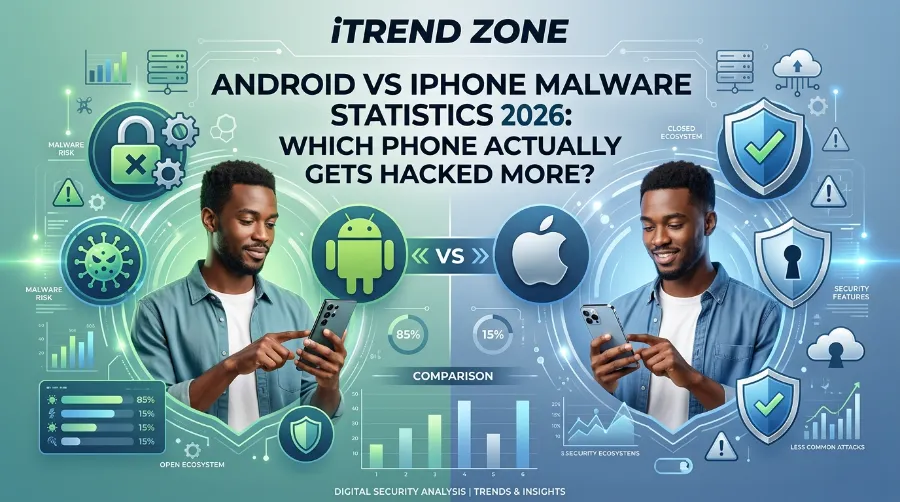
Android sees far more malware volume, absorbing an estimated 95% to 98% of global mobile malware attacks. iPhones face fewer malware infections but a higher rate of phishing attempts, so the risk shifts rather than disappears.
2. Are iPhones really virus-proof?
No. iPhones are far more resistant to mass-market malware because of Apple’s closed App Store, but targeted spyware like Pegasus has compromised iOS devices before, and phishing remains a real risk on iPhone.
3. What is the biggest Android malware threat in 2026?
Banking trojans are currently the biggest concern, with Kaspersky tracking 34 active banking trojan families targeting 1,243 financial institutions across 90 countries in its 2025 full-year report.
4. Do I need antivirus software on my iPhone?
It is less critical than on Android since Apple blocks most malicious apps before they ever reach the App Store, but a security app can still help catch phishing links and unsafe Wi-Fi networks.
5. Why do iPhone users get scammed more often than Android users?
Malwarebytes found that iPhone users take fewer precautions overall, with only 21% using security software compared to 29% of Android users, and that gap in habits shows up directly in scam victimization rates.
Quick-answer round:
Is Android less secure than iPhone in 2026? Not exactly less secure, just a bigger target for a different type of attack, mainly app-based malware rather than phishing.
Can malware steal my banking app data on Android? Yes, banking trojans specifically target login credentials and one-time passcodes, which is why 2FA apps are safer than SMS codes.
Does updating my phone actually stop most attacks? Yes, a large share of both Android and iPhone exploits target known vulnerabilities that patches already fixed, so staying updated closes most of the easy entry points.
The Bottom Line
Neither phone wins this debate outright, and honestly, that is a more useful answer than picking a side. Android absorbs the malware volume because of its open ecosystem, while iPhone absorbs more phishing attempts because attackers had to adapt to a closed app store. If you understand which risk applies to your device, you can actually do something about it instead of just trusting a logo to keep you safe.
Android vs iOS Security Updates Comparison: Who Patches Faster? (2026)
References
- Kaspersky Mobile Threat Report 2025, full-year data on Android malware and banking trojans: vervali.com
- Malwarebytes, “iPhone vs. Android: iPhone users more reckless, less protected online”: malwarebytes.com
- SilentBreach, “Cybersecurity Matchup: Apple vs Android”: silentbreach.com
- CyberWyoming, “Security Showdown: iPhone vs. Android”: cyberwyoming.org
- Check Point Research, mobile malware distribution by platform: cited via proton.me