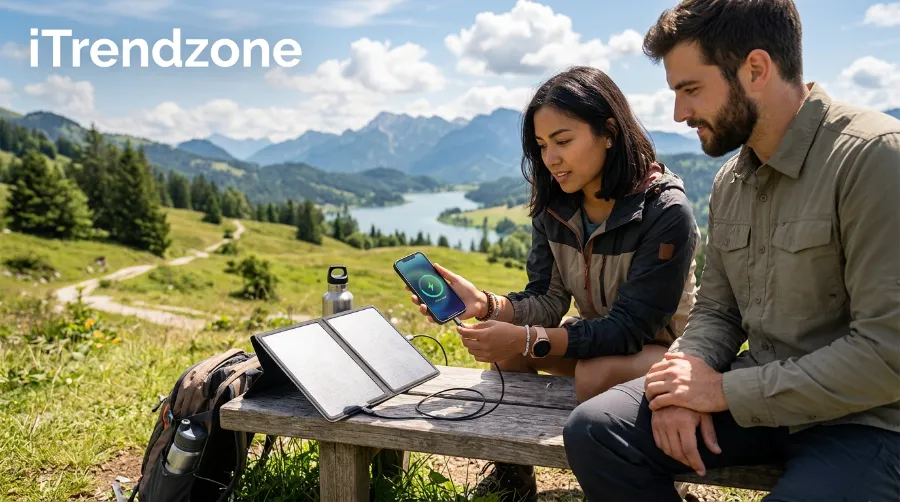

Have you ever watched your phone battery drop to 9 percent on a hiking trail? No bars, no outlets, no backup plan. That single moment is why so many people start searching for a solar phone charger guide before their next trip. Solar chargers promise free, endless power from the sky. The honest answer is more complicated than the marketing photos suggest.
In this guide, we will walk through what actually happens when you point a solar panel at the sun. We cover how fast it really charges a phone, and which setup is worth your money in 2026. This is not a rehash of spec sheets. We pulled data from independent outdoor gear testers and manufacturer documentation. We also checked official charging standards from Apple and the USB Implementers Forum, then cross checked everything against real product listings from the US, the UK, and Europe. So before you add another gadget to your camping bag, let’s separate what solar chargers can genuinely do from what the packaging wants you to believe.
Best Car Phone Charger Guide: Fast Charging on the Road
TL;DR
- Solar phone chargers genuinely work, but only in direct sunlight. A small panel still charges far slower than a wall outlet.
- A 20 to 30 watt folding panel is the realistic sweet spot for phones, tablets, and topping up a power bank at camp.
- Pairing a folding solar panel with a separate power bank almost always beats a single device that tries to do both jobs at once.
Key Takeaways
| Question | Short Answer |
|---|---|
| Do solar phone chargers actually work? | Yes, but only in direct sun; shade or clouds can cut output by more than 80 percent |
| Best wattage for phone charging | 20 to 30 watts for a dedicated panel; anything under 10 watts is emergency only |
| Solar charger vs power bank | Use a panel for daytime charging and a power bank for storage after dark |
| Fastest way to top up a phone outdoors | Charge a power bank fully before you leave, then use solar only to extend it |
| Typical solar panel efficiency in 2026 | Roughly 24 to 25 percent for monocrystalline panels from BigBlue and FlexSolar |
What a Solar Phone Charger Actually Is
A solar phone charger is a portable panel or a panel-and-battery combo. It uses photovoltaic cells to turn sunlight into electricity your phone can use. There are three distinct types on the market, and mixing them up is the number one reason people feel let down.
Best Charging Case Buying Guide for Extra Battery Life
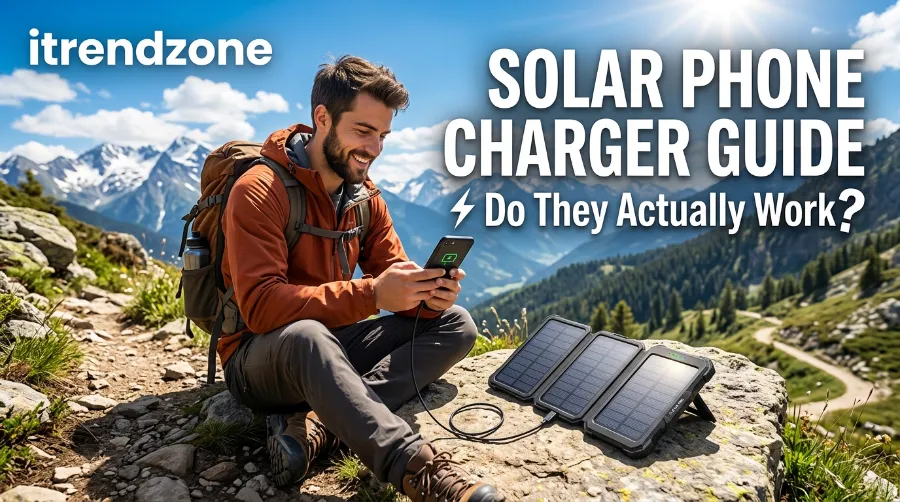
- Standalone folding panels. These have no internal battery. They only produce power while facing the sun, so you need a phone or power bank plugged in during daylight.
- Solar power banks. These carry a built-in battery with a small solar panel on the case. They work mainly as a backup top-up, not a primary charging method.
- Panel plus battery kits. Brands such as SunJack sell a folding panel bundled with a separate power bank. The panel collects energy all day, and the battery handles charging at night.
Understanding this distinction changes how you shop. If you search only for “solar power bank review,” you may end up comparing a serious panel against a pocket gadget with a token solar sticker. That comparison would not be fair to either one.
Solar Phone Charger Guide: Do They Actually Work in Real Conditions?
Yes, solar phone chargers work, though the word “work” needs a fair definition. The photovoltaic cells inside a portable panel convert direct sunlight into DC electricity. That current then flows through a small charge controller, either into your phone or into a connected battery. Under a clear midday sun, this process is genuinely dependable. Under clouds, tree cover, or a low winter sun angle, output drops sharply, sometimes to a trickle.
Independent testers have documented this clearly. One outdoor gear lab tested a 60 watt folding panel and watched its USB-C output fall from 40 watts down to just 4 watts. The cause was a single tree branch shading just one of its six sub-panels, a tenfold swing from a shifting shadow. That one data point explains most of the “my solar charger is useless” complaints on Amazon. The charger is usually fine. The placement was not.
How Much Sun You Actually Need
A portable solar panel needs several consecutive hours of direct, unobstructed sunlight to make a real dent in a phone’s battery. Partial or indirect light will trickle-charge a connected power bank. It will not fast charge a phone the way a wall charger does. For context on what “fast” really means indoors, our wireless charging speed guide breaks down wired versus wireless benchmarks.
Overnight Charging Safety Guide: Is Overnight Phone Charging Safe? What the Data Actually Shows
Cloudy Day and Winter Performance
Solar output is roughly proportional to how directly the panel faces the sun. A low winter sun or an overcast sky can push a panel’s real output well below its rated wattage. This is not a defect. It is simple physics. If you shop mainly for shoulder-season or winter camping, size your panel up rather than expecting a small unit to compensate for weaker sunlight.
Solar Charger Charging Speed: What the Numbers Really Mean
This is where most buying guides get vague. It is also the biggest keyword gap in existing solar charger content: a direct comparison between advertised wattage and real phone charging time.
Wired Charging Speed for Comparison
Modern phones charge remarkably fast over a wired USB-C connection, with no sun involved at all. According to Apple’s own support documentation, iPhone 17, iPhone 17 Pro, and iPhone 17 Pro Max reach 50 percent battery in around 20 minutes with a 40 watt adapter. Earlier USB-C iPhone models reach the same 50 percent mark in about 30 minutes with an 18 watt or higher adapter. Samsung’s Galaxy S26 Ultra reportedly hits 50 percent in roughly 15 minutes on a 60 watt PD 3.1 charger. Google’s Pixel 9 needs about 30 minutes at 27 watts for the same result.
Solar Charging Speed in the Real World
Now compare that to solar. A 100 watt panel is the kind usually paired with a portable power station rather than a phone. It generates only around 300 to 500 watt-hours per day under ideal sun. That is enough for multiple phones, a tablet, and some LED lighting, but nowhere near wall-outlet speeds. A phone-sized 20 to 30 watt folding panel produces far less power, and only while it actually catches direct light.
| Charging Method | Typical Output | Time to 50% on a Modern Phone |
|---|---|---|
| Wall adapter, USB-C PD (18 to 40W) | 18 to 40 watts, constant | 15 to 30 minutes |
| Folding solar panel (20 to 30W), full sun | 15 to 25 watts, variable | 1.5 to 3 hours, sun-dependent |
| Folding solar panel, partial shade or cloud | 2 to 8 watts | Several hours, unreliable |
| Solar power bank’s built-in panel | Under 5 watts | Best treated as emergency top-off only |
If charging speed is your priority even at home or in the car, it is worth reading our best fast chargers 2026 roundup. Our car phone charger guide also covers wired options that will always outrun solar on raw speed.
Solar Charger vs Power Bank: Which One Do You Actually Need
This is one of the most searched comparisons in this category. The honest answer is that a panel and a power bank solve two different problems. A solar panel generates power only while the sun is out. A power bank stores power so you can use it whenever you want, including at 2 a.m. in a tent.
| Factor | Solar Panel | Power Bank | Solar Power Bank |
|---|---|---|---|
| Works after dark | No | Yes | Yes, from stored charge |
| Charging speed | Fast in direct sun only | Fast and consistent | Slow via solar, fast via USB |
| Best use case | Daytime top-up, multi-day trips | Daily backup, travel | Emergency, glove box, backup kit |
| Weight for backpacking | Light to moderate | Moderate | Often bulkier for the capacity |
For most people planning a weekend trip, the smartest setup is a folding panel that charges a separate power bank during the day. The power bank then charges your phone at night. If you already own a power bank and just want to keep it topped up, our portable power bank guide is a useful companion piece.
Best Solar Charger for Camping: What to Look for in 2026
We compared specs and independent test data across more than ten review sites in the US, UK, and Europe. A few buying criteria came up again and again as the ones that actually matter.
- Wattage between 20 and 30 watts. This range charges a phone or power bank at a usable speed without adding excessive weight to a pack.
- Monocrystalline cells rated around 24 to 25 percent efficiency. Independent testing has found panels from BigBlue and FlexSolar performing in this range, close to the practical ceiling for portable, flexible panels.
- USB-C output, not just USB-A. Every new iPhone since the iPhone 15 charges over USB-C, and most current Android flagships already use USB-C PD.
- A real IP rating. IP65 or higher means the panel can handle rain and dust at a campsite without you babysitting it under a tarp.
- A digital ammeter or output display. This lets you angle the panel toward the sun and see the real-time wattage, instead of guessing whether it is working.
Independent testers such as OutdoorGearLab have tested more than 100 portable solar chargers since 2013. In their most recent roundup of 19 solar power banks, the BigBlue Solarpowa 28W consistently ranked near the top for its balance of output and portability. UK-focused buying guides list the Anker Solix PS30 and Jackery SolarSaga 100W in similar categories, one for phones and small devices and the other for larger power stations.
If you are also shopping for a matching cable, our USB-C cable guide explains which cable ratings actually support higher wattage. A cheap cable can bottleneck even a good panel.
Solar Power Bank Review Roundup: What Independent Testers Found
Rather than repeating marketing claims, here is what several independent outlets across the US and UK actually reported in 2026.
| Source and Region | Reported Pick | Key Finding |
|---|---|---|
| OutdoorGearLab (US) | BigBlue Solarpowa 28W | Best overall balance of output, weight, and durability across 19 tested units |
| Bike Hike Safari (US) | Big Blue Solarpowa 28W and FlexSolar E10 Mini | 28W panel best for two-person trips; 10W panel best for ultralight thru-hiking at about 9 ounces |
| Heatable.co.uk (UK) | Anker Solix PS30 | 30 watts, foldable, IP65 rated, a step up from budget 14W panels |
| Honest John (UK) | Pealiker 10,000mAh | Budget solar power bank under £25 that can charge an iPhone 8 more than twice |
| Mayfair Farms (US) | Not brand-specific | Testing across desert and alpine conditions found monocrystalline cells reaching 24 to 25.4 percent efficiency |
One pattern stands out here. Not one of these outlets recommends relying on a tiny built-in solar panel as your only charging source. Every serious guide, regardless of country, ends up recommending a real folding panel paired with separate battery storage.
How to Actually Charge Your Phone With a Solar Charger
Here is the practical, step-by-step process that avoids the most common frustrations.
- Fully charge your power bank before you leave home. Solar should extend your power, not be your only source of it.
- Unfold the panel and angle it directly toward the sun, adjusting every 30 to 60 minutes as the sun moves across the sky.
- Plug the power bank into the panel first, not the phone directly, so the phone is not interrupted every time a cloud passes.
- Keep the panel free of shade, dust, and condensation, since even one shaded cell can drag down the output of the entire panel.
- Charge your phone from the power bank once it has stored a usable charge, ideally in the evening or whenever you actually need it.
- Bring a phone-compatible cable, and check case compatibility before relying on wireless-adjacent solar power banks. Our charging case buying guide covers common case and cable conflicts.
Common Mistakes That Make People Think Solar Chargers “Don’t Work”
Most negative reviews of solar chargers trace back to a handful of avoidable mistakes, not a faulty product.
- Leaving the panel in a backpack side pocket instead of laid flat toward the sun.
- Expecting a tiny built-in panel on a power bank to fully recharge a large battery in one day.
- Using a low-quality or damaged USB cable that cannot carry the panel’s full rated wattage.
- Charging in filtered light, such as through a tent mesh or car window, where light intensity drops.
- Ignoring the manufacturer’s IP rating and exposing the panel to rain it was never built to handle.
What Most Buying Guides Leave Out
We reviewed competitor content across major US outdoor sites, UK consumer roundups, and European retailer blogs for this solar phone charger guide. A few practical topics were consistently underexplained.
- Airline rules for power banks. Most airlines cap carry-on lithium battery packs around 100Wh without airline approval, and many prohibit checking them entirely. That matters if your solar setup includes a large battery.
- Overnight and unattended charging safety. Leaving any lithium battery charging unattended overnight carries a small but real risk. Our overnight charging safety guide covers the precautions worth taking.
- MagSafe and wireless compatibility. A handful of solar power banks now include wireless charging pads, but thick cases can block reliable contact. Our MagSafe charger compatibility guide explains which case types cause problems.
- General accessory shopping order. If a solar charger is your first accessory purchase, our phone charger buying guide is a good starting point before you specialize into solar.
For further reading beyond our own site, SunHub’s guide to solar battery chargers and Anker’s Solix buying guide both go deeper into battery chemistry and long-term maintenance. SolarPowerGear’s phone charger and power bank comparison is also a solid reference for matching capacity to trip length.
Frequently Asked Questions
Top 5 Questions
1. Do solar phone chargers actually charge a phone directly, or do they need a battery in between? A folding solar panel can charge a phone directly in strong, consistent sunlight. Most people still get more reliable results by charging a power bank first, then charging the phone from that battery.
2. What is the best solar charger for camping if I only need to keep one phone alive? A 20 to 25 watt folding panel paired with a 10,000 to 20,000mAh power bank covers most weekend trips. It adds very little weight to a pack.
3. How long does it take to charge a phone with a solar charger? In direct sun, a 20 to 30 watt panel typically takes one and a half to three hours to bring a modern phone to around 50 percent. A wall USB-C PD adapter does the same job in 15 to 30 minutes.
4. Is a solar power bank worth buying instead of a regular power bank? Only if you specifically need occasional off-grid emergency backup. For everyday use, a regular power bank charged from the wall is faster and more predictable.
5. Can cloudy weather completely stop a solar charger from working? It will not stop it completely, but output can drop sharply. Plan for slower charging on overcast days.
Quick Answers
Q: Do solar chargers work through a car windshield? A: Poorly. Glass filters and reduces light intensity, so direct outdoor placement performs noticeably better.
Q: Can I use a solar charger with an Android phone and an iPhone interchangeably? A: Yes, as long as the panel or power bank has the right USB-C or USB-A ports and PD support for each device.
Q: Do solar phone chargers wear out over time? A: Panels degrade slowly over years of UV exposure. The batteries in solar power banks usually wear out faster than the solar cells themselves.
Conclusion
Solar phone chargers are not a myth, and they are not a miracle either. They are a genuinely useful tool once you understand their limits. A well-chosen 20 to 30 watt folding panel, paired with a separate power bank, will keep a phone alive through a multi-day camping trip, a power outage, or a long day outdoors. That is true as long as you give it real sunlight and realistic expectations. Skip the tiny panel glued to a budget power bank if solar is your main goal. Instead, treat solar as a smart way to stretch your existing battery, not a replacement for your wall charger.
References
- Apple Support, “Fast charge your iPhone,” support.apple.com, 2026: https://support.apple.com/102574
- Belkin, “Common Questions About USB-C Power Delivery,” belkin.com, 2026: https://www.belkin.com/clp-power-delivery.html
- OutdoorGearLab, “Best Solar Power Bank Review,” outdoorgearlab.com, updated July 2025: https://www.outdoorgearlab.com/topics/camping-and-hiking/best-solar-power-bank
- Heatable, “Best Solar Chargers UK,” heatable.co.uk, 2026: https://heatable.co.uk/solar/advice/best-solar-chargers
- Honest John, “Top 10: Solar Chargers,” kit.honestjohn.co.uk: https://kit.honestjohn.co.uk/top-tens/top-10-solar-chargers/
- SunHub, “Solar Battery Chargers Guide”: https://www.sunhub.com/blog/solar-battery-chargers-guide/
- Anker Solix, “Solar Powered Phone Charger Buying Guide”: https://www.ankersolix.com/blogs/home-power-backup/solar-powered-phone-charger-buying-guide
- Solar Power Gear, “Best Solar Phone Chargers and Solar Power Banks,” 2026: https://solarpowergear.com/best-solar-phone-chargers-power-banks/