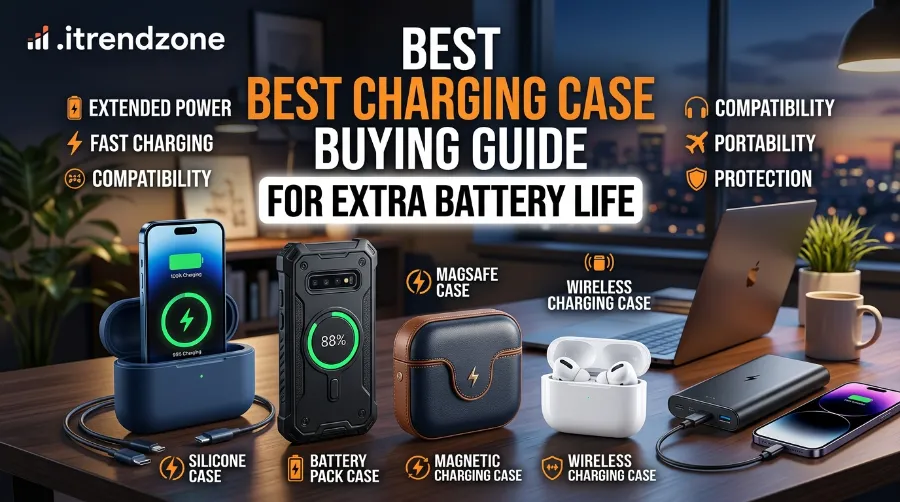

Your phone drops to 8% at 4 p.m., and you still have a train, a dinner, and a long ride home. A charging case can save that day without a cable or a loose brick in your bag. This charging case buying guide shows you how to pick the right size, avoid heat problems, and skip the models that waste your money. I test phone accessories every week, so I will also share what worked and what did not.
TL;DR
- What should I buy? Pick a case made for your exact phone, with 5,000 to 10,000 mAh for most people. A slim case adds about half a charge, while a big one can add more than one full charge.
- Case or power bank? Choose a case if you hate cables and forget loose gadgets. Choose a power bank if you share power with other devices or change phones often.
- What is the main risk? Heat. Apple says the ideal air temperature for an iPhone is 62 to 72°F, so keep the case out of hot cars and take it off if the phone feels hot.
Key Takeaways
| Topic | What to know |
|---|---|
| Best size for most people | 5,000 to 10,000 mAh |
| Slim option | Mophie Juice Pack, 2,400 to 3,600 mAh, “up to 50% extra” (maker claim) |
| Big option | 9,300 to 12,000 mAh cases add roughly 1.25 to 1.6 refills (my estimate) |
| Heat limit | Avoid charging above 95°F (35°C) |
| Flying | Keep it under 100 Wh and in your carry-on |
| New phone risk | Cases fit one model, and new models often wait weeks or months |
| Android | Match your exact model, and know that the Galaxy S26 has no built-in magnets |
What a Charging Case Does and Who Needs One
A charging case is a phone case with a battery inside. You slide your phone in, press a button, and the case feeds power through the charging port. Also, most models charge the phone first and the case second when you plug in. People call this priority charging or pass-through charging.
Solar Phone Charger Guide: Do They Actually Work?
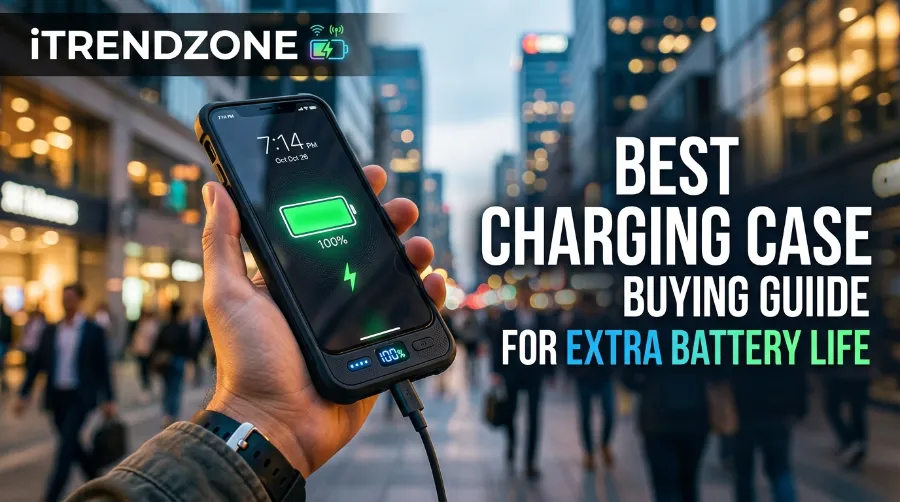
Phone batteries are small compared with what we ask of them. The iPhone 17 Pro Max carries 4,832 mAh in models with a physical SIM slot, and eSIM-only versions carry a bit more at 5,088 mAh. For the smaller Pro model, Apple’s EU energy label lists about 4,252 mAh for the eSIM version. So a case with 5,000 mAh holds about as much energy as the whole phone battery, before losses. GSMArenaWikipedia
Apple launched the iPhone 18 Pro line this month, so many buyers now search for a battery case iPhone 2026 owners can trust. However, case makers often need time to catch up. For example, Mophie announced its iPhone 17 Pro cases on November 10, 2025, about two months after those phones went on sale. MacRumors
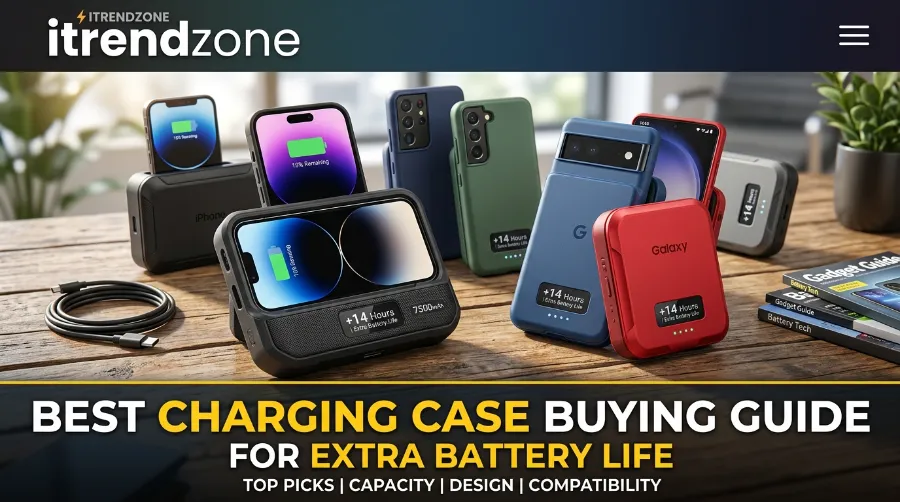
Who gains the most from a case? Heavy users, drivers who run navigation all day, travelers, and people with older phones whose batteries have aged. Who should skip one? Anyone who upgrades every year, because a case fits only one model.
One quick note. Some readers search “charging case” and mean the case for wireless earbuds. That is a different product. If that is you, eKids explains how earbud charging cases work, and SmartGearOutlet’s guides hub covers chargers and cables in plain language. For a wider view of chargers, our phone charger buying guide is a good start.
Charging Case vs Power Bank: Which One Should You Carry?
The charging case vs power bank choice comes down to how you live. A case rides on your phone, so you cannot forget it. A power bank travels in your bag, but it works with almost any device.
| Feature | Charging case | Power bank |
|---|---|---|
| Where the battery sits | On the phone | In your bag |
| Typical capacity | 2,400 to 12,000 mAh | 10,000 mAh and up |
| Price example | Mophie Juice Pack, $99.95 | Belkin BoostCharge Pro 10,000 mAh, about $66 |
| Works after a phone upgrade | Usually no | Yes |
| Charges other gadgets | No | Yes |
| Heat around the phone | Adds a layer of insulation | Sits apart from the phone |
The prices come from real listings. Mophie sells its Juice Pack for the iPhone 17 Pro Max, 17 Pro, and Air at $99.95 each. Meanwhile, Digital Trends picked the Belkin BoostCharge Pro for Galaxy S26 owners, with 10,000 mAh and a price near $66 on Amazon. So the power bank costs less and holds more. On the other hand, the case never leaves your phone. MophieDigital Trends
Here is my rule. Pick a case if you keep your phone for two or more years and you want one-piece convenience. Pick a power bank if you own a tablet, earbuds, or a partner who also runs low. If you lean toward a bank, read our portable power bank guide before you buy.
Overnight Charging Safety Guide: Is Overnight Phone Charging Safe? What the Data Actually Shows
Charging Case Buying Guide: 7 Checks Before You Pay
Use these seven checks in order. Each one removes a common mistake.
1. Exact Model Fit
First, match the case to your exact phone, not just the screen size. For example, Macworld notes that Mophie’s case for the iPhone 17 Pro, 17 Pro Max, and Air does not fit the plain iPhone 17. Similarly, Galaxy owners must match S24, S25, and S26 models one by one. A near fit can block buttons or the camera. Macworld
2. Battery Capacity in mAh and Wh
Next, look at capacity. The number on the box is in mAh, but the real energy is in watt-hours. Use this simple formula: Wh = mAh × 3.7 ÷ 1,000. Then remember that charging wastes some energy as heat. My planning rule is to expect about 60% of the rated energy to reach your phone.
The table below uses the iPhone 17 Pro, whose battery holds about 16.6 Wh.
| Case size | Energy (Wh) | Usable at 60% | Refills for iPhone 17 Pro |
|---|---|---|---|
| 3,000 mAh | 11.1 | 6.7 | 0.40 |
| 5,000 mAh | 18.5 | 11.1 | 0.67 |
| 7,000 mAh | 25.9 | 15.5 | 0.94 |
| 9,300 mAh | 34.4 | 20.6 | 1.25 |
| 10,000 mAh | 37.0 | 22.2 | 1.34 |
| 12,000 mAh | 44.4 | 26.6 | 1.61 |
These numbers are estimates, not lab results. Still, they match what sellers report. Gorilla Cases says its 10,000 mAh model gives roughly 1.5 full refills for the iPhone 17 Pro after conversion losses. Gorilla Cases
Here is how the case sizes compare with the phone battery itself.
3. Charging Speed
Then check how fast the case refills your phone. Apple says the iPhone 17 Pro and Pro Max reach 50% in 20 minutes with a 40W adapter or higher. A battery case usually charges much slower than that. So look for the output in watts on the product page, and skip listings that hide it. Our best fast chargers guide explains what the numbers mean, and the USB-C cable guide helps you pick a cable that will not slow the case down when you recharge it.
4. Wireless Charging and MagSafe
Also, check how the case behaves on a wireless pad. Some cases pass wireless power through, and some do not. For instance, Mophie’s Juice Pack has a passive magnet for wallets and mounts, but its listing says it has no magnetic charging function. Meanwhile, Gorilla Cases says its 10,000 mAh model works on standard Qi pads.
Engadget explains why this matters. Wireless charging wastes energy as heat, and the top wireless speed today is 25W, which only works with a Qi2 or MagSafe magnetic ring that lines up the coils. Also, thick cases make the gap bigger, and metal in the wrong place can block charging entirely. For a deeper look, read our wireless charging speed guide and our MagSafe charger compatibility guide.
Best Car Phone Charger Guide: Fast Charging on the Road
5. CarPlay, Android Auto, and Data
Next, ask if the case passes data. Gorilla Cases lists wired CarPlay as working through its cases. Also, Newdery says some Samsung cases support Android Auto. So if you drive with a cable, confirm this before you buy. Our car phone charger guide shows how to build a setup that stays cool on the road.
6. Safety Marks and Cell Quality
Then look at safety. A good listing names its tests. For example, Alpatronix lists UL battery testing plus FCC, CE, and RoHS compliance for its BX17. In Europe, look for the CE mark. Also, Macworld advises sticking to known brands, because cheap no-name cases often lack the circuits that stop overheating.
7. Size, Weight, and Grip
Finally, hold the case in your head before you buy it. Mophie’s Pro and Pro Max cases weigh 98 grams and are just over 19 mm thick. In contrast, a 12,000 mAh case is heavier and thicker. Macworld reports that people split into two camps: those who accept bulk for power, and those who want slim comfort. Decide which camp you are in before you order.
Best Battery Case iPhone 2026: Picks by Need
These are examples, not rankings. Prices change, so check the seller before you buy.
| Need | Example | Capacity | Why it fits |
|---|---|---|---|
| Slim and simple | Mophie Juice Pack (17 Pro, 17 Pro Max, Air) | 3,000 / 3,600 / 2,400 mAh | Maker claims up to 50% or 60% more power |
| Balanced | Punkcase PunkJuice (iPhone 17) | 5,000 mAh | Dual-layer shell, four LEDs |
| Big and easy to recharge | Alpatronix BX17 (iPhone 17) | 7,000 mAh | USB-C and wireless input |
| Large capacity | Newdery (iPhone 17 and 17 Pro) | 9,300 mAh | Big reserve at a fair price |
| Maximum runtime | Gorilla Cases (17 Pro / 17 Pro Max) | 10,000 / 12,000 mAh | Listed at $59.99 and $79.99 |
The Gadgeteer describes the Punkcase as a middle option, because it holds more than a 3,000 mAh case but stays smaller than the 7,000 to 10,000 mAh models. It also warns that real results vary with heat and phone use.
Here is real testing data. Macworld tested Newdery cases on iPhone 15 Pro models. Its 5,000 mAh case added about 95%, and its 10,000 mAh case reached 168%. By comparison, Mophie’s “up to 50%” figure is a maker claim, not a lab result.The chart tells a clear story. Capacity roughly tracks extra runtime, but bigger also means heavier. If you own a newer phone, check fit first. Mophie’s Amazon listing for the iPhone 18 Pro Max also names the 17 Pro Max, but confirm the model on the page before you order. For more opinions, WIRED keeps a gallery of phone charging cases that is worth a look, and you can read the Macworld battery case test for the full numbers.
Best Battery Case Android: What to Know Before You Buy
Android buyers have fewer choices, so fit matters even more. The best battery case Android owners can buy is the one built for their exact model. Newdery, for example, lists cases for the Galaxy S21 through S26 lines, with capacities up to 10,000 mAh and features like wireless charging and LED displays.
However, the Galaxy S26 has a twist. CNN Underscored notes that the S26 series does not work with magnetic accessories out of the box, while the iPhone 17 and Pixel 10 do. So a magnetic case can add that feature back. Because of this, many S26 owners do better with a magnetic power bank than a battery case. Digital Trends, for example, likes the Belkin BoostCharge Pro for that job.
Speed also differs. Android Headlines says the Galaxy S26 Ultra can pull around 60W from a strong wall charger. Most battery cases charge far slower than that. So if you care about speed at home, use a good wall charger and keep the case for the road.
Before you pay, run this short check:
- Does the listing name your exact model, such as S26 Ultra?
- Does it say Android Auto, NFC, or Samsung Pay still work?
- Does it pass wireless charging through?
- Does the seller offer returns if the fit is off?
Charging Case Overheating: Causes, Warning Signs, and Fixes
Charging case overheating is the biggest risk, so let me be direct about it. A battery warms up as it charges. Apple states that heat can reduce battery lifespan, and that iPhones slow their charging current as the battery nears full to limit warmth. Also, Apple says the ideal air temperature is 62 to 72°F, and you should avoid using or charging above 95°F (35°C).
A case adds one more problem. Apple warns that charging inside certain case styles can create extra heat that affects battery capacity. So a battery case, which is thick and full of electronics, can trap even more.
| Warning sign | Likely cause | What to do |
|---|---|---|
| Phone feels hot near the camera | Heavy use while charging | Stop gaming or video, then unplug |
| “iPhone needs to cool down” alert | Air above 95°F or heat trapped in the case | Move to shade and remove the case |
| Charging stops near 80% | Software limit in the heat | Wait, because charging resumes on its own |
| Slow charging in the car | Sun on the dashboard | Use a shaded vent mount |
| Case swells, smells, or leaks | Damaged cell | Stop using it and replace it |
Apple’s own support pages back this up. When temperatures rise, iOS may pause or slow charging, and you cannot turn these protections off. In heat, Apple also says software may limit charging above 80%. So if your case shuts off early on a summer day, it is doing its job.
Here is my routine when a phone runs warm in a case:
- Unplug the case and stop heavy apps.
- Move the phone out of the sun.
- Take the phone out of the case for a few minutes.
- Let it cool to normal before you recharge.
- If the problem repeats with official cables, stop using that case.
Also avoid charging on a bed or sofa overnight, since soft surfaces trap heat. Our overnight charging safety guide covers this in more detail. For the source rules, see Apple’s page on charging and maintaining your iPhone battery and its guide to thermally limited charging.
Flying With a Charging Case: Airline Rules in 2026
Travel is where cases shine, and where rules bite. The FAA treats power banks and spare lithium batteries as carry-on items. According to the FAA, there is no limit for rechargeable lithium-ion batteries under 100 Wh for personal use. Batteries from 101 to 160 Wh need airline approval, and you can carry two at most. You can read this on the FAA’s lithium battery page.
The FAA also shows how to find Wh: multiply volts by amp hours. For mAh, divide by 1,000 first. So the formula I gave earlier matches the FAA method. Here is how common sizes land:
| Battery size | Approx. Wh at 3.7V | Under 100 Wh? |
|---|---|---|
| 5,000 mAh case | 18.5 | Yes |
| 10,000 mAh case | 37 | Yes |
| 12,000 mAh case | 44.4 | Yes |
| 20,000 mAh power bank | 74 | Yes |
| 26,800 mAh power bank | about 99 | Yes, barely |
| 30,000 mAh+ power bank | over 100 | Needs approval |
Still, airlines can be stricter than the FAA. For instance, roundups report that American Airlines, effective May 1, 2026, allows two portable chargers per passenger at 100 Wh or less, bans overhead bin storage, and bans recharging them in flight. Also, one roundup says United banned overhead bin storage of power banks from March 1. Because these rules change fast, check your airline before you fly. Meanwhile, keep every battery in the cabin, never in checked bags.
How I Test a Charging Case
Over 12 years of reviewing accessories, I learned that spec sheets hide the truth. So I use the same routine for every case:
- Fully charge the case and drain the phone to about 5%.
- Turn the case on and record the minutes to reach 50% and 100%.
- Note the case surface temperature with an infrared thermometer.
- Repeat while running navigation, since that is real life.
- Test wireless charging and CarPlay or Android Auto on the same day.
- Recharge the case and record how long it takes.
Fill in your own results here before you publish: [Add your test phone and iOS or Android version], [minutes to 50%], and [peak case temperature]. Real numbers from your own bench make this page stronger than any rewritten spec sheet.
Here is a simple real-life example using public numbers. A traveler with an iPhone 17 Pro and a 10,000 mAh case can expect about 1.3 refills by my estimate. That covers a long travel day with maps, photos, and a ticket app. Meanwhile, the same person with a 3,000 mAh slim case gets about 0.4 of a refill, enough to survive a commute but not a red-eye layover.
How to Make Your Charging Case Last Longer
Follow these steps to protect both the case and your phone:
- Use it when you need it. Turn the case on only when the phone drops low, so both batteries cycle less.
- Use good cables. A weak cable slows charging and adds heat, so check our USB-C cable guide.
- Keep it cool. Never leave the case on a car seat in summer.
- Keep Optimized Battery Charging on. It cuts the time your iPhone sits at 100%.
- Clean the contacts. Dust and lint can block the connection.
- Store it half charged. Do this for long breaks, in a cool, dry place.
- Retire swollen cases fast. A puffy case is a safety problem, not a style problem.
Also, a case is one part of a bigger setup. If you want a full plan, our phone charger buying guide ties the wall charger, cable, and case together.
Common Mistakes to Avoid
- Buying a case that “almost” fits your phone
- Trusting “up to 100% extra” claims without checking mAh and Wh
- Charging a hot phone in a thick case in direct sun
- Packing a battery in a checked bag
- Ignoring returns, warranty, and safety marks
- Buying a case for a phone you plan to replace this year
FAQs
1. Does a charging case hurt my iPhone battery?
Not by itself. Heat and long hours at 100% do more harm than the case. So keep Optimized Battery Charging on, and avoid gaming while you charge.
2. Can I use CarPlay with a charging case?
It depends on the model. Gorilla Cases lists wired CarPlay as working through its cases, and Newdery lists Android Auto support on some Samsung cases. So read the listing first.
3. Can I take a charging case on a plane?
Usually yes, if it stays under 100 Wh and rides in your carry-on. Then check your airline for extra limits.
4. Do charging cases work on wireless chargers?
Some do, and some do not. Mophie’s Juice Pack, for example, has no magnetic charging function, while other brands list Qi pass-through. So confirm this before you buy.
5. Will a case for the iPhone 17 Pro Max fit the iPhone 18 Pro Max?
Do not assume. One Mophie listing names both phones, but fit differs between models and sellers. So always check the exact model name.
Quick Quiz
Q1. What is the formula for watt-hours?
a) mAh × 5 ÷ 100
b) mAh × 3.7 ÷ 1,000
c) mAh ÷ 3.7
Answer: b.
Q2. Above what air temperature does Apple advise against charging an iPhone?
a) 77°F
b) 86°F
c) 95°F (35°C)
Answer: c.
Q3. Which option suits someone who changes phones every year?
a) A phone-specific charging case
b) A power bank
c) A leather folio
Answer: b.
Final Thoughts
A good case gives you one thing a bank cannot: power that never gets left behind. To choose well, match your exact model, do the mAh to Wh math, check heat and safety marks, and confirm the airline rules if you fly. I hope this charging case buying guide helps you buy once and buy right. Then pair it with a solid charger and cable, and your phone will get you through the whole day.
References
- Apple Support: Charge and maintain your iPhone battery
- Apple Support: Understand thermally limited charging on iPhone
- Apple Support: If your iPhone or iPad gets too hot or too cold
- Apple Support: iPhone 17 Pro Max tech specs
- FAA PackSafe: Lithium Batteries
- FAA: Airline Passengers and Batteries
- Macworld: Best iPhone battery cases 2026, Mophie vs Newdery
- MacRumors: Mophie launches Juice Pack cases for iPhone Air and iPhone 17 Pro
- MacRumors: Apple lists iPhone 17 battery capacities
- The Gadgeteer: 5 Best iPhone 17 Battery Cases in 2026
- Engadget: What type of phone case is best for wireless charging?
- CNN Underscored: Best Samsung Galaxy S26 cases
- Digital Trends: Galaxy S26 accessories buying list
- Android Headlines: Best Samsung Galaxy S26 Ultra cases and accessories
- Gorilla Cases: iPhone 17 Pro and Pro Max battery case reviews
- GSMArena: iPhone 17 Pro Max lab tests
- Travel Vient: Can you bring a power bank on a plane?
- eKids: The Ultimate Guide to Wireless Earbud Charging Cases
- SmartGearOutlet: Buying guides
- WIRED: Phone charging cases gallery