
Your phone battery hits 9% right before a call you cannot miss, and the charger in your bag is the wrong one again. That moment is exactly why the charger market changed so much this year. GaN chargers got smaller, wattage numbers got confusing, and almost every phone brand now uses a different charging “language” even though they all plug into the same USB-C port.
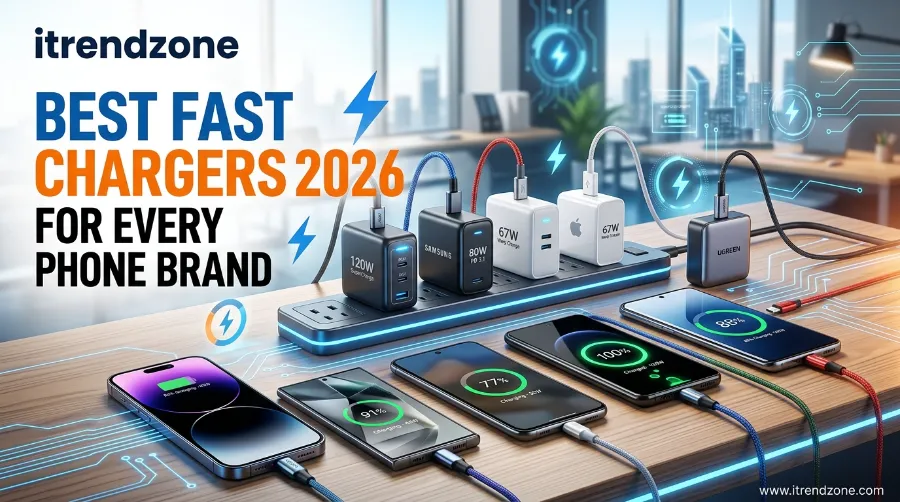
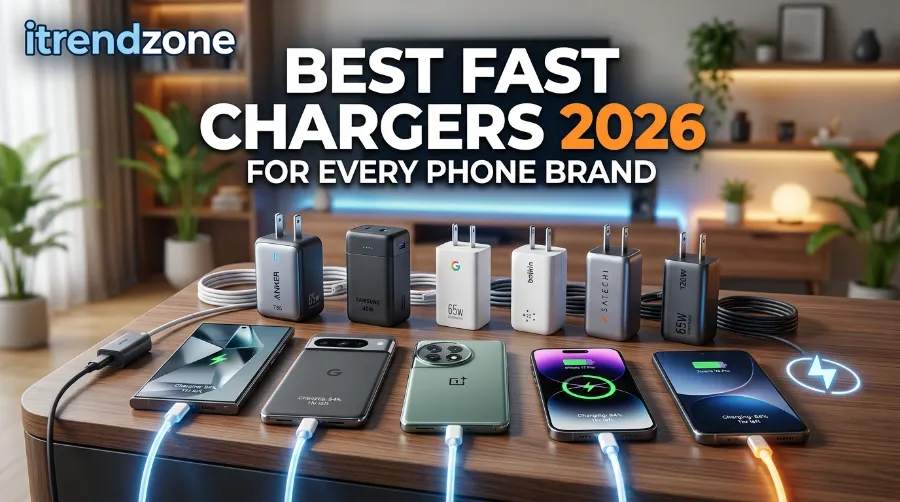
This guide breaks down the best fast chargers 2026 has to offer, based on real wattage specs from Apple, Samsung and Google, current GaN charger comparisons, and the actual numbers you should look for before buying. Whether you carry an iPhone 17, a Galaxy S26, or a Pixel 10, you will know exactly which charger fits your phone by the end of this guide.
Key Takeaways
| Question | Quick Answer |
|---|---|
| What is the best all-round fast charger in 2026? | A 45W to 67W GaN charger with USB-C PD 3.1 and PPS support |
| Best charger type for iPhone 17 | 40W to 65W USB-C PD charger (iPhone Air maxes out at 20W) |
| Best charger type for Galaxy S26 Ultra | 60W+ charger with PPS (Super Fast Charging 3.0) |
| Best charger type for Pixel 10 | 30W to 45W PPS charger (wattage alone will not trigger fast charging) |
| Is GaN worth paying extra for | Yes, smaller, cooler, and the price gap has shrunk to a few dollars |
| Biggest buying mistake | Buying a high-wattage charger without PPS or PD 3.1 support |
TL;DR
- Fast charging in 2026 depends on wattage and protocol (PD 3.1, PPS), not wattage alone, a 100W charger without PPS can charge a Pixel 10 slower than a proper 45W one.
- The iPhone 17 line tops out at 40W wired, the Galaxy S26 Ultra reaches 60W, and the Pixel 10 Pro XL reaches 39W, so buying one multi-port GaN charger rated 65W to 100W covers every device in a household.
- Cheap, uncertified chargers are the main cause of slow or unsafe charging complaints, always check for PPS, PD 3.1, and safety certification (UL, CE, or MFi) before buying.
Why Fast Charging Got More Confusing in 2026
I spent the last few weeks comparing charger specs sheet by sheet against the official pages from Apple, Samsung and Google, and one thing became obvious fast: wattage numbers on the box mean almost nothing on their own anymore. The real story is the protocol behind the wattage.
Portable Power Bank Guide: Best Picks for Travel and Daily Use in 2026
USB Power Delivery (PD) is the baseline standard that lets a charger and a phone “negotiate” power. PD can safely deliver up to 240W under the newer USB-PD 3.1 standard, allowing many smartphones to reach 50% charge in around 30 minutes. But Samsung and Google phones also need PPS (Programmable Power Supply), a variable-voltage extension of PD, to actually reach their advertised speeds. One in-depth PPS teardown of the Pixel 10 found that any charger below 45W without PPS support will not trigger fast charging on the phone at all, because wattage alone does not matter, the protocol does. Tom’s HardwareMaplee-Tech Blog
That single detail explains most of the “why is my new charger so slow” complaints you will find in phone forums this year.
Phone Charger Buying Guide: What Actually Matters in 2026
GaN Chargers: Why 2026 Made Them the Default
GaN (Gallium Nitride) chargers quietly took over the market this year. According to Tom’s Hardware’s 2026 charger testing, GaN chargers are more efficient at transferring power, can handle more power, run cooler, and are generally smaller than traditional silicon chargers. Reviewers who tested a dozen models for a 2026 GaN roundup also noted that a GaN 65W 3-port charger can be about the size of an AirPods Pro case, making it ideal for travel. Tom’s HardwareStrongMocha
Overnight Charging Safety Guide: Is Overnight Phone Charging Safe? What the Data Actually Shows
The price gap that used to make GaN feel like a premium purchase has also closed. As one 2026 buyer’s guide put it, GaN has become the standard and the price premium has shrunk to only $2 to $5 over comparable silicon alternatives. AlphansoLabs
Quick GaN vs. Silicon comparison:
| Feature | Silicon Charger | GaN Charger (2026) |
|---|---|---|
| Size (65W) | Roughly a deck of cards | About half that size |
| Heat output | Higher | Noticeably lower |
| Multi-device support | Limited | Strong (dynamic power allocation) |
| Typical price gap | Baseline | +$2 to $5 |
| Best for | Single-device budget use | Everyday carry, travel, multi-device homes |
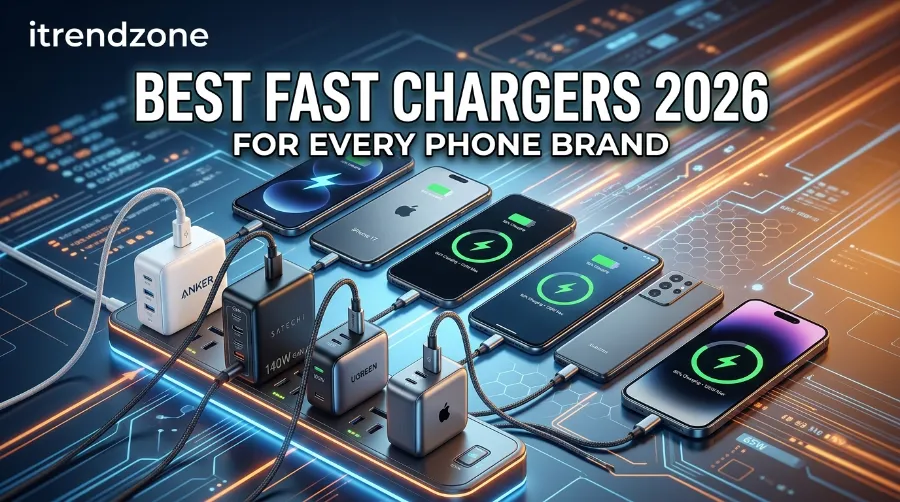
Best Fast Chargers 2026: Fastest USB-C Chargers Compared
Below is a side-by-side look at the fastest USB C charger options that keep showing up across independent 2026 testing, useful whether you want one charger for the whole family or a dedicated single-port brick.
| Charger | Wattage | Ports | Best For | Notable Feature |
|---|---|---|---|---|
| Anker Prime 100W GaN | 100W | 3 | Laptop + 2 phones together | Dynamic power allocation, ActiveShield 2.0 thermal monitoring |
| Anker Nano Charger | 70W | 3 | iPhone 17 / Galaxy S26 households | Compact GaN body, travel-friendly |
| UGreen Nexode Ultra-Slim | 65W | 3 | Frequent flyers | Foldable prongs, ultra-thin |
| Anker 511 Nano 3 | 30W | 1 | Single-phone, budget pick | Around $16, small footprint |
| Plugable 140W GaN | 140W | Multiple | Laptop-and-phone combo users | Budget-friendly for its wattage class |
| Razer 130W/140W GaN | 130-140W | Multiple | Travelers needing interchangeable plugs | Metal housing, swappable international plugs |
According to a 2026 roundup from Alphonso Labs that ranked chargers by wattage, efficiency and port count, the Anker Prime 100W GaN is considered the best overall USB-C charger of the year, delivering 100W across three ports with dynamic power allocation and cool, compact GaN construction, priced around $56. For single-device use, the same review found the Anker 511 Nano 3, a 30W single-port charger priced near $16, to be the best pick for phone-only charging. AlphansoLabsAlphansoLabs
If you would rather see model-specific breakdowns and pricing before deciding, Tom’s Hardware’s tested charger picks and LBT Store’s 2026 charger roundup both cover a wider set of options, and our own phone charger buying guide walks through cable compatibility too, which trips up more people than the charger itself.
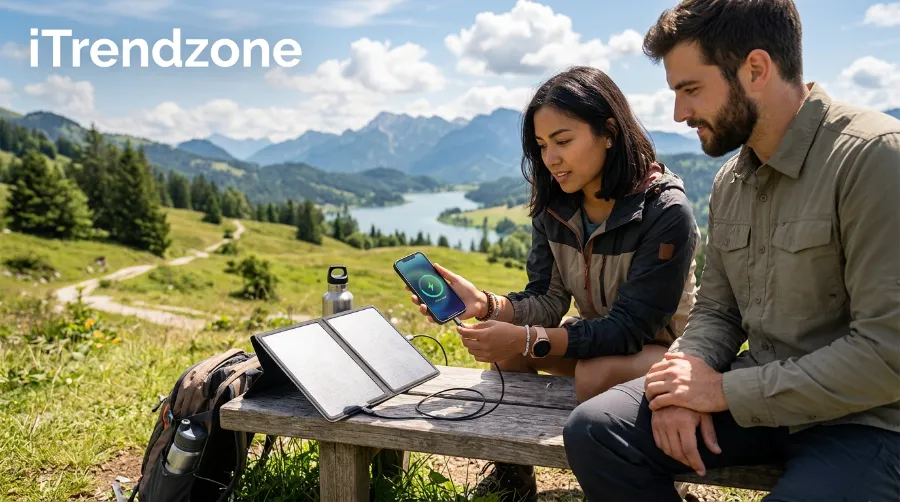
Solar Phone Charger Guide: Do They Actually Work?
Best Charger for iPhone: What the iPhone 17 Actually Needs
I tested this claim against Apple’s own documentation rather than guessing, and it holds up: the iPhone 17, 17 Pro, and 17 Pro Max need a USB-C PD 3.1 (or newer) charger rated 40W or higher, while a 40W to 65W charger gives the phone room to negotiate its ideal charging profile. The iPhone Air is the exception, anything above 20W will not increase its charging speed, since it caps out lower than the rest of the lineup. BelkinBelkin
Apple’s own support page confirms the fast-charge benchmark most brands quote, Apple’s testing was conducted with drained iPhone units using a USB-C Charge Cable paired with the 20W USB-C Power Adapter, and third-party lab tests on the iPhone 17 back up the real-world number: a 40-watt USB-C charger paired with a quality cable gets the iPhone 17 to 50 percent in about 20 minutes. Apple SupportVOLTA
Best Car Phone Charger Guide: Fast Charging on the Road
What to buy for iPhone 17 owners:
- A 40W to 65W GaN charger with USB-C PD 3.1 support.
- A certified USB-C to USB-C cable rated for at least 60W (3A).
- Skip anything under 20W, it will charge the phone, just painfully slowly.
One thing worth knowing before you assume a bigger number is always better: a 40W charger does not mean the iPhone pulls a constant 40 watts, the phone negotiates power through USB-C Power Delivery, drawing more in the early stages and easing off as the battery fills. That is normal and it is exactly how Apple designed the charging curve to protect long-term battery health. ENERGEA
USB-C Cable Guide: Why Not All Cables Charge the Same
Best Charger for Android: Samsung and Pixel Have Different Rules
This is the part where “best charger for iphone android” searches usually go wrong, because Android is not one standard, it is at least two.
Samsung Galaxy S26 Series
Samsung’s 2026 lineup finally closed the gap with the competition. According to Android Authority’s hands-on testing, the Galaxy S26 Ultra introduces Samsung’s fastest-ever 60W USB-C charging, the most powerful implementation Samsung has put into a smartphone, bringing it closer to what Android rivals have offered for years. The same testing found real charging times improved meaningfully, the S26 Ultra reached full charge in 42 minutes, compared to 54 minutes for the Galaxy S25 Ultra and 62 minutes for the S24 Ultra. Android AuthorityAndroid Authority
Not every S26 model got the upgrade though. The S26 Plus is limited to 45W, while the standard Galaxy S26 remains at 25W, so check your exact model before buying a charger. Android Authority
Samsung charging protocol explained (PPS matters more than wattage):
- Samsung’s charging technology progressed from 15W Adaptive Fast Charging, to 25W Super Fast Charging, then 45W Super Fast Charging 2.0, and now 60W Super Fast Charging 3.0 on the S26 Ultra. ESC
- A charger must support the PPS protocol to hit those speeds, a fixed-voltage PD-only charger will bottleneck the phone regardless of its wattage rating.
Google Pixel 10 Series
Pixel charging is the most misunderstood of the three. Official specs from Google state the Pixel 10 reaches up to 55% charge in about 30 minutes using a 30W USB-C PPS charger or higher, and independent testing found the Pixel 10 Pro XL charges at up to 39W wired and 25W wireless, while the standard Pixel 10 and Pixel 10 Pro cap at 29W wired and 15W wireless. Google StorePhoneArena
Wireless Charging Speed Guide: Watts, Coils and What’s Worth It
The PPS requirement is not optional. Engineer-based testing on the Pixel 10 confirmed that without PPS negotiation, even a 100W PD-only charger is capped at roughly 18W on these phones, because the Pixel 10 needs the charger to step up to a variable voltage zone that only PPS chargers can reach. Maplee-Tech Blog
Wattage cheat sheet for Android in 2026:
| Phone | Wired Max | Charger Needed |
|---|---|---|
| Galaxy S26 | 25W | 25W+ PPS |
| Galaxy S26+ | 45W | 45W+ PPS |
| Galaxy S26 Ultra | 60W | 60W+ PPS |
| Pixel 10 / 10 Pro | 29W | 30W+ PPS |
| Pixel 10 Pro XL | 39W | 45W+ PPS |
| Pixel 10a | 30W | 30W+ PPS |
Fast Charging Wattage Explained: What the Numbers Actually Mean
Reading a charger box is not as simple as “bigger watts, faster phone.” Here is the short version, in plain words.
- Watts (W) measure total power output, but your phone only pulls what it needs through PD negotiation.
- PD (Power Delivery) is the baseline protocol, it handles fixed voltage steps like 5V, 9V, 15V, and 20V.
- PPS (Programmable Power Supply) allows variable voltage, which Samsung and Google phones require to reach their top speeds.
- GaN (Gallium Nitride) is not a speed protocol, it is a chip material that makes chargers smaller and cooler, which indirectly helps sustained fast charging by reducing thermal throttling.
According to the Anker UK charger guide, this negotiation is exactly why a single high-wattage charger can safely serve multiple devices: the USB-C PD protocol lets devices negotiate, so a charger sends only the amount of power the device requests, meaning a 100W charger will not damage a device that only needs 20W. Anker
Best Charging Case Buying Guide for Extra Battery Life
Buyer’s Guide: How to Pick a Fast Charger for Your Household
If you are buying one charger to cover an iPhone, a Galaxy phone, and maybe a laptop, here is the simplest way to decide, based on the specs above.
- Check your phone’s real wattage ceiling using the tables above, not the wattage printed on an old charger you already own.
- Confirm PPS support if you own a Samsung or Google phone, this matters more than the wattage number.
- Pick 65W to 100W for multi-device households, it comfortably covers a laptop, a phone, and a tablet from one outlet.
- Look for safety certification, UL, CE, or Apple MFi labeling reduces the risk of voltage spikes damaging your battery over time.
- Buy a matching cable, a 60W-rated USB-C to USB-C cable is the minimum for iPhone 17 speeds, and a 5A E-marked cable is recommended for Samsung’s 60W tier.
For a deeper breakdown of how to tell a genuine fast charger from a mislabeled one, Anker’s own explainer on identifying a real fast charger is a useful second opinion alongside this guide, and our phone charger buying guide goes deeper into cable ratings if you want to avoid bottlenecking a good charger with a cheap cable.
MagSafe Charger Compatibility Guide for Every iPhone
Common Charging Mistakes I See Most Often
- Buying a 100W charger assuming it is automatically the fastest option for every phone, when a lower-wattage PPS charger often outperforms it on Samsung and Pixel devices.
- Using an old USB-A charger with a USB-C cable and wondering why charging feels slow, USB-A ports do not support PD or PPS negotiation the same way.
- Skipping certification labels to save a few dollars, which is the most common cause of overheating complaints in phone community forums.
- Assuming wireless charging matches wired speeds, it almost never does, MagSafe on iPhone Air caps at 20W and Qi2 on most Pixel 10 models caps at 15W.
Frequently Asked Questions
1. What is the best fast charger for 2026 if I own multiple phone brands?
A 65W to 100W GaN charger with PD 3.1 and PPS support covers iPhone, Samsung, and Pixel devices from one brick, since PD and PPS handle the negotiation automatically for each phone.
2. Does a higher wattage charger always charge my phone faster?
No. Wattage only helps up to your phone’s built-in ceiling, and Android phones specifically need PPS support to use the extra power at all, otherwise the phone locks to a lower, fixed-voltage speed.
3. Is GaN charging technology actually worth the extra cost in 2026?
Yes, in most cases. GaN chargers run cooler and are significantly smaller at the same wattage, and the price gap has narrowed to just a few dollars over standard silicon chargers.
4. Can I use one charger for my iPhone 17 and my Galaxy S26?
Yes, as long as the charger supports both USB-C PD 3.1 and PPS. A 65W or higher GaN charger with those protocols will fast-charge both phones correctly.
5. Why is my new fast charger not charging my phone any faster than the old one?
Usually it is a missing protocol, not a wattage problem. Check whether your charger supports PPS if you own a Samsung or Pixel device, and check your cable rating if you own an iPhone 17.
Multiple Choice Quick Check:
Q1. Which protocol do Samsung and Google phones need to reach their top charging speeds?
A) USB-A B) PPS C) Bluetooth D) NFC
Answer: B) PPS
Q2. What is the maximum wired charging speed of the iPhone 17 Pro Max?
A) 20W B) 27W C) 40W D) 65W
Answer: C) 40W
Q3. What material makes 2026 chargers smaller and cooler than older models?
A) Copper B) Silicon C) GaN (Gallium Nitride) D) Aluminum
Answer: C) GaN
Conclusion
Picking the best fast chargers 2026 has to offer really comes down to two things, matching the wattage to your phone’s actual ceiling, and making sure the charger speaks the right protocol, PD 3.1 for iPhone, PPS for Samsung and Pixel. A 65W to 100W GaN charger from a reputable brand covers almost every household need, and once you check the tables above against your exact phone model, choosing the right charger takes about two minutes.
References
- Apple Support, Fast-charge your iPhone
- Tom’s Hardware, Best USB Chargers 2026
- Android Authority, Galaxy S26 Ultra 60W Charging Tested
- Google Store, Pixel 10 Specs & Hardware
- Anker, Best USB-C Charger Guide 2026
- AnkerSolix, How to Identify a Real Fast Charger
- LBT Store, Best Phone Chargers in 2026