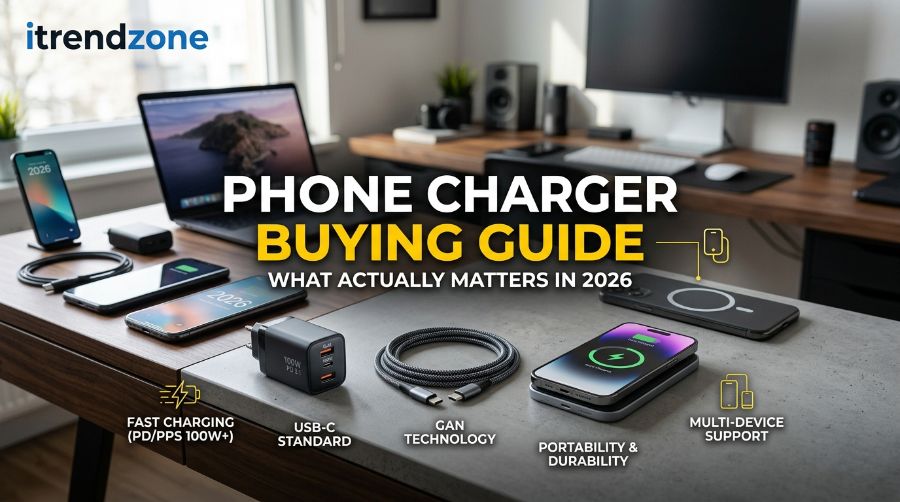

Standing in front of a wall of chargers at Best Buy or scrolling through forty nearly identical listings on Amazon, most shoppers freeze. Every box screams “fast charging,” every number sounds impressive, and somehow the actual answer to “which one do I need” never gets easier to find. This phone charger buying guide cuts through that noise and focuses on the handful of specs that genuinely change how your phone charges in 2026, nothing else.
The truth is, a charger is one of the few tech purchases where paying more usually buys you convenience, not necessarily speed, since your phone controls how much power it accepts. That single fact reshapes almost everything below, from the wattage guide to compatibility rules that changed across Europe this year.
Key Takeaways
| What Matters | Quick Answer |
|---|---|
| Minimum wattage for a modern flagship | 20 to 30W for most phones, up to 45 to 65W for ultra fast Android models |
| Standard to look for | USB-C with USB Power Delivery (PD), ideally PD 3.1 with PPS |
| Best charger type for most people | 30 to 65W GaN dual port charger |
| Cable rule above 60W | Needs an E-marker chip rated cable, not just any USB-C cable |
| EU regulation status | All phones, tablets, and small electronics need USB-C since December 2024; laptops follow from April 28, 2026 |
| Biggest buying mistake | Chasing headline wattage numbers your phone cannot actually use |
TL;DR
- Match the charger’s wattage to what your phone can actually accept, not the highest number on the box.
- USB-C with PD and PPS support is the safest, most future-proof choice for both iPhone and Android in 2026.
- A single 45 to 65W GaN charger with two ports usually replaces your entire drawer of old adapters.
Why Charger Shopping Got More Confusing, Not Less
A decade ago, a charger was simple: pick the one that matched your phone’s port. Now the same USB-C port sits on an iPhone, a Samsung flagship, a Nintendo Switch, and a laptop, yet each device negotiates a completely different amount of power. That shift is the entire reason a proper charger compatibility guide matters more in 2026 than it ever did before.
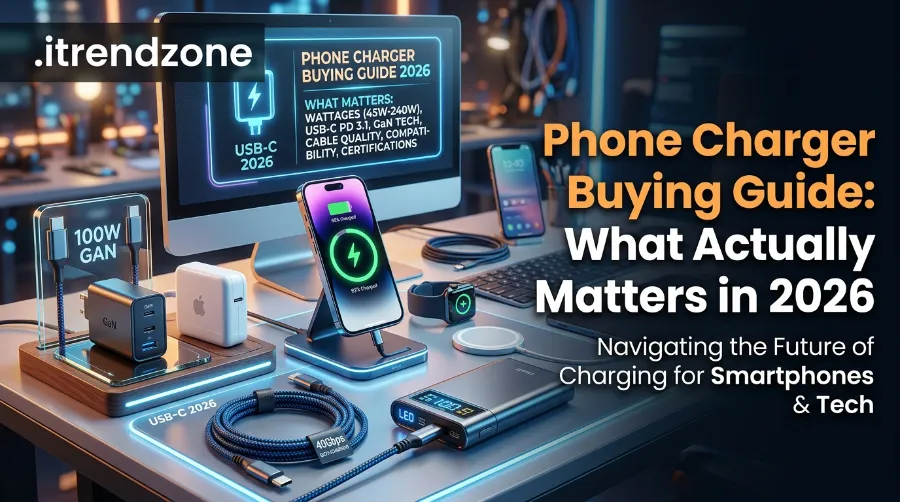
Manufacturers have leaned into this confusion too. Brands print numbers like 240W or 300W on boxes, and most of that power is aimed at gaming laptops or power banks, not your phone. Meanwhile, regulation in Europe has quietly rewritten the rules for what ships in the box at all, which we will get to shortly.
Wireless Charging Speed Guide: Watts, Coils and What’s Worth It
Fast Charger Wattage Guide: How Many Watts Do You Actually Need
This is the single most searched, and most misunderstood, part of buying a charger. Higher wattage does not mean your phone charges proportionally faster once you pass a certain threshold, because the phone’s own battery controller decides how much power it will accept at any moment.
Here is roughly where things stand for real-world devices in 2026:
| Device Type | Typical Charging Wattage Needed | Recommended Charger |
|---|---|---|
| iPhone 15 to 17 series | Around 20 to 27W peak | 30W USB-C PD |
| Samsung Galaxy S24 to S26 series | 25 to 45W | 45W USB-C PD with PPS |
| Google Pixel 8 to 10 series | 23 to 30W | 30 to 45W USB-C PD |
| Flagship Android from OnePlus, Xiaomi, Realme | 65 to 120W (often proprietary) | Brand’s own GaN charger, or a universal 100W PD unit |
| Wireless earbuds and smartwatch | 5 to 10W | Any basic 20W charger |
| Laptop (charged from same brick) | 65 to 100W+ | 100W USB-C PD GaN charger |
Industry testing has shown that for most modern flagship phones, wattage beyond roughly 45W stops delivering meaningful speed gains for the phone itself, since battery chemistry and thermal limits take over long before the charger’s ceiling is reached. Even the functional floor for what counts as genuinely fast charging in 2026 sits around 45W, with 18W now considered simply the minimum baseline rather than a fast option. Apple’s own hardware is a good example of this. iPhones have historically topped out around the high 20W range at peak draw, which is why even a modest 30W adapter is enough to hit Apple’s fastest advertised charge speeds. Meanwhile most 2024 to 2026 Android flagships accept anywhere from 45W up to 100W, though 65W tends to offer the best balance between speed and heat control for daily use. AlibabaAlibaba
If you want a simple rule that avoids overthinking this every time you shop, use this checklist:
- Check your phone’s actual peak charging wattage in its official specs page before buying anything.
- Add 10 to 15W of headroom so the charger is not working at its absolute limit constantly.
- Ignore any wattage number far above what your specific device can use, it is marketing for other products in that brand’s lineup.
- Prioritize PD with PPS support over raw wattage if you own an iPhone and an Android device in the same household.
Charger Compatibility Guide: USB-C, PPS, and the New EU Rules
Compatibility used to mean “does the plug fit.” In 2026, it means something closer to “will the charger and phone agree on how much power to send,” and that conversation happens through a protocol called USB Power Delivery, or USB-C PD.
Under this system, the device and the charger communicate automatically and settle on the correct power level without any input from the person plugging it in, which is why the same charger can safely power an 18W phone and a 65W laptop. The current generation of this standard, often labelled PD 3.1 or PD 3.2, also supports something called Programmable Power Supply, or PPS, which lets voltage adjust in small, precise steps rather than jumping between fixed levels. This matters practically because PPS reduces heat during a charge, and heat is one of the biggest contributors to long-term battery wear. Tom’s Hardware
There is also a hardware detail almost nobody checks: the cable. Once you go above roughly 60W, the cable itself needs a built-in E-marker chip to safely identify itself and carry that power, and a cheap cable without one will bottleneck even the best charger. This is a common, avoidable mistake. Someone buys a 100W charger, pairs it with a random cable from a drawer, and wonders why their laptop still charges slowly. Gadgital
Then there is regulation, which changed the entire European market this year. Since December 28, 2024, the EU has required USB-C charging ports across phones, tablets, cameras, headphones, game consoles, and several other device categories, and buyers must also be given the option to purchase a new device without a charger included. The next phase lands on April 28, 2026, when laptops sold in the EU will officially require USB-C charging support as well, closing the final gap in the policy. For readers in the UK and across Europe, this means two practical things: first, a modern USB-C PD charger you already own likely works across nearly every new gadget you buy going forward, and second, older proprietary bricks are quietly becoming obsolete. Telecoms.comAcroname
Best Fast Chargers 2026 for Every Phone Brand
Best Phone Charger 2026: A Practical Buying Checklist
Rather than chasing a single “best” model, since phone lineups and charger releases shift constantly, it helps to buy against a checklist. Here is what a genuinely good charger purchase looks like this year.
- Look for GaN technology. Gallium nitride chargers have become noticeably smaller over the past year while running cooler than older silicon based chargers, which matters for both travel and long-term reliability. Alibaba
- Confirm PD 3.1 or PD 3.2 support with PPS, especially if you own devices from more than one brand.
- Check the port count. A dual port 45 to 65W charger usually covers a phone and a tablet or laptop at the same time without major speed loss.
- Match the cable rating to the charger’s wattage, particularly for anything rated above 60W.
- Verify safety certification, such as UL or CE marks, rather than buying the cheapest unbranded listing available.
- Skip proprietary ultra high wattage chargers unless you specifically own the matching flagship phone that supports them.
For a deeper breakdown of specific charger types and their pros and cons, ESR’s own guide to phone charger types is a solid technical reference point, and Best Buy’s cell phone charger buying guide covers retail-level comparisons if you want a second opinion before purchasing.
Phone Charging Accessories Worth Buying (And Ones to Skip)
Wattage is only half the picture. The right phone charging accessories around your main charger often matter just as much for daily convenience.
Worth buying in most households:
- A short, high-quality braided USB-C to USB-C cable for the nightstand.
- A car charger with dual USB-C PD ports, especially for families sharing one vehicle.
- A basic 10W wireless charging pad for the desk, since not every charge needs to be fast.
- A compact 20,000mAh USB-C PD power bank for travel days.
Generally skip:
- Ultra cheap unbranded “5-in-1” charging cables that bundle micro USB, Lightning, and USB-C together, since these often use thin, underpowered wiring.
- Charging accessories advertising wattage numbers with no visible safety certification.
- Wireless charging stands claiming 30W plus output for phones that physically cannot accept that much wirelessly.
Real World Examples: What The Numbers Actually Mean
A few concrete comparisons make the abstract wattage talk easier to picture. A phone charging from roughly 20 percent to 80 percent on a properly matched 30W PD charger typically takes somewhere around 30 to 35 minutes for most modern iPhones, largely because the phone itself throttles input once the battery passes the halfway point to protect long-term health. A Galaxy S25 or S26 class device on a 45W PPS charger tends to reach a similar 80 percent mark noticeably faster, often within 25 minutes, since Samsung’s charging curve tolerates a higher sustained wattage for longer before throttling.
On the higher end of the market, newer PD 3.1 based chargers can now deliver power tiers up to 240W by stepping voltage up to 48V at 5A, a jump that mainly benefits laptops and power stations rather than phones, since no current smartphone battery is built to safely absorb that much power. This is exactly why the “bigger number equals better” instinct misleads so many buyers browsing charger listings. ESC
It is worth remembering how far this has come. Under the original USB 2.0 specification, a standard port was capped at just 2.5W of output, and USB 3.0 only pushed that ceiling to 4.5W. Today’s 45W phone charger delivers ten times that older limit, comfortably, from a device the size of a matchbox. ElcomSoft
Common Mistakes People Make When Buying a Charger
Even careful shoppers repeat the same handful of errors, and most of them are easy to avoid once you know what to look for.
- Buying wattage far above what the phone can use, assuming it will “future proof” the purchase.
- Pairing a high wattage charger with an old, low rated cable and blaming the charger for slow speeds.
- Ignoring PPS support, which affects heat and long-term battery health more than most people realize.
- Assuming all USB-C chargers are interchangeable, when actual power delivery capability varies significantly between models.
- Forgetting that wireless charging is inherently slower and generates more heat than a wired PD connection, even at similar advertised wattage.
For readers who also travel with a laptop, our related guide on universal USB-C charging setups walks through matching one charger across multiple devices, and if you are choosing between wired and wireless setups day to day, this comparison of wired versus wireless charging habits breaks down the battery health tradeoffs in more depth.
Frequently Asked Questions
1. What wattage charger do I actually need for my phone?
Most iPhones peak around 20 to 27W, while most Android flagships sit between 25 and 65W. Check your specific model’s official spec page rather than assuming based on brand.
2. Is a higher wattage charger bad for my phone’s battery?
Not inherently. Your phone’s internal controller limits how much power it draws regardless of what the charger can technically supply, so a 100W charger will not overpower a 25W phone.
3. Do I need a special cable for fast charging?
Above roughly 60W, yes. You need a cable with an E-marker chip, since standard cables are not rated to carry that much power safely.
4. Is USB-C PD the same as Quick Charge?
No. PD is an open standard used across Apple, Samsung, and Google devices, while Quick Charge is a proprietary Qualcomm standard. Many chargers support both, but PD is the safer default to look for in 2026.
5. Why do EU charger rules matter if I live in the US or UK?
Manufacturers increasingly standardize hardware globally rather than building separate versions per region, so USB-C PD adoption driven by EU policy is shaping charger design worldwide, UK included, since the country falls under the same regulatory scope.
More Quick Answers:
Can I use a laptop charger to charge my phone?
Yes, as long as it is USB-C PD, since the phone will simply request the lower wattage it needs.
Does wireless charging damage batteries faster than wired charging?
It can contribute to slightly faster degradation over years of daily use, mainly due to added heat, though the effect is gradual rather than dramatic.
Are expensive branded chargers actually better than cheaper alternatives?
Often yes, primarily due to safety certification, build quality, and more consistent PPS implementation, rather than raw charging speed alone.
Conclusion
Buying a phone charger in 2026 really comes down to three things: knowing what your specific phone can accept, choosing USB-C PD with PPS support, and pairing it with a properly rated cable. Everything else, the flashy wattage numbers, the proprietary branding, the accessory bundles, is secondary once those three boxes are checked. Whether you are shopping in the US, the UK, or anywhere across the EU where USB-C rules now apply broadly, a well-matched 30 to 65W GaN charger will comfortably cover the vast majority of everyday needs without overspending on power your phone will never use.
References
- ESR, Phone Charger Types Explained, https://www.esrtech.com/blogs/charging/phone-charger-types
- Best Buy Canada, Cell Phone Charger Buying Guide, https://blog.bestbuy.ca/smartphones-accessories/cell-phone-charger-buying-guide
- It’s Our Tech, Choosing a Mobile Phone Charger, https://itsourtech.com/blogs/college-station-tech-tips/choosing-mobile-phone-charger
- European Commission, EU Common Charger Rules, https://commission.europa.eu/news-and-media/news/eu-common-charger-rules-power-all-your-devices-single-charger-2024-12-28_en
- Tom’s Hardware, The USB Power Delivery Specification Explained, https://www.tomshardware.com/peripherals/usb/the-usb-power-delivery-pd-specification-everything-you-need-to-know-about-usb-pd3+