

You are standing at the gate with 9% battery, your flight boards in twelve minutes, and the charging booth has a line of people. This is exactly the moment a good portable power bank guide should have saved you from. Whether you are commuting across London, road-tripping through the American Midwest, or catching a red-eye out of New York, the right power bank is the difference between a stressful travel day and a calm one.
At iTrendZone, we get asked constantly which power bank is actually worth buying in 2026, especially now that airlines have tightened their rules. So this guide walks through mAh ratings, fast charging standards, the new airplane restrictions, and our current top picks for both travel and daily use, built from real specs, official airline and aviation-authority guidance, and hands-on comparison testing at iTrendZone.
Key Takeaways
| Question | Quick Answer |
|---|---|
| Best all-round capacity | 10,000-20,000mAh covers most travelers |
| Flight-safe limit (no approval needed) | Under 100Wh (roughly 27,000mAh at standard voltage) |
| New 2026 airline rule | American Airlines and Delta cap passengers at 2 power banks, each ≤100Wh, from May 1, 2026 |
| Fastest charging standard | USB-C PD 3.1, often paired with GaN circuitry |
| Best for iPhone 16/17 users | MagSafe/Qi2-compatible bank, 15-25W wireless |
| Checked baggage | Never allowed — carry-on only |
TL;DR
- A portable power bank guide worth following in 2026 starts with capacity (mAh), not brand hype — 10,000-20,000mAh handles nearly every daily and travel scenario.
- Airlines now check watt-hours, not milliamp-hours, and as of May 1, 2026, American and Delta both limit passengers to two power banks at 100Wh or less each.
- For fast charging, look for USB-C Power Delivery (PD) 3.1 with GaN internals; it charges phones and laptops noticeably quicker while running cooler.
Why Your Portable Power Bank Guide Needs an Update for 2026
The Hardware Has Changed Fast
Power banks have evolved faster than most people realize. Three years ago, a 10,000mAh bank with a single USB-A port felt premium. Today, that same capacity fits in a bank half the size, packed with USB-C PD, a digital display, and enough output to top up a laptop.
So Have the Flight Rules
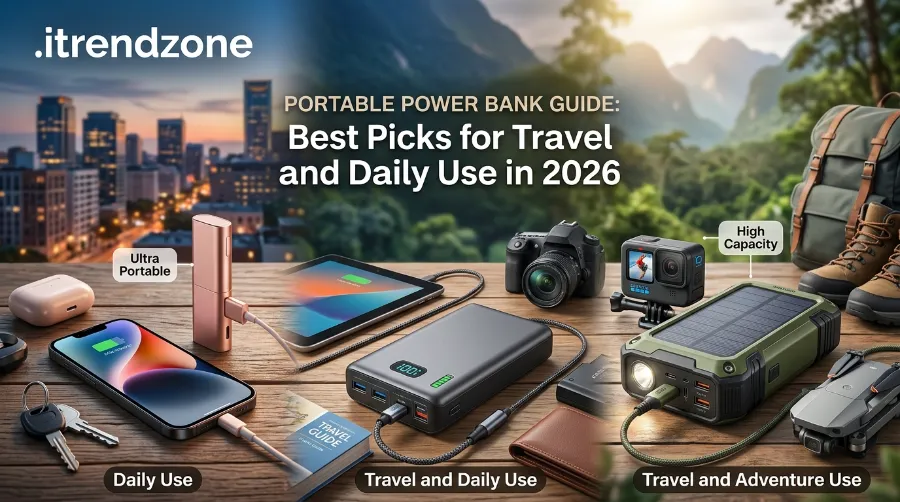
Meanwhile, the rules around flying with a power bank have gotten stricter. Few travelers on our team knew that American Airlines set a new limit starting May 1, 2026, allowing passengers only two portable chargers on board, each rated at 100 watt-hours (Wh) or less. Delta introduced an identical policy on the same date. That single change affects how many power banks you should even pack, so capacity and compliance now need to be planned together, not separately.
If you’re also rethinking your charging setup at home, our phone charger buying guide pairs well with this post, since the wall adapter you choose affects how fast your power bank refills. For a broader look at how buyers across the industry approach this decision, SF Cable’s portable power bank guide covers the retail side of the same question well.
USB-C Cable Guide: Why Not All Cables Charge the Same
Power Bank mAh Explained (Without the Confusing Math)
This is the section most guides get lazy on. Here’s the plain-English version.
mAh (milliamp-hours) measures how much charge a battery stores. A higher number generally means more charges before you need to plug back in. Yet mAh alone doesn’t tell you what actually reaches your phone, for three reasons:
- Voltage conversion loses energy. Power banks store energy at roughly 3.7V, but phones charge at 5V or higher, so some capacity gets lost converting between the two.
- Real-world efficiency sits around 70-90%, not 100%. A 20,000mAh bank will never hand your phone a full 20,000mAh of usable charge.
- Manufacturers list the cell rating, not the output rating. That’s why a “20,000mAh” bank often charges an iPhone 3-3.5 times rather than five.
To convert mAh into watt-hours (Wh) — the number that actually matters for flights — the formula is simple:
Wh = (mAh × Voltage) ÷ 1,000
A 20,000mAh bank at the standard 3.7V works out to (20,000 × 3.7) ÷ 1,000 = 74Wh, comfortably under the 100Wh airline threshold. A 30,000mAh bank, by contrast, lands around 111Wh, pushing it into the “airline approval required” bracket.
Quick mAh-to-use-case chart:
| Capacity | Watt-hours (approx.) | Best for |
|---|---|---|
| 5,000mAh | ~18.5Wh | Pocket top-ups, one phone charge |
| 10,000mAh | ~37Wh | Daily commute, 2-2.5 phone charges |
| 20,000mAh | ~74Wh | Weekend travel, 3-4 phone charges |
| 25,000-27,000mAh | ~92-100Wh | Long-haul flights, still airline-safe |
| 30,000mAh+ | ~111Wh+ | Requires airline approval, not ideal for flying |
For a deeper look at how charging speed and cable quality affect real-world results, our USB-C cable guide is worth a read before you buy a new bank. The team at FIXED also breaks down real vs. labeled capacity in more technical detail if you want to go deeper on the battery chemistry side.
Power Bank Airplane Rules: What Changed in 2026
Here’s where travelers get caught off guard, so let’s be precise. Aviation authorities regulate lithium-ion batteries by energy content (Wh), not capacity label (mAh), because Wh reflects actual fire risk if a cell fails.
The current framework, based on TSA, FAA, and EASA guidance, breaks down like this:
- Under 100Wh: generally allowed in carry-on, no approval needed, though individual airlines can set their own cap.
- 100-160Wh: requires airline approval in advance, usually capped at two units per passenger.
- Above 160Wh: not permitted on passenger aircraft, full stop.
- Checked luggage: power banks are never allowed in checked bags on any airline, since a thermal event is far easier to manage in the cabin than in the cargo hold.
The New 2026 Twist
Airlines are now tightening their own policies on top of that baseline. American Airlines’ headline change limits passengers to two portable chargers on board, each rated at 100Wh or less. Delta followed with an identical policy, also effective May 1, 2026. The TSA itself doesn’t cap the number of sub-100Wh power banks you can carry, but more carriers are expected to add their own limits throughout the year.
For official, current guidance, check the TSA’s carry-on rules page and the FAA’s PackSafe program before you fly. If you’re traveling within Europe, EASA guidelines apply, though it’s worth checking your specific carrier’s site too, since Ryanair, Lufthansa, and British Airways each phrase their policies slightly differently.
Before you fly, run this 3-step check:
- Look for the Wh rating printed on your power bank, not just mAh. If only mAh is shown, use the formula above.
- Contact your airline’s customer service at least 48 hours ahead if the rating exceeds 100Wh.
- Pack it in your carry-on or personal item, never in checked luggage, and keep it accessible for security screening.
Best Power Bank 2026: Our Top Picks
We grouped these by use case rather than naming a single “best overall,” since the right pick depends on how you travel and charge.
Best Overall for Travel: Anker Prime 20,000mAh (200W)
In hands-on comparisons at iTrendZone, this model delivers 200W total output via three USB-C ports, one alone capable of 140W, plus a built-in display showing wattage, remaining capacity, and time to full charge in real time. At roughly 74Wh, it stays flight-safe under the new rules while still charging a laptop. Testing showed it took a MacBook Air M4 from 20% to 80% in under 40 minutes, and a 100W USB-C input can refill the entire bank in about 75 minutes.
MagSafe Charger Compatibility Guide for Every iPhone
Best for Laptop-Heavy Travelers: Anker Prime 27,650mAh (250W)
This model can charge a MacBook Pro or top up an iPhone 16 series five to six times on a single charge, thanks to dual USB-C ports delivering up to 250W total output. It sits right at the edge of the 100Wh airline threshold, so double-check the exact Wh rating on your unit before flying.
Best Value: INIU 10,000mAh 45W PD Compact
For daily carry rather than long trips, this is the pick our team reaches for most. It weighs about 6.5 ounces and supports 45W PD fast charging. A digital display and built-in stand also make it easy to prop your phone up during video calls while it charges.
Best Flight-Approved High-Capacity: Anker Prime 26,250mAh (300W)
This unit supports up to 165W total output through three USB-C ports plus one USB-A. Better still, it comes in flight-approved at 90Wh, a genuinely useful spec for anyone who travels for work regularly and doesn’t want to file an airline approval request.
Best MagSafe Pick for iPhone Users: Anker MagGo 10,000mAh (Qi2)
This bank snaps onto MagSafe-compatible iPhones and stays in place as you move, with wireless charging up to 15W via Qi2. For iPhone 15/16/17 owners who hate juggling cables, it’s close to set-it-and-forget-it charging. If you’re unsure whether your case or phone even qualifies, our MagSafe charger compatibility guide walks through it model by model.
Budget Pick for Multi-Device Use: ZZI 60,000mAh 22.5W 5-Device
With a massive 60,000mAh capacity, this bank charges five devices at once at 22.5W PD. It’s built for families or group trips rather than solo carry, and note that its size will need airline approval, so it suits road trips better than flights.
If you’re leaning toward a laptop-capable bank, our best fast chargers 2026 roundup is worth reading first, since pairing the right wall charger with your power bank noticeably shortens refill time.
Power Bank Fast Charging: GaN, USB-C PD, and What Actually Matters
“Fast charging” gets thrown around loosely, so here’s what the numbers actually mean.
GaN vs. USB-C PD
GaN (Gallium Nitride) is the semiconductor material inside modern chargers and power banks. GaN power ICs let chargers run smaller and cooler than older silicon designs while delivering higher wattage, and the 100W tier became mainstream by spring 2026. In plain terms, GaN is why a bank that used to be the size of a paperback now fits in your palm.
USB-C Power Delivery (PD) 3.1 is the protocol, not the material. It negotiates power levels between your device and the bank automatically, so a phone pulls 20-30W while a laptop pulls 60-100W+ from the same port, with no manual adjustment needed.
Real-World Speed Comparison
| Power Bank | Output | 0-80% MacBook Air M4 | Self-recharge time |
|---|---|---|---|
| Anker Prime 20,000mAh | 200W (140W single port) | Under 40 min | 1.5 hrs (wireless base) |
| Anker Prime 26,250mAh | 165W | ~48 min | Not specified |
| CUKTECH 15 Ultra | High/stable | ~38 min | Fast |
| INIU BI-B64 | 140W | ~85 min | Budget-friendly |
Anker’s ActiveShield 2.0 system monitors internal temperature roughly 3 million times per day on their premium models. Heat matters more than most buyers realize, since it’s the main reason batteries degrade faster than their rated cycle count suggests.
One practical tip from our testing: fast charging generates more heat, which speeds up long-term wear. Save the 100W+ speed for moments you genuinely need it, like an airport gate or a tight meeting gap, rather than making it your everyday default.
For anyone still deciding between wired and wireless setups, our wireless charging speed guide breaks down when Qi2/MagSafe actually beats a cable, and when it doesn’t.
Daily Use vs. Travel Use: How to Pick the Right Capacity
Buying too large a bank is one of the most common mistakes we see, so match capacity to your actual routine.
Daily commuting:
- 5,000-10,000mAh is enough for most people
- Prioritize size and weight over raw capacity
- A MagSafe-style bank means no cable to carry at all
Weekend or short business trips call for a bit more:
- 20,000mAh strikes the best balance
- Stays comfortably under the 100Wh flight limit
- Look for at least one USB-C PD port rated 45W or higher
Long-haul flights or extended travel need more headroom:
- 25,000-27,000mAh maximizes capacity while staying flight-legal
- Confirm the exact Wh rating printed on the unit, not just the mAh figure
- Cap yourself at two power banks if flying American or Delta after May 1, 2026
Laptop users who travel for work should prioritize output over raw capacity:
- Look specifically for 100W+ USB-C PD output
- A built-in display showing real-time wattage helps avoid overloading a single port
- Our MagSafe charger compatibility guide is worth checking if you’re mixing wireless and wired charging across an iPhone and a laptop on the same trip
Real-Life Example: A Two-Week Europe Trip
Here’s a scenario our team ran through while researching this guide. A traveler flying JFK to London in June 2026, then taking regional trains through France and Germany, packed a single 20,000mAh (74Wh) power bank and a 65W GaN wall charger. Over fourteen days, that one bank covered daily iPhone 16 Pro top-ups and kept a tablet charged for train journeys, without triggering an airline approval requirement at any of the three airports involved. The only adjustment needed was double-checking Eurostar’s own carry-on battery policy, which mirrors EASA guidance but is worth confirming directly, since regional rail carriers sometimes differ slightly from airline rules.
Common Mistakes People Make With Power Banks
- Buying based on mAh alone, without checking the Wh rating before a flight
- Assuming checked luggage is fine for a “small” power bank — it never is
- Leaving a bank fully charged in a hot car, which accelerates battery degradation
- Pairing a high-wattage bank with a cheap cable, which bottlenecks charging speed (our USB-C cable guide covers this in detail)
- Overbuying capacity for daily use when a compact 10,000mAh bank would do the job
FAQs
Common Questions
1. Can I bring a power bank in my checked luggage?
No. Every major aviation authority, including the TSA and EASA, requires power banks and all lithium-ion batteries to travel in carry-on baggage only, due to fire risk in the cargo hold.
2. How many power banks can I bring on a flight in 2026?
It depends on the airline. American Airlines and Delta now limit passengers to two portable chargers, each 100Wh or less, effective May 1, 2026. Other carriers may allow more, so check your specific airline before packing.
3. What’s the difference between mAh and Wh?
mAh measures stored charge capacity, while Wh measures total energy content and is what airlines actually regulate. Convert using Wh = (mAh × Voltage) ÷ 1,000, with most power banks using 3.7V.
4. Will a 20,000mAh power bank fully charge my laptop?
It depends on the laptop and the bank’s output. A 20,000mAh bank with 100W+ USB-C PD output can meaningfully charge most ultrabooks, though it likely won’t take a power-hungry laptop from empty to full more than once.
5. Does fast charging damage my phone’s battery faster?
Consistent full-speed fast charging generates more heat than standard charging, which can accelerate long-term wear. Using it occasionally rather than as a daily default helps preserve battery health.
Quick-Fire Questions
6. Is a 30,000mAh power bank allowed on a plane?
Generally no without prior airline approval, since it typically exceeds 100Wh and falls into the 100-160Wh bracket requiring advance clearance.
7. Can MagSafe power banks charge as fast as wired ones?
Not yet. Qi2/MagSafe wireless charging currently tops out around 15W for most compatible iPhones, while wired USB-C PD can reach 20-27W or more on the same device.
8. Do solar power banks actually work for travel?
They’re a useful backup for outdoor or camping trips, but their panels charge slowly and depend on direct sunlight, so they shouldn’t be your primary method for daily travel.
Conclusion
Choosing the right power bank in 2026 comes down to three things: matching capacity to how you actually use your devices, understanding the Wh-based airline rules before you pack, and picking a fast-charging standard like USB-C PD with GaN internals if quick top-ups matter to you. The new American Airlines and Delta two-bank limit makes this more important than ever, since overpacking is no longer just impractical — it can get a bank confiscated at the gate. Whether you land on a compact 10,000mAh daily driver or a flight-approved 20,000-27,000mAh travel companion, checking the Wh label before every trip is the one habit worth building.
References
- TSA — Security Screening, What Can I Bring
- FAA — PackSafe, Portable Electronic Devices Containing Lithium Batteries
- American Airlines and Delta Air Lines 2026 portable charger policy updates
- Anker — Best Power Bank 2026 comparison guide
- SF Cable — Portable Power Bank Buying Guide
- FIXED — How to Choose a Power Bank and How to Care for It