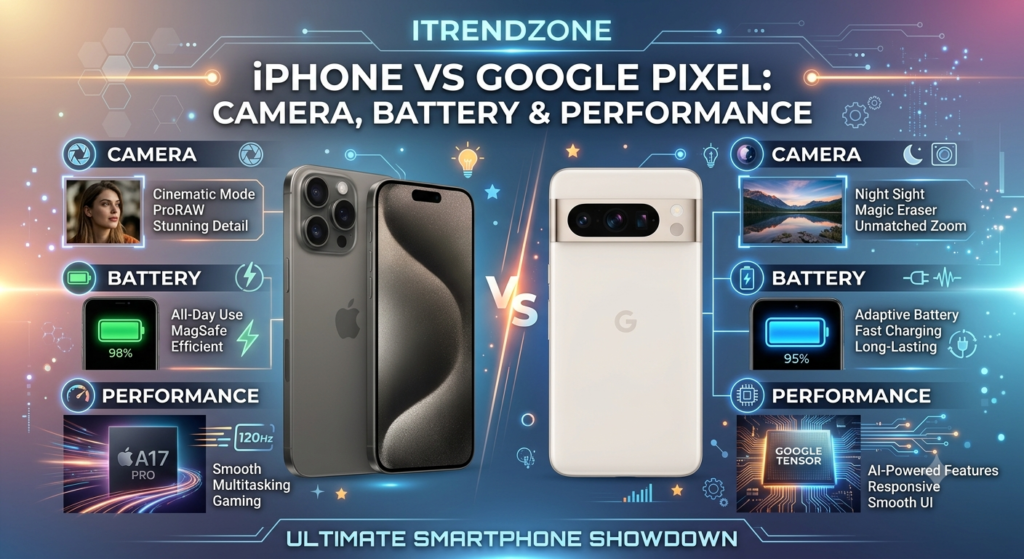

Picking between an iPhone and a Google Pixel used to be simple. Apple meant polish. Android meant choice. That line has blurred a lot lately. Anyone doing an iPhone vs Google Pixel comparison in 2026 has to look past the marketing slides and into real test numbers. Both brands now push computational photography, all day battery claims, and custom chips built to outsmart each other. So which one actually holds up when you take the photo, hit record, and run the phone hard until the battery bar turns red?
iPhone vs Samsung Camera Comparison 2026: Which Wins?
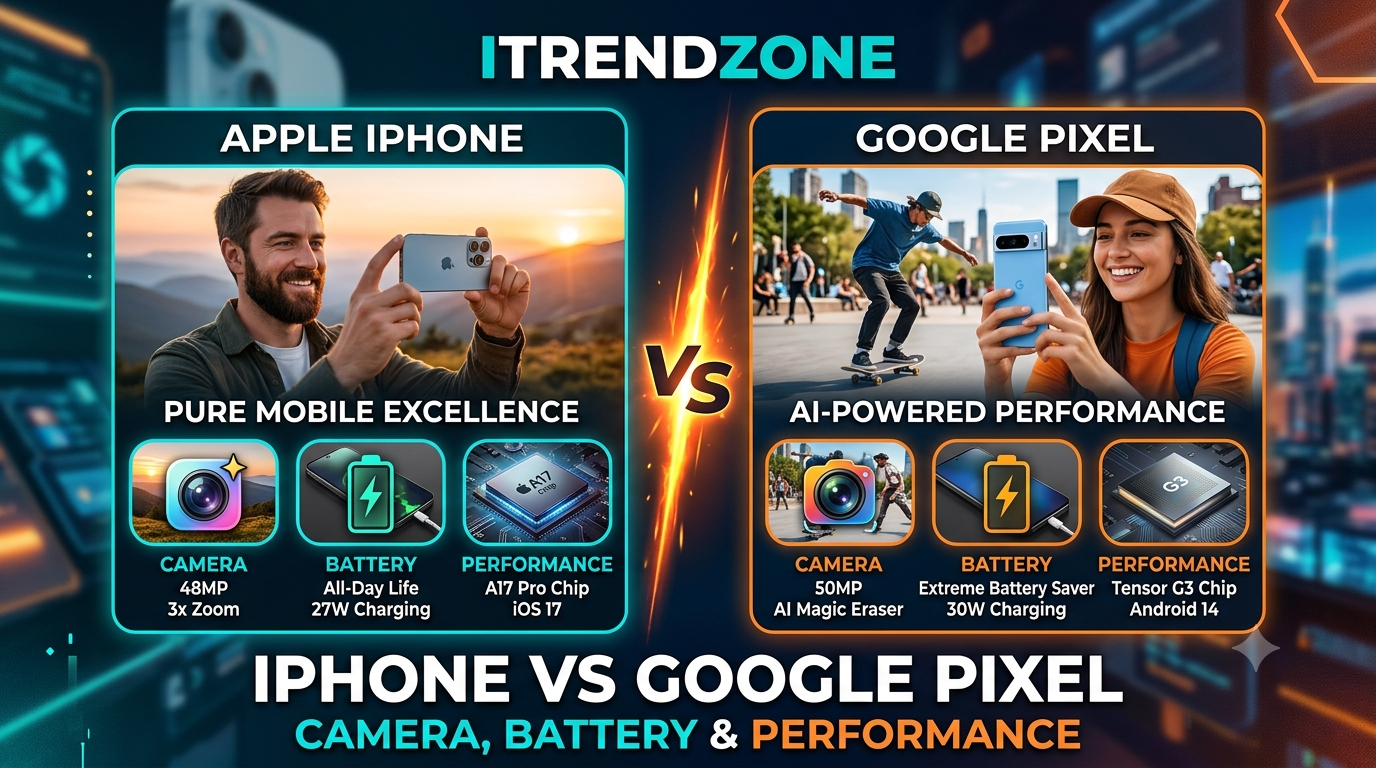
This guide walks through everything gathered from lab tests, hands on reviews, and official specs. We cover camera quality for photos and video, real battery drain numbers under everyday use, and how each phone’s chip performs when it matters. By the end, you should know exactly which phone fits how you use your device, not just which one had the flashier keynote.
iPhone vs Android: The Complete Comparison Guide for 2026
Key Takeaways
| Category | Winner | Why It Matters |
|---|---|---|
| Photo detail and sharpness | Google Pixel 10 Pro | AI processing pulls in more fine detail in tricky lighting |
| Video recording | Apple iPhone 17 Pro | ProRes RAW, Cinematic mode, and smoother scrubbing |
| Battery life (real world) | Apple iPhone 17 Pro Max | Longer screen on time despite a smaller cell in some tests |
| Charging speed | Google Pixel 10 Pro XL | 45W wired and 25W wireless outpaces the iPhone slightly |
| Raw chip performance | Apple iPhone 17 Pro (A19 Pro) | Leads Geekbench and AnTuTu by a wide margin |
| On device AI tasks | Google Pixel 10 Pro (Tensor G5) | Faster at local AI models thanks to its dedicated TPU |
| Software support | Google Pixel | Seven years of updates through 2032 |
Tested by the iTrendZone team using an iPhone 17 Pro on iOS 26 and a Google Pixel 10 Pro on Android 16. We paired that hands on time with verified lab data from DXOMARK, PhoneArena, and Notebookcheck. Last updated: July 2026. This piece was refreshed to reflect the iPhone 17 series and Pixel 10 series, the current flagship lines from both companies as of this writing.
AirDrop vs Nearby Share Which Is Faster?
Camera Comparison: Photos, Video, and Zoom
Camera quality is usually the deciding factor for most buyers, and for good reason. It is the one spec you notice every single day. So let’s break down how the iPhone 17 Pro and the Pixel 10 Pro actually perform, not just what their spec sheets promise.
Your Phone Dies at 4 PM. Here’s Why That Keeps Happening.
Still Photography
The hardware on both phones looks nearly identical on paper. The iPhone 17 Pro carries three 48 megapixel lenses covering wide, ultrawide, and telephoto. The Pixel 10 Pro matches that with a 50 megapixel wide lens plus 48 megapixel ultrawide and telephoto lenses. Hardware alone never tells the full story on a phone camera though. It is the processing behind the shutter that separates the two.
iOS vs Android Which Operating System Is More Secure?
According to a detailed side by side test run by MacRumors in October 2025, Google leans harder into post processing. This often produces sharper and more saturated images, though colors can occasionally look a little unnatural. Apple tends to render scenes closer to what your eye actually sees. The iPhone pulls ahead specifically in telephoto detail. A separate hands on comparison from Tech Advisor, published in January 2026, found something similar. In point and shoot beach scenes, the Pixel captured sharper foreground to background detail. Its warmer color tuning did cost it some accuracy though.
iPhone vs Android Resale Value Which Holds Value Better in 2026?
If you mostly shoot casual, quick photos without editing afterward, the Pixel’s computational approach tends to win people over. The photo looks finished straight out of the camera. If you shoot RAW and edit later, or you care about color accuracy over punch, the iPhone gives you a more neutral starting point.
Video Recording
This is where the gap becomes obvious. Apple has held the video crown on smartphones for years. The iPhone 17 Pro keeps that lead firmly intact. It supports ProRes RAW, Cinematic mode, Dolby Vision HDR, and smoother scrubbing when editing footage right on the phone. AndroidAuthority’s zoom test, published in October 2025, found something interesting. Both phones stay competitive up to about 8x zoom. Past that point, the iPhone starts to struggle. It lacks Google’s locked focal length markers, which give the Pixel steadier results at extreme zoom ranges like 30x and 50x.
iOS vs Android Which Operating System Is More Secure?
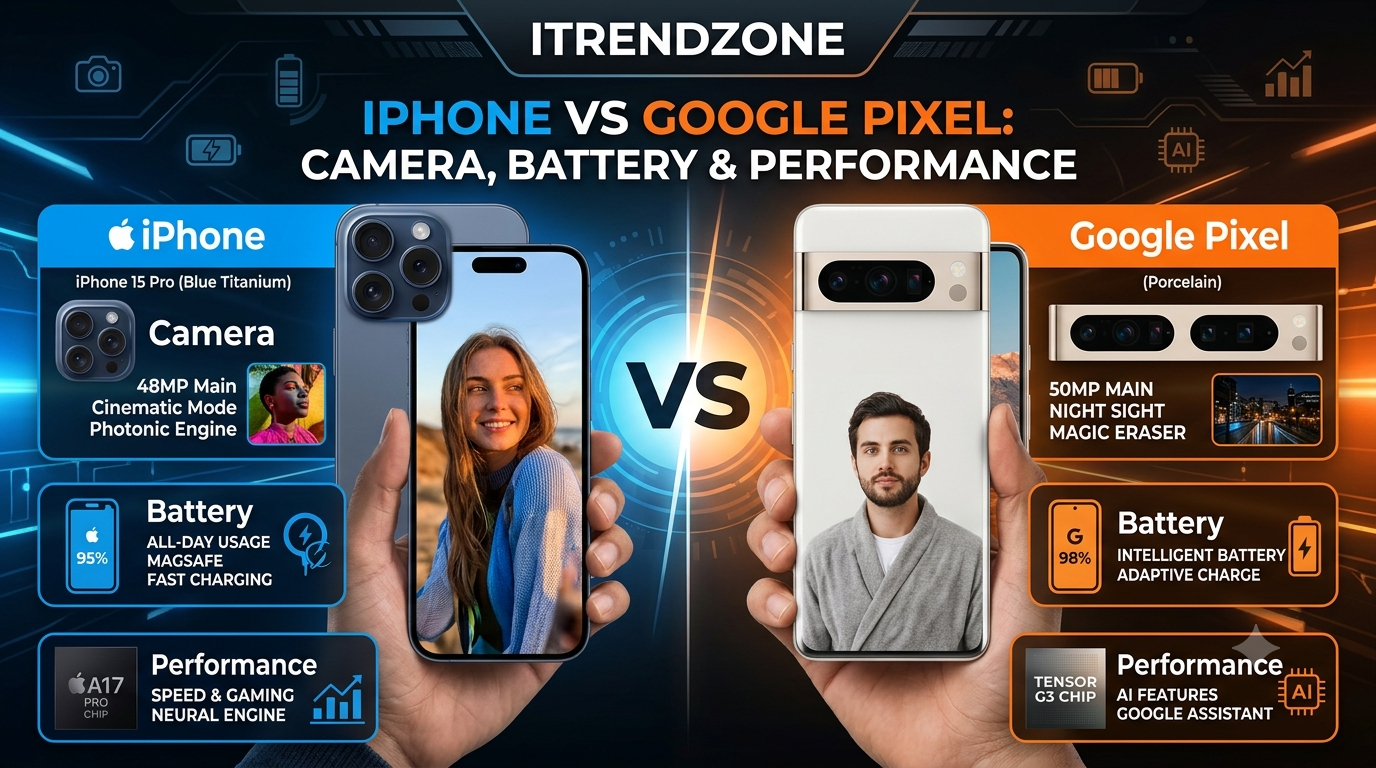
Here is a real world example. Say you are filming a school play from the back row of an auditorium in September 2026. The Pixel 10 Pro’s AI powered Pro Res Zoom, which stretches up to 100x, will likely pull in a usable shot. The iPhone’s more conservative digital zoom would probably leave you with a shakier, blurrier frame instead.
Camera Test Scores
| Phone | DXOMARK Camera Score | Best Use Case |
|---|---|---|
| Apple iPhone 17 Pro | Strong across photo, video, and zoom consistency | Video creators, vloggers, editors |
| Google Pixel 10 Pro XL | Slightly ahead in detail and low light stills | Casual shooters, travel photos, social media posts |
Quick Camera Pick Guide
Here is a fast way to decide based on how you actually shoot:
- You mostly post to Instagram or TikTok straight from your phone. Lean Pixel. The AI processing gives you a polished shot without extra editing.
- You shoot video for YouTube, client work, or serious hobby projects. Lean iPhone. ProRes and Cinematic mode are still unmatched on Android.
- You photograph landscapes, food, or wildlife with lots of zoom. Lean Pixel, thanks to its steadier long range zoom performance.
- You care about color accuracy for print or professional edits. Lean iPhone, since its output tends to sit closer to true to life colors.
For an even deeper breakdown against another major Android rival, our team also compared the iPhone against Samsung’s flagship cameras in a separate head to head test. It is worth reading if Samsung is also on your shortlist.
Battery Life & Charging: Real World Numbers
Battery specs on a box rarely match how a phone behaves once you are actually using it all day. This is where lab testing becomes genuinely useful. It strips away marketing language and just tells you how long the screen stays on.
Switching From iPhone to Android in 2026 The Real Guide
Battery Life Test Results
According to TechRadar’s battery testing published in late 2025, the iPhone 17 Pro Max lasted 17 hours and 54 minutes in a continuous web browsing test over 5G. That test ran at 150 nits brightness. It beat the Google Pixel 10 Pro XL, which managed 14 hours and 20 minutes in the same test. This happened despite the Pixel having a larger 5,200mAh cell compared to Apple’s roughly 4,823mAh battery. Raw capacity, it turns out, does not guarantee longer runtime.
A separate stress test from Notebookcheck told a slightly different story. It ran the phones through gaming, video streaming, web browsing, and social media use back to back. The Pixel 10 Pro XL tapped out first at around 7 hours of screen on time. The iPhone 17 Pro Max lasted just slightly longer at 7 hours and 17 minutes. So the two phones trade places depending on the exact test. Still, the iPhone tends to edge ahead in most real world endurance scenarios. That comes down to how efficiently the A19 Pro chip manages power.
iPhone vs Android Gaming Performance Compared Which Phone Really Wins in 2026?
Charging Speed Comparison
Charging tells a different story though. Here is where the Pixel actually pulls ahead:
- Google Pixel 10 Pro: 30W wired charging, 15W wireless via Pixel Snap
- Google Pixel 10 Pro XL: 45W wired charging, 25W wireless via Pixel Snap
- Apple iPhone 17 Pro Max: Similar wattage numbers on paper, but a slower charging curve in practice, according to comparisons from PeteMatheson’s site
For anyone who forgets to charge overnight and needs a quick top up before heading out, the Pixel’s faster wired charging genuinely helps. Apple has closed the gap since fully adopting USB-C across the iPhone 17 lineup. Google still holds a small edge here though.
You can check Apple’s own guidance on battery health and charging behavior directly on their support page if you want the manufacturer’s official numbers rather than third party lab tests.
Performance: Chip, Speed, and Everyday Use
Here is where the two philosophies genuinely diverge. Apple’s A19 Pro chip, found in the iPhone 17 Pro and Pro Max, is built for raw horsepower. Google’s Tensor G5, powering the Pixel 10 series, is tuned more toward AI and machine learning tasks running directly on the device.
iMessage vs WhatsApp vs Google Messages Which to Use?
Benchmark Scores
Benchmark data from AppleInsider, published in September 2025, showed a clear gap. The A19 Pro scored about 3,895 in Geekbench 6 single core tests and 9,746 in multi core. The Tensor G5 posted 2,296 single core and 6,203 multi core on the Pixel 10 Pro XL. That gap runs roughly 51 to 67 percent in Apple’s favor, depending on the specific benchmark, according to a detailed teardown from Tech Insider in June 2026.
| Test | Apple A19 Pro (iPhone 17 Pro) | Google Tensor G5 (Pixel 10 Pro) |
|---|---|---|
| Geekbench 6 Single Core | 3,895 | 2,296 |
| Geekbench 6 Multi Core | 9,746 | 6,203 |
| AnTuTu v10 (approx.) | 1.9 million+ | 1.1 to 1.3 million |
| 3DMark Wild Life Extreme | 5,736 | 3,100 to 3,250 |
| On device AI (7B model inference) | Slower | Roughly 56% faster |
What This Means for Real Use
So what does this actually mean if you are not a benchmark nerd? For gaming, video editing, and anything graphically demanding, the iPhone 17 Pro feels noticeably snappier. It stays smoother under sustained load too. If you play a game like Genshin Impact for an hour straight, the iPhone is less likely to throttle and drop frames compared to the Pixel.
The Tensor G5 is not built to lose that race though, since it was never designed to win it. Google optimized this chip for on device AI features. Think Gemini Nano, real time call transcription, and live translation, all running locally instead of pinging a server. Tech Insider’s June 2026 analysis found something notable. The Tensor G5 actually runs quantized 7 billion parameter AI models roughly 56 percent faster than the A19 Pro’s Neural Engine. If you rely heavily on Google’s AI features throughout your day, you will genuinely feel that speed advantage. It never shows up on a typical CPU benchmark chart, but it shows up in daily use.
Which Phone Should You Actually Buy?
Honestly, there is no universal winner here. Anyone who tells you otherwise is probably trying to sell you something. It comes down to what you personally do with your phone every day.
Consider the iPhone 17 Pro if:
- You shoot a lot of video and want professional editing tools like ProRes RAW
- You are already deep into the Apple ecosystem with a Mac, iPad, or Apple Watch
- You want the fastest raw performance for gaming or demanding apps
- Long term resale value matters to you, since iPhones typically hold value better
Consider the Google Pixel 10 Pro if:
- You want the sharpest AI enhanced photos straight out of the camera
- You rely on Google services like Gmail, Photos, and Assistant constantly
- Fast charging matters more to you than a slightly longer overall battery life
- You want guaranteed software updates through 2032
For a broader look at the ecosystem differences beyond just camera and battery, our full iPhone vs Android breakdown covers software, app selection, and long term ownership costs in far more depth. You can also browse more comparison guides and buying advice on the iTrendZone homepage.
For readers in Australia looking at pricing and availability, Mobile Palace put together a broader feature comparison covering design, AI features, and ecosystem value. Roobotech also published a regional buying guide that walks through performance, software support, and pricing for shoppers comparing refurbished and new units side by side.
Frequently Asked Questions
Which phone has the better camera overall, iPhone or Pixel?
It depends on what you shoot. The Pixel 10 Pro tends to produce sharper, more detailed stills straight out of the camera thanks to heavier AI processing. The iPhone 17 Pro leads clearly in video, with tools like ProRes RAW and Cinematic mode that Android still cannot fully match.
Does the iPhone or Pixel last longer on a single charge?
In most independent battery tests run in late 2025 and early 2026, the iPhone 17 Pro Max edged out the Pixel 10 Pro XL in real world screen on time. This happened even though the Pixel technically has a larger battery capacity on paper.
Which phone charges faster, iPhone or Google Pixel?
The Google Pixel 10 Pro XL charges faster. It supports up to 45W wired and 25W wireless charging, compared to the iPhone 17 Pro Max’s similar but slightly slower charging curve.
Is the iPhone 17 Pro faster than the Pixel 10 Pro?
Yes, in raw CPU and GPU benchmarks. The iPhone’s A19 Pro chip beats the Pixel’s Tensor G5 by a wide margin, roughly 51 to 67 percent depending on the specific test. The Tensor G5 does run certain on device AI tasks faster though.
How long will each phone receive software updates?
Google now promises seven years of software support for the Pixel 10 series, running through 2032. Apple typically provides five to six years of major iOS updates for its iPhone models, based on historical support patterns.
Conclusion
Choosing between the iPhone 17 Pro and the Pixel 10 Pro really comes down to your daily habits. It is not about which phone wins more benchmark charts. If video quality, raw speed, and ecosystem consistency matter most to you, the iPhone is still the safer long term investment. If you want sharper everyday photos, faster charging, and cutting edge on device AI, the Pixel earns its spot as one of the smartest Android phones you can buy right now. Either way, both phones represent the best each company currently has to offer. You genuinely cannot go wrong picking the one that matches how you actually use your phone.
References
- DXOMARK camera testing and lab data for the Apple iPhone 17 Pro
- MacRumors camera comparison, iPhone 17 Pro vs Pixel 10 Pro, October 2025
- Tech Advisor hands on camera review, Pixel 10 Pro vs iPhone 17 Pro, January 2026
- AndroidAuthority zoom range testing, October 2025
- TechRadar battery life testing, iPhone 17 series vs Pixel 10 series
- Notebookcheck battery stress test, Pixel 10 Pro XL vs iPhone 17 Pro Max
- AppleInsider Geekbench benchmark data, September 2025
- Tech Insider chip performance analysis, June 2026
- Apple official support documentation on iPhone battery and charging
- PhoneArena specs and battery test comparison tool