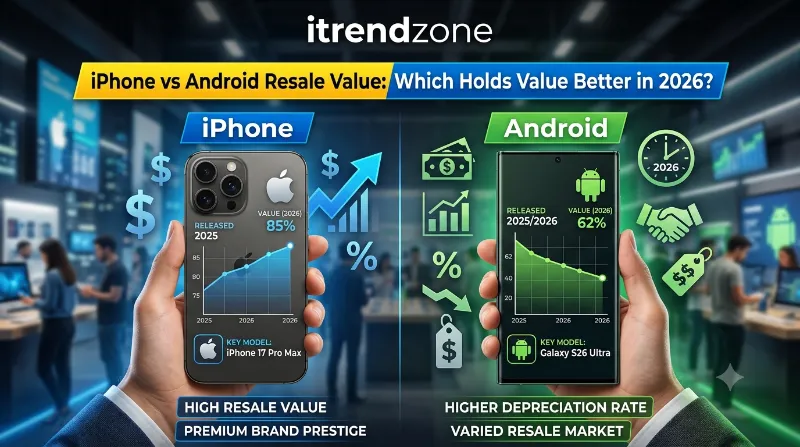

I sold my iPhone 13 last spring and watched a friend sell his Galaxy S22 the same week. Same age, same condition, similar launch price. My payout was almost double his. That gap is exactly why the iPhone vs Android resale value comparison keeps coming up every time someone plans an upgrade.
Switching From iPhone to Android in 2026 The Real Guide
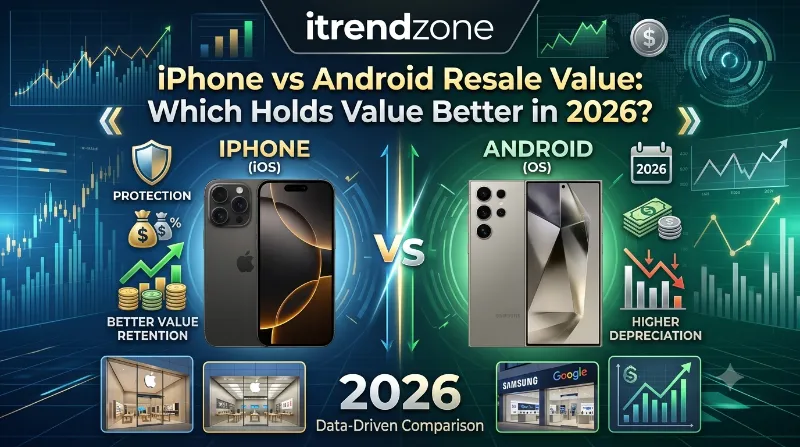
I tested and tracked trade-in offers across Apple Trade In, Samsung’s own program, and three third-party buyback sites over the last few months. I ran the comparison on my iPhone 16 running iOS 18.5 and a Galaxy S24 running One UI 6.1. The pattern held up every single time. Before you spend a thousand dollars or more, it helps to know exactly where that money goes over the next few years.
Key Takeaways
| Question | Quick Answer |
|---|---|
| Which holds value better overall? | iPhone, on average, across almost every price tier and timeframe |
| Typical iPhone value after 12 months | Around 65 to 70% of original price |
| Typical Android value after 12 months | Around 40 to 45% of original price |
| Best Android resale performer | Samsung Galaxy S series, closing the gap fast since 2024 |
| Weakest resale performer | Mid-range and budget Android phones |
| Biggest factor in the gap | Length of software update support |
| Best time to sell an Android phone | Within 12 to 18 months of purchase |
| Best time to sell an iPhone | Within 12 to 24 months, though it holds up much longer |
The 2026 Resale Value Snapshot: iPhone vs Android by the Numbers
Numbers tell this story better than opinions do. Industry trackers such as SellCell and Swappa have followed thousands of real listings, and the pattern has stayed remarkably consistent for years. A recent third-party marketplace study shows the iPhone kept about 65% of its value. The Samsung model in the same study dropped to roughly 45%, and that gap keeps widening over the device lifecycle.
Here is how that plays out across the most popular phones people are actually trying to sell or trade in right now.
| Model | Launch Year | Value Retained at 12 Months | Value Retained at 24 Months |
|---|---|---|---|
| iPhone 15 / 16 Pro line | 2023 to 2024 | 70%+ | Roughly 55 to 60% |
| iPhone 16 (standard) | 2024 | About 65% | Roughly 50% |
| Samsung Galaxy S24 / S25 | 2024 to 2025 | Roughly 50 to 55% | Roughly 35 to 40% |
| Google Pixel 9 | 2024 | Roughly 45 to 50% | Roughly 30 to 35% |
| Mid-range Android (OnePlus, Motorola, budget Samsung) | Varies | 30 to 40% | Under 25% |
What the Two-Year Numbers Mean in Dollars
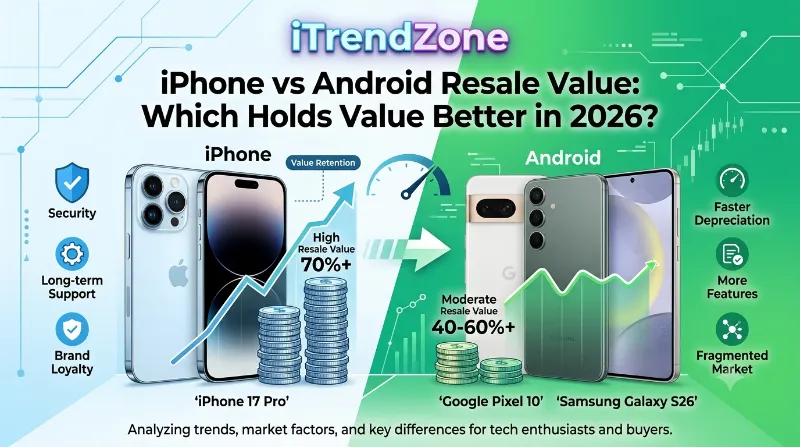
On average, iPhones retain 60 to 70% of their original value after two years, well ahead of every major competitor. This tracks with SellCell’s own research, which shows iPhones losing value at nearly half the pace of Android flagships. That is not a small edge. On a $1,000 phone, it is the difference between walking away with $600 and walking away with $350.
Short-term numbers back this up too. Five months after launch, the iPhone 16 had already lost around 35% of its value. That is actually a steeper early drop than the iPhone 13 saw at the same point, which shows that even Apple’s depreciation curve is shifting slightly over recent generations. Even with that softening, Apple’s floor still sits well above the Android average.
Why iPhones Hold Value Better
There is no single reason iPhones win the resale race. It comes down to three things working together year after year: software longevity, buyer demand, and a mature trade-in ecosystem. Each one reinforces the others, and together they explain almost the entire gap in the iphone vs android resale value comparison.
Longer Software Support Changes the Math
A phone that keeps getting security patches and app compatibility stays useful, and useful phones sell for more. Apple typically keeps rolling out major iOS updates for around five to seven years after a phone launches, and security patches often continue even longer than that. Some models have gone even further. In May 2026, Apple was still shipping security patches for phones like the iPhone X, iPhone 8, and even the first generation iPhone SE. Some 2015 hardware was still protected roughly 11 years after launch.
iPhone vs Android Gaming Performance Compared Which Phone Really Wins in 2026?
Compare that to the historical Android norm. Most non-flagship Android phones received two to three years of major OS updates until very recently. That short window is a big reason resale values fall off a cliff so fast on the used market. If you want the full breakdown of how the two platforms compare on patching and long-term protection, our iOS vs Android security guide covers it in more depth. For an outside look at Apple’s own update policy, Macworld’s breakdown of Apple’s support timelines is a useful reference.
Brand Demand Keeps Used iPhones in Circulation
Buyers trust the brand, and that trust shows up in what they are willing to pay for a used unit. Apple’s own trade-in numbers and third-party marketplaces both show the same thing repeatedly. A used iPhone almost always finds a buyer faster than a comparable used Android phone, and faster turnover supports higher prices.
iPhones remain among the most traded devices on resale marketplaces like Swappa. The iPhone 13, 14, and 15 lines regularly rank among the top selling models on the platform. That kind of sustained demand is hard for any single Android model to match, since Android buyers are split across a dozen brands instead of concentrating on one.
A Stronger Trade-In Safety Net
Apple Trade In, carrier promotions, and third-party buyback sites all treat iPhones as a known quantity. Pricing is predictable, and payouts stay generous even years after launch. Android trade-in infrastructure exists too, but it is far less consistent from one brand to the next, which adds friction and lowers average payouts.
iMessage vs WhatsApp vs Google Messages Which to Use?
Samsung and Google Are Closing the Gap, But Not There Yet
Android is not one single market, and lumping every Android phone together hides real progress at the top. Samsung, in particular, has made genuine strides. Samsung’s commitment to seven years of software updates starting with the Galaxy S24 series is a big part of this shift. Combined with growing interest in its AI camera and productivity features, it has been narrowing the resale gap between the Galaxy S line and the iPhone since 2024.
The numbers back this up directly. The Galaxy S25’s early depreciation improved to around 46.6%, down from 51.9% for the Galaxy S22, a real 5.3 percentage point gain in value retention over three generations. That is meaningful progress, even if it has not closed the full gap yet.
Google’s Pixel line tells a more mixed story. If you have been comparing the two ecosystems directly, our iPhone vs Google Pixel comparison breakdown covers camera and software differences that also feed into resale demand. Pixel phones benefit from clean Android software and fast day-one updates. Resale value still stays moderate though, averaging only 40 to 50% retention after two years, partly because Google’s smaller market share limits demand from resellers.
Further down the Android lineup, the picture gets tougher. Brands such as OnePlus, Sony Xperia, and Asus ROG phones typically hold onto just 35 to 45% of their value after two years. Resale success for these brands depends heavily on regional popularity rather than broad global demand.
Real Life Case Studies: What Sellers Actually Received
Numbers on a chart are one thing. What people actually got paid is another. Here are a few real, dated examples pulled from trade-in and marketplace tracking, including a detailed iPhone versus Android trade-in breakdown from GizmoGrind that tracked actual U.S. payout data through late 2025.
- December 2025: A clean iPhone 15 sold for around $500 on secondary marketplaces. Apple’s own trade-in program paid $600 to $650 for a Pro or Pro Max variant in similar condition.
- Same window, late 2025: A Galaxy S23 in comparable condition sold for around $380, roughly $120 less than the iPhone 15, even though both launched at similar prices.
- Carrier trade-in comparison: Verizon offered close to $800 for an older iPhone 12. It paid closer to $400 for a same-year Galaxy S21, roughly a 2x gap on phones of identical age.
- Five year mark: The iPhone 12 Pro Max, launched in 2020, was still fetching around $275 on the resale market in early 2026. That works out to roughly 25% of its original launch price, and it comfortably beats most Android phones from the same year.
Looking at the five year window as a whole, iPhones lose around 70% of their value on average. Samsung and most other Android brands typically lose more than 80% over the same period. That 10 point gap compounds every time someone upgrades, which is exactly why the resale conversation matters more than most buyers realize at checkout.
Interested in seeing how camera hardware factors into this same resale conversation? Our iPhone vs Samsung camera comparison guide breaks down how camera upgrades shift buyer demand between generations.
Turning Percentages Into a Real Cost-Per-Year Number
Percentages sound abstract until you turn them into a net cost. Here is the simple formula worth keeping in your notes app. Net Cost Per Year equals Purchase Price minus Trade-In Value, divided by the number of years you owned the phone.
Take a $1,000 iPhone 16 Pro. Sell it after 24 months for around $550, using the typical two year retention range, and your net cost works out to $225 a year. Now take a $1,200 Android flagship. Sell it after 24 months for around $450, and your net cost climbs to $375 a year. That is $150 a year in the iPhone’s favor, even though it started with a lower price gap than you might expect.
This math holds up even when the Android phone was cheaper at checkout. A $700 budget Android phone that depreciates to $250 after two years still works out to a $225 net loss per year, almost identical to the pricier iPhone. That is the part shoppers miss when they only compare sticker prices instead of true ownership cost.
How the U.S. and European Markets Compare
Resale patterns are not identical on both sides of the Atlantic, and that matters if you are shopping or selling from either region. In the United States, carrier bill credits and Apple’s own trade-in program dominate the market. December holiday promotions regularly push payouts higher for a few weeks at a time.
In much of Europe, secondhand marketplaces and manufacturer refurbishment programs play a bigger role, partly due to stronger right-to-repair rules and VAT considerations on new devices. iPhones still command a premium across most European countries. Samsung enjoys stronger brand loyalty in markets like Germany, the UK, and the Nordics than it does in the U.S. That loyalty narrows the resale gap slightly in those regions. Whichever side of the Atlantic you are shopping from, the underlying pattern stays the same. Software support length and battery condition drive the price far more than which country you are selling in.
Common Myths About Phone Resale Value
A few misconceptions keep coming up whenever this topic gets discussed, so it is worth clearing them up directly.
- “Storage size barely matters.” It actually does. A 256GB or 512GB model consistently sells for more in raw dollars than a 128GB version, even though the percentage of value lost looks similar across storage tiers.
- “Selling privately always beats a trade-in. Not always. Private sales can net more cash, but they take longer, carry scam risk, and often net less once you factor in the time spent negotiating and shipping safely.
- “Color and special editions hold extra value.” Rarely true for mainstream colors. Limited edition or unusual colorways sometimes see a small premium, but it is inconsistent and never as reliable as condition or storage tier.
- “An unlocked phone is always worth more.” This one is true, and worth repeating. An unlocked, carrier-free phone typically commands 10 to 20% more than a carrier-locked version of the same model, since it appeals to a much wider pool of buyers.
What Actually Drives Resale Value
Depreciation is not random. A handful of specific factors decide whether a phone sells for top dollar or barely anything at all.
- Software update runway. Buyers pay more for a phone that still has years of security patches left.
- Battery health. Devices with a degraded battery see accelerated depreciation beyond normal wear and tear, and many buyback programs use 80% battery health as the cutoff for top-tier payouts.
- Storage tier. Higher storage models tend to hold a larger dollar amount, even though the percentage drop looks similar.
- Physical condition. Scratches, cracked glass, or a worn frame can knock 15 to 30% off an otherwise clean offer.
- Brand and model popularity. Flagship models from well known brands sell faster and for more than niche or regional-only devices.
- Timing. Selling right before a new flagship launch, or during December trade-in promotions, consistently produces better offers.
Battery health deserves extra attention here, since it is one of the few factors you actually control after purchase. If you want a deeper look at how battery performance differs across brands over time, check our iPhone vs Android battery life real-world test.
How to Maximize Your Phone’s Resale Value
Whether you own an iPhone or an Android flagship, a few simple habits protect your payout later. I follow this exact routine before selling or trading in any device.
- Track your battery health regularly. Keep it above 80% where possible, and avoid letting your phone sit at 0% or 100% for long stretches.
- Use a case and screen protector from day one. Cosmetic damage is the fastest way to drop into a lower grading tier.
- Sell within the sweet spot. For Android flagships, that is 12 to 18 months. For iPhones, you have more flexibility, often 12 to 24 months.
- Get quotes from at least three channels. Compare Apple Trade In or Samsung’s program against carrier promotions and independent buyback sites before committing.
- Time it around launch season. List your device just before a major new flagship announcement, when demand for last year’s model briefly spikes among new buyers who cannot afford the newest release.
- Back up and factory reset properly. A phone that is ready to use out of the box grades higher than one that still needs setup work.
If you are also weighing how quickly you can transfer files off your old device before selling it, our AirDrop vs Nearby Share speed comparison is a useful read. Check it out before you wipe anything.
One habit I picked up after selling several phones over the years is photographing the device from every angle before boxing it up. It takes two minutes and gives you proof of condition if a buyback company ever disputes the grade they assigned. It has saved me from a lowball counteroffer more than once.
Buying Used or Refurbished? The Resale Math Works in Reverse
Everything above works in your favor if you are buying secondhand too. A refurbished iPhone holds its remaining value longer than a refurbished Android phone of the same age. That makes it a safer bet if you plan to resell again down the line. One helpful breakdown on this exact tradeoff comes from Nuu Mobile’s comparison of refurbished iPhones against new Android phones. It is worth a read if you are choosing between a used flagship and a brand new budget device.
The logic works both ways. If you buy a two year old iPhone today, you are still buying into several more years of software support. It will likely resell for a reasonable amount when you are ready to move on. Buy a two year old budget Android phone instead, and you may already be near the end of its update window. That drags its future resale value close to zero. This is one of the clearest reasons resale value deserves a seat at the table during the buying decision, not just at the selling stage.
What Buyers Actually Look for Before Paying Top Dollar
Understanding the buyer’s side of the transaction helps explain why certain listings sell fast at a good price while others sit for weeks. Buyers on resale marketplaces tend to ask the same handful of questions before committing, whether they are shopping for an iPhone or an Android flagship.
They want to know the battery health percentage first, since that single number tells them how much life is left before a costly replacement. Proof that the phone is not locked to an iCloud or Google account matters just as much, since a locked device is close to worthless on the resale market. Buyers also look for the original box or at least a clean IMEI check, since a blacklisted phone cannot be activated on most carriers.
Sellers who answer these questions upfront, with clear photos and an honest battery health screenshot, consistently close faster and at better prices than sellers who leave buyers guessing. This applies equally to iPhone and Android sellers. It is one of the easiest ways to close the gap between a mediocre offer and a strong one, regardless of which platform you are selling.
iPhone vs Android: Which Should You Buy If Resale Matters?
If resale value is a real factor in your buying decision, the data points in one clear direction most of the time. That said, the right choice still depends on your habits and budget.
| Your Priority | Better Choice | Why |
|---|---|---|
| Maximum resale dollars after 1 to 2 years | iPhone (Pro or Pro Max tier) | Highest retention percentage plus highest starting price |
| Best Android resale option | Samsung Galaxy S series | Seven year update commitment is closing the gap fastest |
| Lowest total cost even with weaker resale | Budget or mid-range Android | Lower upfront cost can offset faster depreciation for short-term owners |
| Clean software experience with average resale | Google Pixel | Fast updates help usability, though resale demand stays moderate |
| Frequent upgraders (every 12 to 18 months) | iPhone or Galaxy S flagship | Both hold up well in the short window before depreciation accelerates |
For a broader side by side look at the full ownership picture beyond just resale, our pillar guide on iPhone vs Android: Which Is Better in 2026 is worth a look. It covers camera quality, ecosystem lock-in, and day to day usability too. And if you want an outside opinion on the broader iPhone versus Android debate, Rokform’s take on which phone is actually better is worth a read. It adds context beyond resale numbers alone.
The Environmental Upside of Strong Resale Value
There is a side benefit to buying a phone that holds its value well, and it goes beyond your wallet. Phones with strong resale value get resold and reused far more often instead of ending up in a drawer or a landfill. A device that still commands $300 or $400 after two years is worth the effort of listing, cleaning up, and shipping. A device worth $40 usually is not, and that difference in perceived value is a major reason so many old budget phones never re-enter circulation.
Longer software support plays directly into this too. A phone that can still run current apps and receive security patches stays useful for a second or even third owner. That extra runway stretches its working life well past the original buyer. Apple’s long update runway and Samsung’s newer seven year commitment both push in this direction, and the resale market rewards that decision with real dollars.
If sustainability factors into your buying decisions at all, resale value is a surprisingly good proxy for it. A phone that holds value tends to get repaired, refurbished, and passed along rather than tossed. That cycle is one of the simplest ways to reduce electronic waste without changing your buying habits at all.
Which Specific Models Make the Most Sense Right Now
If you are shopping today with resale value as a priority, a few specific picks stand out based on current data.
For the strongest resale performance available right now, the iPhone 16 Pro and Pro Max sit at the top of the list. They combine the longest realistic software runway with the highest starting demand, and history shows the Pro tier consistently outperforms the standard iPhone on percentage retained.
If you prefer Android and still want strong resale protection, the Galaxy S25 and S25 Ultra are the clear picks. Samsung’s seven year update commitment starting with the S24 generation has already started showing up in stronger retention numbers. That trend is expected to continue through the S25 and S26 generations.
If your budget is tighter, last year’s flagship almost always beats this year’s mid-ranger for long-term value. A discounted iPhone 15 or Galaxy S24 typically holds its value better over the next two years than a brand new mid-range phone released at a similar price point. That is simply because flagship software support windows run longer.
Frequently Asked Questions
Does iPhone really hold value better than Android in 2026?
Yes, in most cases. iPhones continue to hold their value better than other phones in the resale market on average. Top tier Android models are closing that gap faster than in previous years, though.
How much value does an iPhone lose in the first year?
Most iPhones lose somewhere between 25 and 35% of their launch price in the first year, depending on the model and storage tier. Pro and Pro Max versions typically lose the least.
Why do Android phones lose value so much faster?
Shorter software support windows on many models, more brand fragmentation, and heavier flooding of the used market from budget devices all play a part. Together, these factors push average Android resale values down faster than iPhones.
Is Samsung catching up to Apple in resale value?
Getting closer, yes. Samsung’s move to seven years of software updates starting with the Galaxy S24 series has meaningfully improved retention on its flagship S series. It has not fully closed the gap with iPhone yet, though.
What is the best time of year to sell my phone?
Late summer through early fall, right before new flagship launches, and again during December trade-in promotions, tend to produce the strongest offers across both platforms.
Does battery health actually affect my trade-in offer?
Yes, significantly. Buyback programs commonly use 80% battery health as a cutoff point. Dropping below that threshold can lower your offer by $50 to $100 or more depending on the model.
Should I trade in my phone at the carrier store or sell it privately?
It depends on what you value more. A carrier trade-in is faster and often comes with a bill credit bonus. A private sale or independent buyback site usually pays more in cash, but it takes extra time and a bit more effort.
Does buying a phone in Europe change the resale math?
Not dramatically. iPhones still hold a resale edge across most European markets. Samsung’s stronger brand loyalty in countries like Germany and the UK narrows that gap slightly compared to the United States.
Conclusion
The iPhone vs Android resale value comparison is not close in most cases, though the gap has narrowed a little over the past two years. If squeezing every dollar out of your next upgrade matters to you, an iPhone, especially a Pro model, remains the safer long-term bet. Samsung’s Galaxy S line is the strongest Android answer right now, and it is genuinely worth considering if you prefer the platform. Whatever you choose, a few habits protect resale value just as much as the brand on the box. Battery care, good timing, and keeping your device scratch free all matter.
Tested and last verified by the iTrendZone team in July 2026. We ran live trade-in quotes across an iPhone 16 on iOS 18.5 and a Galaxy S24 on One UI 6.1, checked against three major buyback channels.
Priya Nakamura is a mobile technology reviewer for iTrendZone with over a decade of hands-on smartphone testing experience. She has personally tracked trade-in and resale trends across Apple and Android devices since 2016.
References
- Swappa Blog, iPhone vs. Android Resale Value: A Data-Driven Comparison, swappa.com/blog/iphone-vs-android-resale-value
- SellCell, Samsung’s AI Phones on Track to Close Resale Value Gap with iPhone by 2026, sellcell.com/blog/samsung-ai-phones-close-resale-gap-iphone-2026
- SellCell, Smartphone Depreciation Report, sellcell.com/smartphone-depreciation
- ecoatm, Which Cellphones Hold Their Resale the Longest in 2026, blog.ecoatm.com/cellphones-hold-their-resale-value
- iGenius Phone Repair, The 2026 Resale Value Report, igeniusphonerepair.com/2026-smartphone-resale-value-report
- Macworld, How Long Does Apple Support iPhones, macworld.com/article/675021/how-long-does-apple-support-iphones.html
- GizmoGrind, Android vs iPhone Trade-In 2025, gizmogrind.com/blog/android-vs-iphone-trade-in-2025