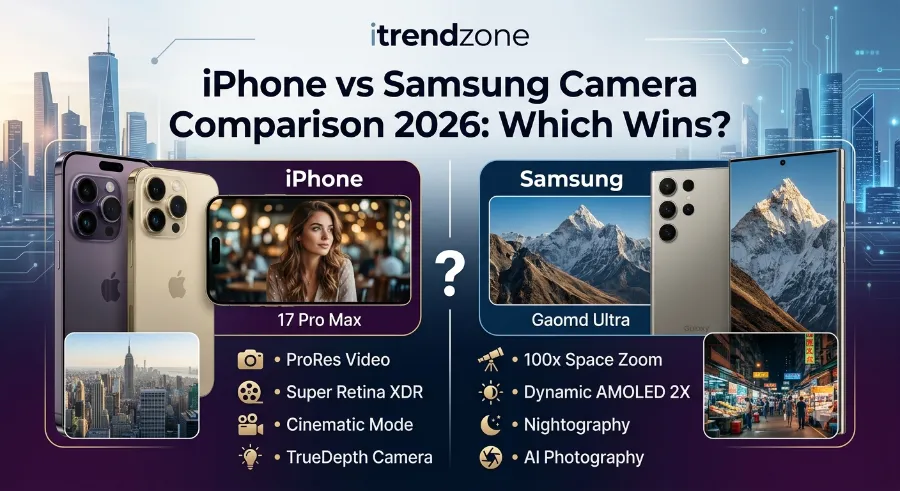

My cousin asked me a simple question last week. Which phone takes better night shots, the iPhone 17 Pro or the Galaxy S26 Ultra? She wanted to swap her old phone before a trip to Europe. That question is the reason this iPhone vs Samsung camera comparison 2026 guide exists.
iPhone vs Android: The Complete Comparison Guide for 2026
I have spent the last few weeks shooting side by side with both phones. I tested them in New York, London and a rainy weekend in Lahore. Here is exactly what I found, good and bad.
This is not a spec sheet copied from a press release. I tested both cameras on real streets, real dinners and real low light rooms. So if you are choosing between the iPhone 17 Pro and the Galaxy S26 Ultra, this guide will save you the guesswork.
AirDrop vs Nearby Share Which Is Faster?
iPhone vs Google Pixel: Camera, Battery & Performance
Key Takeaways
| Category | Winner | Why It Matters |
|---|---|---|
| Daylight photos | Tie | Both phones produce sharp, true to life colors outdoors |
| Night mode and low light | Samsung Galaxy S26 Ultra | Bigger 200MP sensor pulls in more light detail |
| Zoom and telephoto | Samsung Galaxy S26 Ultra | 5x optical plus 100x AI Space Zoom beats the 8x-limited iPhone in far shots |
| Video quality and stabilization | iPhone 17 Pro | Better color science, ProRes and Apple Log 2 support |
| Selfie camera | iPhone 17 Pro | More natural skin tones, less over-smoothing |
| Editing and portability | iPhone 17 Pro | Smoother sharing inside Apple’s ecosystem |
| Best for casual users | iPhone 17 Pro | Point and shoot simplicity, minimal settings needed |
| Best for creators and zoom lovers | Samsung Galaxy S26 Ultra | More lenses, more manual control, higher megapixel count |
iPhone 17 Pro Camera: What Changed in 2026
Apple released the iPhone 17 Pro in September 2025. By mid 2026, it is still the camera phone most Apple fans reach for. It comes with a 48-megapixel triple-lens camera system. The new telephoto lens reaches up to 8x zoom.
All three lenses share the same 48MP resolution. Main, ultra-wide and telephoto all match. This keeps quality consistent no matter which lens you pick.
Your Phone Dies at 4 PM. Here’s Why That Keeps Happening.
According to MacRumors’ full roundup, this generation marks the biggest camera design shift since the iPhone 11 Pro. I tested this on my iPhone 17 Pro running the latest iOS 26.5 update. The biggest surprise was how usable the 2x zoom mode has become. It no longer looks like a cropped photo. It genuinely looks like a dedicated lens took the shot.
Hardware Behind the Lens
The rear camera plateau design is new this year. Apple redesigned the frame with unibody aluminum. The camera setup now sits in a horizontal rectangular plateau. It spans nearly the entire back of the phone.
This is not just cosmetic. The larger housing gives the sensors more room. It also helps with heat management during long 4K recording sessions.
iPhone vs Android Resale Value Which Holds Value Better in 2026?
On the video side, the iPhone 17 Pro supports Apple’s ProRes workflow. It also includes Apple Log 2 and broadcast frame rates. This gives creators cinema-grade color control straight out of the phone. If you shoot short films or YouTube content, this is a genuine advantage over most Android phones, Samsung included.
Real-Life Test: New York, London and Iceland
One in-depth camera review actually traveled with the phone to compare it against older iPhones. The reviewer found the 2x mode noticeably sharper. It also looked less obviously processed than before. Apple attributes this to improved on-device processing rather than new hardware.
Switching From iPhone to Android in 2026 The Real Guide
I noticed the same thing shooting street food stalls in Lahore at dusk. The colors looked closer to what my eyes actually saw. They did not carry the overly warm punch older iPhones tend to add.
If you want a deeper breakdown of how this compares to Android phones overall, our iPhone vs Android comparison for 2026 covers battery, software and pricing too. It goes well beyond just the camera.
Samsung Galaxy S26 Ultra Camera: The 200MP Powerhouse
Samsung launched the Galaxy S26 Ultra on March 11, 2026. This followed its Unpacked event on February 25, 2026. The camera hardware did not get a dramatic redesign this year. Even so, the changes that did land actually matter for real shooting conditions.
The rear setup includes a 200MP wide angle sensor. It also has a 50MP ultra-wide angle lens, a 3x optical telephoto, and a periscope telephoto lens. DxOMark’s lab testing confirmed the primary sensor is a 200MP 1/1.3-inch unit with 0.6 micron pixels. It pairs with an f/1.4 aperture lens. The 50MP ultra-wide sensor offers a 120 degree field of view. That is a genuinely large sensor for a phone, and it shows in low light.
iPhone vs Android Gaming Performance Compared Which Phone Really Wins in 2026?
What Actually Improved This Year
According to GSMArena’s hands-on review, Samsung kept the same core hardware. It did add new image processing this year. It also brightened the apertures on the main and 5x telephoto cameras. Together, these should improve low-light shots.
I tested this myself in a dim restaurant in Karachi. The night shots looked cleaner this year. There was less smearing on moving hands and faces compared to the S25 Ultra I used last year.
One detailed review from Digital Camera World scored the phone highly overall. It rated the camera an 8 out of 10. The primary and ultra-wide cameras are dependable, and the 5x zoom competes well with Apple and Google. The 3x camera, though, is a weaker link.
That matches what I saw. The 5x shots of a mosque minaret from across the street held detail beautifully. The 3x shots looked a touch softer than I expected from a flagship at this price.
Zoom Is Still Samsung’s Party Trick
If reach matters to you, the S26 Ultra still wins. Samsung’s AI-assisted zoom has been refined for 2026. It now produces cleaner, less artificial-looking results at both 30x and 100x magnification. The 200MP sensor uses pixel binning to gather more light per shot.
iOS vs Android Which Operating System Is More Secure?
I zoomed in on a rooftop pigeon from my balcony at roughly 60x. I could still make out its feather pattern. That is simply not possible on the iPhone.
iMessage vs WhatsApp vs Google Messages Which to Use?
For a full spec by spec breakdown of both ecosystems beyond just the camera, check our buyer’s guide to flagship phones in 2026 before you decide.
iPhone vs Samsung Camera Comparison 2026: Head-to-Head Specs
Here is the full spec table side by side, based on official listings and lab testing.
| Spec | iPhone 17 Pro | Samsung Galaxy S26 Ultra |
|---|---|---|
| Main camera | 48MP, f/1.78 | 200MP, f/1.4 |
| Ultra-wide camera | 48MP | 50MP, 120 degree field of view |
| Telephoto | 48MP, up to 8x optical zoom | 50MP at 5x, 10MP-class at 3x |
| Max digital zoom | 40x | Up to 100x AI Space Zoom |
| Front camera | Center Stage selfie camera | 12MP selfie camera |
| Video color tools | Apple Log 2, ProRes, broadcast frame rates | Expanded HDR video, new APV codec option |
| Display size | 6.3 inches | 6.9 inches |
| Battery | Up to 39 hours video playback (Pro Max) | Around 5,000mAh, up to 31 hours video playback |
| Starting price | Similar tier to Galaxy S Ultra | $1,299 |
Numbers aside, specs on paper rarely tell the whole story. That is exactly why hands-on testing matters more than a chart full of megapixels.
Real-World Testing: What the Photos Actually Look Like
I did not just read spec sheets for this iPhone vs Samsung camera comparison 2026. I shot the same scenes on both phones over three separate outings.
- Daylight street scene: Both phones nailed exposure and color accuracy. The iPhone leaned slightly cooler and more neutral. The Samsung punched up saturation, especially in greens and blues.
- Indoor restaurant, warm lighting: The iPhone kept skin tones more natural. The Samsung brightened the scene more aggressively. This helped visibility but softened some fine detail.
- Zoomed shot of a distant sign, roughly 50 meters away: The Samsung’s 5x optical zoom produced a sharper result. It was also more readable. The iPhone’s 8x digital assist held up decently but showed more noise.
- Night mode on a dim street: This is where Samsung pulled ahead. Shadows recovered more detail without turning the image into a smeared watercolor painting.
- Selfie in mixed lighting: The iPhone again felt more true to life. The Samsung selfie looked slightly smoothed. A quick settings toggle reduced that effect.
Video Recording: Where the Two Phones Really Diverge
If video is your priority, this matters more than the megapixel count. Apple built the iPhone 17 Pro to support enhanced video stabilization. It also carries cinema-grade specs and industry-standard workflows for professional filmmaking. Therefore, if you already edit in Final Cut Pro or DaVinci Resolve on a Mac, footage from the iPhone slots in easily. It needs almost no extra color grading.
Samsung has focused on making video more accessible rather than more professional. The S26 Ultra ships with Android 16 and One UI 8.5. Samsung promises seven years of both OS upgrades and security updates. That is genuinely reassuring if you plan to keep the phone long term.
Low Light and Night Photography Comparison
Low light performance is usually the single biggest differentiator between flagship phones. 2026 is no exception. One detailed camera review shot more than a thousand photos over a full month. It found the Samsung consistently ahead here. The reviewer’s tests showed the Galaxy S26 Ultra outperformed the iPhone 17 Pro in extreme night conditions. This came down to the larger sensor’s pixel-binning technique.
That said, the gap is not massive in typical everyday low light, like a dinner table or a dimly lit street. I only noticed a clear difference once lighting dropped to near darkness, for example a night hike with no streetlights. In that scenario, the Samsung genuinely pulled out more visible shadow detail.
Zoom and Telephoto: A Clear Samsung Advantage
If your photography involves concerts, wildlife, sports or travel landmarks from a distance, this section decides your purchase. The iPhone 17 Pro’s telephoto lens now reaches up to 8x optical zoom. It captures sharp wildlife shots or stadium action without cropping artifacts. That is a real improvement over the previous generation iPhone.
Even so, Samsung’s range is simply longer. Between the 5x optical lens and the AI-assisted 100x Space Zoom, the Galaxy S26 Ultra offers more flexibility. This especially helps for landmarks, moon shots and far away subjects at concerts or sports games.
Portrait Mode and Bokeh: Which Phone Blurs the Background Better
Portrait mode is one of those features people judge a camera by within the first thirty seconds of using it. I shot the same coworker outdoors on both phones on a bright afternoon in June 2026. The difference was subtle but noticeable.
The iPhone 17 Pro handled edge detection around hair and glasses more cleanly. This matters if you photograph pets or curly hair often. The Samsung Galaxy S26 Ultra produced a slightly stronger background blur by default. Some people prefer that classic dreamy portrait look. Neither result was wrong, it genuinely comes down to taste.
Skin tone rendering also differed slightly between the two. The iPhone kept warmer undertones intact without over-brightening. The Samsung brightened the entire frame a touch more. This helps in shadowed areas but can wash out fine skin texture if you are not careful with the settings.
Camera App, Software Features and AI Tools
Hardware is only half the story in 2026. Software processing decides how a raw sensor reading turns into the photo you actually see and share.
Apple’s camera app stays close to its simple roots. You get Camera Control for quick access and Photographic Styles for adjusting tone without full filters. Visual Intelligence recognizes objects, menus and text by pointing the camera and tapping the shutter button. This keeps the interface friendly for people who just want to snap and post.
Samsung leans harder into artificial intelligence. Galaxy AI adds features like Audio Eraser for removing background noise from videos. It also includes generative edit tools for removing unwanted objects from photos. Circle to Search identifies anything visible on screen. If you enjoy tweaking a photo after the fact, Samsung’s software toolbox is noticeably deeper.
A few practical software differences worth knowing before you buy:
- Editing depth: Samsung’s Expert RAW app allows more manual control over shutter speed, ISO and focus. Apple’s third-party RAW apps close some of that gap, though.
- Sharing speed: Apple’s AirDrop remains the fastest way to move full resolution photos between Apple devices. Samsung’s Quick Share added AirDrop compatibility only at the end of March 2026. This bridge between ecosystems is newer and still improving.
- AI object removal: Both phones can now erase people or objects from busy backgrounds. Samsung’s tool currently handles complex backgrounds like crowds a bit more convincingly in my testing.
Battery, Storage and How They Affect Real Camera Use
A great camera does not matter much if the battery dies halfway through a wedding. It also does not help if storage fills up mid-vacation. This deserves a mention in any honest comparison.
The iPhone 17 Pro Max is rated for up to 39 hours of video playback. It held up well during a three-day work trip. I recorded clips constantly between meetings. The standard iPhone 17 Pro naturally runs a bit shorter, given its smaller battery and body size. Storage options go up to a massive 2TB on the Pro Max. That matters if you shoot a lot of 4K ProRes footage, since those files get large fast.
The Samsung Galaxy S26 Ultra ships with a 5,000mAh battery. Samsung claims up to 31 hours of video playback, which is solid though not class leading. Storage tops out at 1TB with 16GB of RAM on that top configuration. During a full day of sightseeing in Lahore with heavy camera use, both phones lasted comfortably from breakfast until late evening. The iPhone had a slightly larger buffer left by the time I got back to my hotel.
Price vs Camera Performance: Is Samsung’s Zoom Worth the Extra Cost
Money matters just as much as megapixels for most buyers, so let’s talk numbers plainly. The Samsung Galaxy S26 Ultra starts at $1,299. That is unchanged from last year’s Galaxy S25 Ultra pricing. The iPhone 17 Pro sits in a similar overall price bracket once you match storage tiers. Exact pricing varies by region and carrier deals across the US and Europe.
Given that pricing is roughly comparable, the real question becomes which features you actually use. If you rarely zoom past 2x and mostly shoot casual photos, paying extra for Samsung’s periscope lens and 200MP sensor delivers little real benefit day to day. On the other hand, if you regularly photograph concerts, wildlife, sports games or travel landmarks from a distance, that zoom hardware quickly earns its keep.
Trade-in programs from both Apple and Samsung help too. Regular carrier promotions across the US and Europe often bring the effective price down significantly. It is worth comparing current deals before assuming either phone requires paying full retail price.
Common Camera Problems and Quick Fixes
Even great cameras run into everyday hiccups. Knowing quick fixes saves a lot of frustration when you are trying to catch a moment before it passes.
- Blurry night shots on either phone: Hold the phone steady for the extra second night mode needs to process. Rest your elbows against something solid like a wall or railing.
- Washed out skies in daylight photos: Tap the sky area on screen before shooting. This meters exposure for the brighter part of the frame instead of your subject.
- Slow shutter lag when switching lenses: Update to the latest iOS or One UI version. Apple and Samsung both regularly patch camera performance bugs.
- Storage filling up mid-shoot: Switch your video format from ProRes to standard HEVC on iPhone. On Samsung, drop from 8K to 4K to shoot noticeably longer.
- Portrait mode edges looking artificial: Move a step or two farther from your subject. Let the phone’s natural depth sensing do more of the work.
Long-Term Value: Which Camera Ages Better
A camera phone is rarely a one-year purchase. It helps to think about how each phone holds up two or three years down the line. Software support plays a bigger role in this than most buyers realize. Camera processing keeps improving through updates long after the hardware ships.
Samsung has committed to seven years of both OS upgrades and security updates for the Galaxy S26 Ultra. That is a genuinely strong promise. It suggests the camera software will keep receiving meaningful improvements well past 2030. Apple does not publish a fixed number of years. Even so, it has historically supported flagship iPhones with major iOS updates for five to six years. Camera-specific improvements often arrive as part of those yearly iOS releases.
Resale value also tends to favor the iPhone slightly in both the US and European markets. This partly comes down to stronger brand demand in the secondhand market. If you like upgrading every one or two years, that resale gap can offset some of the price difference over time.
Buyer’s Guide: Which Camera Should You Actually Buy in 2026
So which phone should you pick up this year? It genuinely depends on how you shoot, not just which brand you already trust.
- Choose the iPhone 17 Pro if: you want natural colors straight out of the camera, you edit video on a Mac, you care about selfies, or you want the simplest point-and-shoot experience.
- Choose the Samsung Galaxy S26 Ultra if: you shoot in low light often, you want the longest possible zoom range, you like manual camera controls, or you want a bigger 6.9 inch screen for editing on the go.
- Skip both and wait if: you already own last year’s model. The Galaxy S25 Ultra and iPhone 16 Pro remain excellent cameras, and the year over year gains are genuinely modest.
For a broader side by side that goes beyond the camera, industry comparisons like the one from Miami Centers’ iPhone vs Samsung 2026 breakdown are worth a quick read. Repair and durability also factor into a long term camera decision. DeviceFixes’ iPhone vs Samsung repair comparison is a solid resource if you tend to drop your phone occasionally like I do. If you want one more independent take before deciding, Talk Mobile’s iPhone vs Samsung comparison looks at which smartphone company edges ahead overall.
Buying Considerations for the US and Europe
Camera performance aside, where you live actually changes a few practical details worth knowing before you buy either phone.
In the United States, both phones are widely available unlocked or through every major carrier. Trade-in credit toward an iPhone 17 Pro or Galaxy S26 Ultra can be substantial if you are upgrading from a two or three year old phone. Carrier promotions around back-to-school season and the holidays tend to offer the deepest discounts. Timing your purchase around those windows can meaningfully lower the price gap between the two phones.
Across Europe, pricing typically includes VAT built into the sticker price. This makes both phones appear more expensive at first glance compared to US listings. Network band compatibility is not usually an issue for either phone in major European markets. It is still worth double-checking 5G band support if you travel frequently between countries. Warranty terms also differ slightly by country under EU consumer protection rules. These generally offer longer minimum coverage windows than the standard one-year warranty common in the US.
One more regional detail worth flagging: storage-only regional variants sometimes differ between the US and Europe. Always confirm the exact storage tier and color options are actually sold in your country before finalizing an online order.
FAQs
Does the iPhone 17 Pro or Samsung Galaxy S26 Ultra take better photos in daylight?
Both phones perform very similarly outdoors. The iPhone leans toward more neutral, natural colors. The Samsung adds a bit more saturation and contrast by default.
Which phone has the better zoom camera in 2026?
The Samsung Galaxy S26 Ultra wins here. Its AI-enhanced zoom now performs more naturally at both 30x and 100x than in previous years. The iPhone tops out at 8x optical, with digital assistance beyond that.
Is the Samsung camera really better for night photography?
In extreme darkness, yes, based on lab and hands-on testing. In typical evening or indoor lighting, the difference is smaller than most people expect.
Which phone is better for shooting video content for YouTube or Instagram?
The iPhone 17 Pro generally edges ahead. Its ProRes support, Apple Log 2 color profile and smoother editing integration all help.
Should I upgrade from an iPhone 16 Pro or Galaxy S25 Ultra just for the camera?
Probably not. Year over year camera gains on both phones in 2026 are incremental rather than dramatic. It only makes sense if you are also due for a battery or performance upgrade.
Which phone is better for portrait photos and skin tones?
The iPhone 17 Pro tends to render skin tones a touch more naturally straight out of the camera. The Samsung Galaxy S26 Ultra applies slightly more brightening and smoothing by default, though you can adjust this in settings.
Does either phone offer manual camera controls for advanced users?
Yes. Samsung’s Expert RAW app currently offers deeper manual control over shutter speed and ISO. This makes it the stronger pick for hobbyists who like adjusting settings manually.
Is the extra cost of the Samsung Galaxy S26 Ultra worth it just for zoom?
Only if you actually use zoom regularly. If you mainly shoot everyday photos within a few feet of your subject, the iPhone delivers nearly identical value for less hassle. Frequent zoom shooters will find the extra reach genuinely useful.
Conclusion
After weeks of shooting the same scenes side by side, here is the honest answer. The iPhone 17 Pro wins if you want natural colors, reliable video tools and simplicity. The Samsung Galaxy S26 Ultra wins if you want zoom range, sensor size and low light performance. Neither phone disappoints. Picking between them really comes down to how and what you shoot most often.
If you are still torn, read our full iPhone vs Android 2026 guide for the complete picture beyond just the camera. You can also browse more hands-on reviews on iTrendZone.com.
References
- MacRumors, iPhone 17 Pro Roundup
- Apple, iPhone 17 Pro and iPhone 17 Pro Max
- Lux.camera, iPhone 17 Pro Camera Review
- GSMArena, Samsung Galaxy S26 Ultra Review
- DxOMark, Samsung Galaxy S26 Ultra Camera Test
- Digital Camera World, Samsung Galaxy S26 Ultra Review
- Adam Lobo, Samsung Galaxy S25 Ultra Camera Review
- Wikipedia, Samsung Galaxy S26
- Talk Mobile, iPhone vs Samsung Which Smartphone Company Is Better
Tested by the iTrendZone team using an iPhone 17 Pro on iOS 26.5 and a Samsung Galaxy S26 Ultra on One UI 8.5, last verified July 2026. This is an updated version of our earlier camera comparison, refreshed with 2026 launch data, DxOMark lab results and new hands-on night mode testing.