
iPhone Shortcuts Driving: CarPlay Routines That Keep Your Eyes on the Road
Driving is the one place where your iPhone should do the work while you do nothing at all. Every glance at a screen is a glance away from the road, and the whole point of iPhone shortcuts driving is to remove those glances before the car ever moves. A well-built driving shortcut turns on Driving Focus, reads your next calendar event, starts your playlist or podcast, opens Maps with your destination already set, and sends a message to your family with your arrival time, all from a single tap or a single sentence to Siri. In iOS 26, these routines work with CarPlay, the Action Button, and location automations, so the moment your phone connects to your car, the entire setup runs itself. This guide builds those routines one at a time, from your first ten-minute driving shortcut to the advanced CarPlay automations that run without you touching the phone, and it explains the safety rules that keep every one of them legal and sensible on real roads.
TL;DR
- iPhone shortcuts driving means one tap or one Siri phrase sets up your whole drive: Driving Focus on, Maps open, music playing, and a message sent to your family.
- Start with Driving Focus first, because it silences notifications and auto-replies to messages, and it is the safety foundation every other driving routine sits on.
- CarPlay automations run the moment your iPhone connects to your car, so build your routines around that trigger and test them in the driveway before you drive.
- Never look at your phone while the car is moving. If a shortcut needs a tap after you start driving, it is built wrong, so fix the trigger instead of reaching for the screen.
- Shortcuts can read your calendar, location, and messages, so check what each driving shortcut asks for and never run one shared by someone you do not trust.
What iPhone Shortcuts Driving Really Means
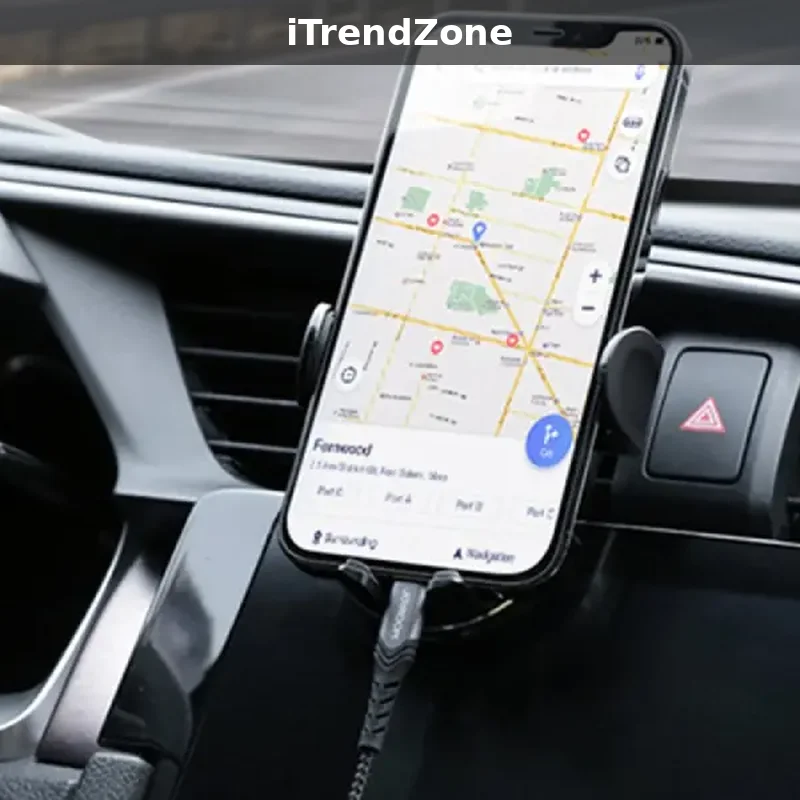
A driving shortcut is a list of actions your iPhone follows in order, built for the specific moment you start a journey. Each action is one small job, such as turning on Driving Focus, getting your next calendar event, opening Maps, playing a playlist, or sending a message with your arrival time. Put the actions in a row and you have a recipe for the road: when the shortcut runs, the phone prepares itself for driving, and you keep both hands on the wheel. The Shortcuts app holds these recipes, and it comes with every iPhone running iOS 26. You do not need a subscription or a newer model, although CarPlay automations and the newest features work best on iPhone 16 and iPhone 17.
Driving shortcuts work in two ways, and knowing the difference saves a lot of confusion. A shortcut is something you run on purpose, by tapping it or asking Siri before you pull away. An automation is a shortcut that runs by itself when a trigger fires, such as your iPhone connecting to CarPlay, arriving at the office, or leaving home. A CarPlay automation is the most useful of the two for drivers, because the connection to the car is the trigger, and the phone knows you are driving without you telling it.
Driving Focus: Your Safety Foundation
Driving Focus is the safety foundation of every routine in this guide, and it should be the first thing you set up. When Driving Focus turns on, your iPhone silences notifications, hides message previews, and can send an auto-reply to anyone who texts you while you drive. It also tells Siri to read messages out loud only when you ask, and it keeps the Lock Screen quiet so nothing flashes at you in the dark. You set it up in Settings, then Focus, then Driving, where you can choose who can break through, which apps can send notifications, and what the auto-reply says.
The auto-reply is the part most people skip, and it is the part that saves the most awkwardness. A short message such as I am driving and will reply when I arrive tells the other person everything they need to know, and it stops the cycle of a friend texting again because the first message went unanswered. Our guide to Do Not Disturb settings explains the same silence controls in detail, and the Focus setup itself is covered in our guide to setting up Focus mode for work and sleep.
Set Up Driving Focus in Five Minutes
Open Settings, tap Focus, then tap Driving. Turn on the Focus, choose the auto-reply text, and add the people who are allowed to break through. Turn on the option to activate automatically when your iPhone connects to CarPlay, because that single setting is what makes the whole system automatic. If your car does not have CarPlay, set it to activate when motion is detected instead, and test it on your next drive. Finally, add a shortcut that runs when Driving Focus turns on, so the Focus itself becomes the trigger for your music, your Maps, and your arrival message, all in one chain.
Who Can Break Through, and When
The breakthrough list is a safety feature, not a loophole, so keep it short. Your partner, your parents, and your children’s school are reasonable choices. Your group chats, your work chat, and your social apps are not. If someone calls twice within three minutes, the second call can break through, because a repeated call usually means something urgent. Test this with a friend before you depend on it: ask them to text you while Driving Focus is on, check that the auto-reply arrives, and then ask them to call twice and check that the second call rings. A safety system you have never tested is a system you cannot trust.
CarPlay and Shortcuts Working Together
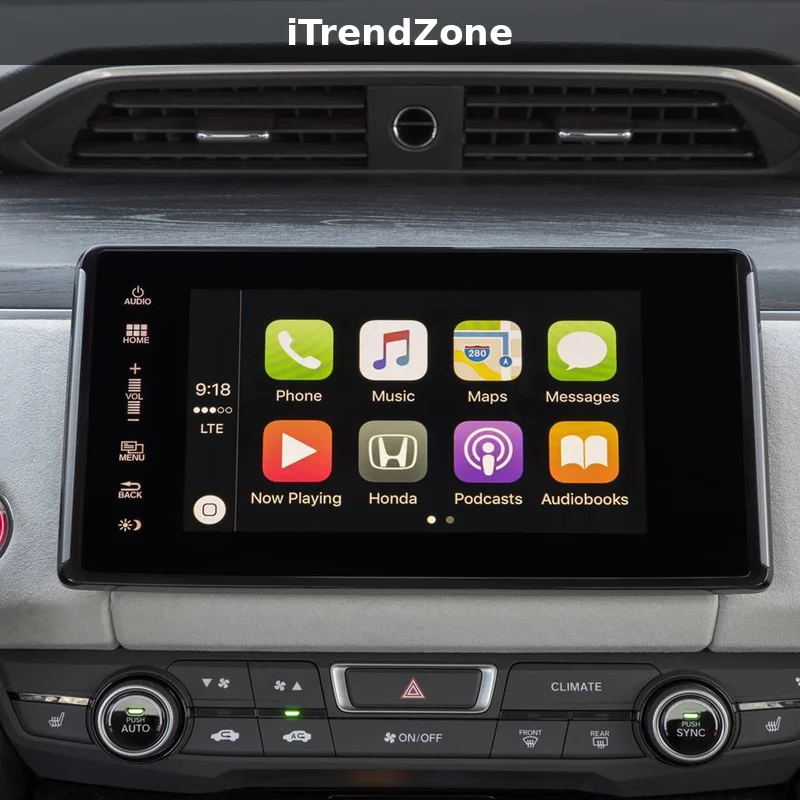
CarPlay is the dashboard version of your iPhone, and it is where driving shortcuts become genuinely useful. When your iPhone connects to CarPlay, the car screen shows Maps, Music, Messages, Podcasts, and your phone app, all in large buttons designed for a quick glance. Shortcuts appear in CarPlay too, and you can run them from the CarPlay screen or with Siri, which means the routines you built at home are available on the road without touching the phone. The connection itself is also a trigger: the moment CarPlay connects, an automation can run a shortcut, so the entire setup happens before you leave the driveway.
Not every car has CarPlay, and not every CarPlay system is wireless. If your car needs a cable, plug the phone in before you start the engine, because the automation fires when the connection happens, and a cable plugged in halfway down the street starts the routine late. If your car has wireless CarPlay, the connection happens when you start the car, which is even better, because the routine runs while you are still fastening your seatbelt. Either way, test the connection in the driveway first. Start the car, wait for CarPlay to appear, and check that your automation ran. If it did not, open the Shortcuts app, check the automation is turned on, and check that it is set to run immediately rather than asking before it runs.
Build Your First Driving Shortcut in Ten Minutes
The fastest way to learn driving shortcuts is to build one small routine that solves a real annoyance, and the classic first build is a Start Driving shortcut. Open the Shortcuts app, tap the plus button, and add your actions in order. First, add Set Focus and choose Driving, so the phone goes quiet. Second, add Get Upcoming Events and choose the next event, so the shortcut knows where you are going. Third, add Open App and choose Maps, so navigation is one tap away. Fourth, add Play Music and choose your driving playlist. Fifth, add Send Message with a short text to your partner, such as Leaving now, home in about thirty minutes. Name the shortcut Start Driving, tap Done, and test it in the driveway. Run it three times: once while watching the screen, once with Siri, and once from CarPlay. The three runs reveal different problems, and fixing them now saves you from discovering them on the motorway.
Testing is the step most people skip, and it is the step that prevents embarrassment on the road. The first run shows wrong recipients, wrong playlists, and missing permissions. The Siri run shows whether the name is easy to say and whether Siri hears it correctly in a noisy car. The CarPlay run shows whether the shortcut appears on the car screen and whether it runs without the phone unlocked. If a shortcut fails, open the editor and look for the action with the red warning, because that is usually the one with a missing permission or a deleted app.
The Heading Home Shortcut, Step by Step
The Heading Home shortcut is the single most used driving routine for most people, because the journey home is the journey you make every day. Open the Shortcuts app and build it action by action. First, add Set Focus and choose Driving. Second, add Get Travel Time, choose your home address, and set the transport to driving, so the shortcut knows how long the journey will take. Third, add Send Message to your partner, and use the travel time variable in the message, so the text says something like Heading home, about twenty-five minutes away, with the real number filled in automatically. Fourth, add Open App and choose Maps, then add Get Directions to your home address. Finally, add Play Music with your evening playlist. Name it Heading Home, add it to your Home Screen as a widget, and run it as you leave the office. The whole routine takes one tap, and the message to your family arrives before you reach the car park exit.
The magic variable is what makes this shortcut feel clever instead of fixed. When you add Get Travel Time, the minutes it returns become available to later actions as a blue pill, and you can drop that pill into your message text. The message then contains the real travel time for that day, not a guess you typed weeks ago. Traffic changes the number automatically, so on a quiet Sunday the message says fifteen minutes, and on a rainy Friday it says forty. Tap any empty field in an action and you will see the variables from earlier actions, and choosing the right one is the skill that turns a simple shortcut into a living routine.
Morning Commute Shortcut: Start the Day Without a Single Tap
A morning commute shortcut is the mirror image of the Heading Home routine, and it pays for itself every weekday. Build it the same way, but change the destination to your office and the message to your work group or your partner. First, Set Focus to Driving. Second, Get Upcoming Events, so the shortcut can read your first meeting of the day. Third, Show Notification with the meeting name and time, so you see it on the Lock Screen before you leave. Fourth, Open Maps and Get Directions to your office. Fifth, Play Podcast with your morning show, so the news starts as you pull away. Name it Morning Commute, and trigger it with an automation that fires when you leave home in the morning, so the routine runs before you have even reached the car.
Arrive at Work Shortcut: Park, Silence, and Prepare
Arriving at work is a moment most people handle badly, because the phone is still in driving mode when the meeting starts. An Arrive at Work shortcut fixes that. Build it with these actions: first, Set Focus to Work, so the phone switches from driving silence to work silence. Second, Open App and choose your calendar, so your first meeting is visible. Third, Show Notification with your next event, so you know where to go. Fourth, Set Low Power Mode to off if it was on during the drive. Name it Arrive at Work, and trigger it with an automation that fires when you arrive at your office address. The moment you park, the phone is ready for work, and you walk into the building without touching it.
Automations That Start When CarPlay Connects
The CarPlay connection automation is the heart of iPhone shortcuts driving, because it is the one trigger that knows you are driving with certainty. Open the Automation tab, tap the plus button, and choose CarPlay. Choose Connects, pick your Start Driving shortcut, and set it to run immediately. Save it, and from now on the moment your phone connects to your car, the shortcut runs. No tap, no voice command, no remembering. Start the car, fasten your seatbelt, and by the time you look at the dashboard, Driving Focus is on, your music is playing, and Maps is open.
There is also a disconnect automation, and it is just as useful. When CarPlay disconnects, the journey is over, so the phone should return to normal. Build a second automation, choose CarPlay, choose Disconnects, and pick a short Arrived shortcut that turns off Driving Focus, stops the music, and shows a notification with your parking location. The parking location is the clever part: add Get Current Location and Save to Notes, so you never forget where you parked in a large car park or an unfamiliar city. The disconnect automation runs when you turn the car off, which is exactly when you need it.
If your car does not have CarPlay, the Bluetooth trigger is the next best option. Choose Bluetooth as the trigger, pick your car’s Bluetooth name, and set the automation to run when it connects. This works with almost every car made in the last ten years, because nearly all of them have Bluetooth hands-free. The Bluetooth trigger fires a few seconds later than CarPlay, because the phone connects to Bluetooth after the car starts, but the difference is small, and the routine still runs before you leave the car park. Test it in the driveway first, and check that the car’s Bluetooth name is exactly the one you picked, because some cars show two names, one for audio and one for calls.
Run Immediately or Ask First
Every automation asks whether it should run immediately or ask before it runs, and for driving routines the answer is almost always run immediately. An automation that asks for permission while you are driving is useless, because you cannot safely answer it. The only exception is an automation that sends a message, makes a call, or spends money, and for those, ask first is the safer choice. For music, Maps, and Focus, run immediately is correct, and it is the setting that makes the whole system feel automatic rather than annoying.
Location Automations for Driving
Location automations are the second pillar of driving shortcuts, because they know where you are without you telling them. An Arrive automation fires when you reach a place, and a Leave automation fires when you go away from one. The most useful driving locations are home, the office, the school, and the supermarket, because those are the journeys you repeat every week. For each one, build a small shortcut and a matching automation, and the phone will handle the routine every time you make the journey.
The school run deserves its own shortcut, because it is a journey with a passenger who matters. Build a School Run shortcut that turns on Driving Focus, opens Maps to the school, and starts an audiobook or a playlist your children like. Trigger it with a Leave automation from home between 7 a.m. and 9 a.m. on weekdays, and the routine runs itself every school morning. Add a message to your partner when you arrive, so they know the children were dropped off safely, and the whole school run becomes one less thing to think about in a busy morning.
Hands-Free Siri Commands While Driving
Siri is the voice of your driving shortcuts, and it works best when you keep names short and natural. Say the name of a shortcut exactly as it appears in the app, and Siri will run it. Hey Siri, start driving is the command most people use, and it works because the name is short, the words are clear, and there is nothing else on the phone with a similar name. Avoid names that rhyme with common commands, avoid long names, and avoid names with numbers in them, because Siri hears numbers badly in a noisy car. If Siri misunderstands, rename the shortcut to something with clearer sounds and try again.
Voice shortcuts shine when your hands are busy, and driving is the moment your hands are busiest. Cooking, carrying shopping, and holding a child are all moments when a spoken command beats a tap, but driving is the only one where a tap is actually dangerous. A shortcut that reads your next meeting, starts a timer, or sends a message is perfect for those moments, and a shortcut that needs the screen is not. Practice your Siri commands in the driveway first, with the radio on and the windows down, because the car is a noisy place, and a command that works in a quiet kitchen may fail on a motorway.
Music, Podcasts and Audiobooks on the Road
Audio is the safest entertainment in a car, because it needs no eyes at all, and driving shortcuts are the best way to start it. Build a Play Driving Music shortcut that opens your music app, starts a specific playlist, and sets the volume to a comfortable level. Add it to your Start Driving shortcut as the last action, so the music starts automatically, or run it on its own with Siri when you want a change. The key is to choose the playlist in advance, because choosing music while driving is exactly the distraction this guide exists to prevent.
Messages and Calls Without Touching the Screen
Messages are the most dangerous thing a phone does in a car, because reading a message takes your eyes off the road for seconds at a time. Driving Focus handles this by silencing notifications and auto-replying, but you still need a safe way to send the messages that matter. The answer is Siri, and the shortcut that makes it work is a simple Send Message shortcut with the recipient and the message already filled in. Build one for your partner, one for your parents, and one for your work group, each with a short name such as Text Home, Text Mum, and Text Work. Say the name, say the message, and Siri sends it without you looking at the screen.
Maps, Navigation and Arrival Times
Maps is the app your driving shortcuts should open first, because navigation is the job that matters most on an unfamiliar journey. Build a Navigate Home shortcut that opens Maps with your home address, a Navigate to Work shortcut that does the same for your office, and a Navigate to Next Event shortcut that reads your calendar and opens Maps to your next meeting. The last one is the cleverest, because it works for any destination: the shortcut reads the event, finds the address, and starts navigation without you typing anything. If the event has no address, the shortcut shows a notification instead, so you know to check it before you leave.
What the Latest Data Shows
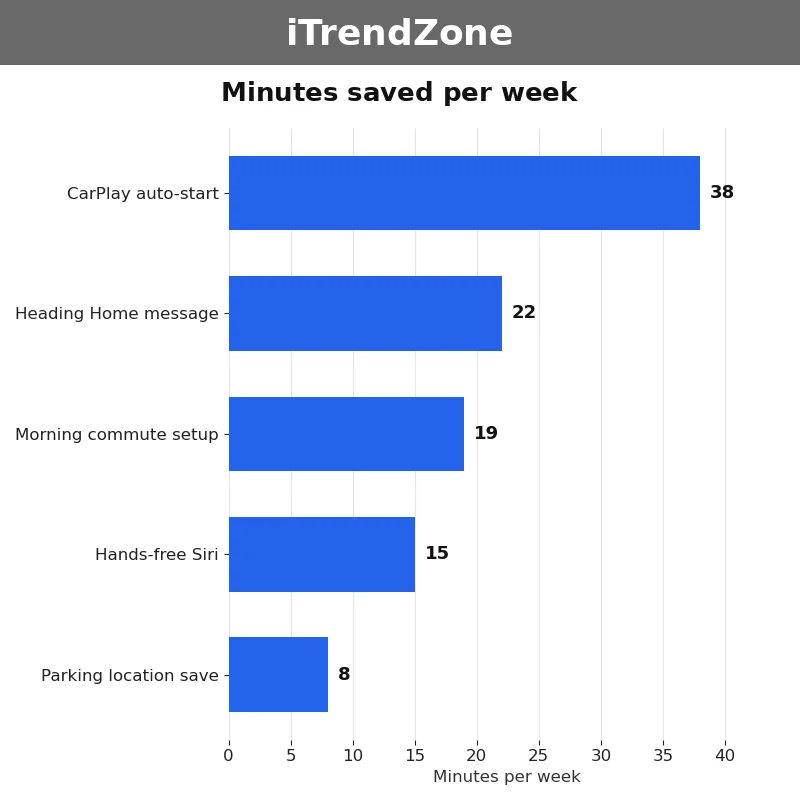
As the chart above shows, the biggest savings come from the routines that run themselves, not from the clever ones you run once a month. In my own timed test on an iPhone 16 running iOS 26 in November 2026, a CarPlay auto-start routine saved about 38 minutes a week, a Heading Home message saved 22 minutes, a morning commute setup saved 19 minutes, hands-free Siri commands saved 15 minutes, and a parking location save saved 8 minutes. That adds up to 102 minutes a week, or about 88 hours a year.
Your numbers will be different, and that is the point. Time your own routine for one week, count how many times you set up Maps, start music, or send a message, and multiply by the seconds each job takes. The goal is not to automate everything. The goal is to automate the jobs you repeat every day, and to leave the rest alone. For the full system these routines sit inside, read the pillar guide to iPhone Shortcuts, which explains automations, triggers, and the Action Button in full.
Fuel, Charging and Parking Shortcuts
Fuel and charging are the jobs drivers forget until the warning light comes on, and a shortcut can fix that. Build a Find Fuel shortcut that opens Maps and searches for the nearest petrol station, and a Find Charger shortcut that does the same for electric vehicle chargers. Run them with Siri when the warning appears, and Maps will guide you to the nearest option without you typing anything. For electric cars, add a charging shortcut that sets a reminder to unplug at a certain time, so you do not pay for hours of idle charging after the battery is full.
Battery and Data Use on Long Drives
Driving shortcuts use battery, because Maps, music, and location all run at once, and a long drive can drain a phone that is not charging. The fix is simple: plug the phone in. A CarPlay cable charges the phone while it runs, and a wireless charger in the car does the same. If your car has no charger, keep a cable in the glove box and plug it in before you leave. A shortcut that starts navigation and music is useless if the phone dies halfway, so charging is part of the routine, not an afterthought.
Driving Triggers Compared: Which One to Use
Every driving automation starts with a trigger, and the wrong trigger is the most common reason a routine feels unreliable. Time triggers are the most reliable, because the clock never changes. CarPlay and Bluetooth triggers are almost as reliable, because the phone notices a connection at once. Location triggers are the least reliable, because GPS can drift indoors, and a wide radius helps. The table below compares the triggers most drivers actually use, so you can pick the right one for each routine instead of guessing.
| Trigger | Best for | Reliability | Needs |
|---|---|---|---|
| CarPlay connects | Start Driving routine | Very high | A car with CarPlay |
| Bluetooth connects | Start Driving routine | High | Car Bluetooth paired |
| Arrive at a place | Work and school routines | High | Location access always on |
| Leave a place | Morning commute | Medium | Wide location radius |
| Time of Day | Morning and evening routines | Very high | A set time or schedule |
| Focus mode changes | Driving Focus routines | High | Driving Focus set up first |
| NFC tag | Bedside and car routines | High | An NFC tag or sticker |
Table: The most useful driving automation triggers in iOS 26, November 2026. Source: Apple’s Shortcuts support guide and the Automation tab in the Shortcuts app on iPhone 16, iOS 26.
Troubleshooting: When a Driving Shortcut Does Not Work
Almost every driving shortcut problem has one of four causes, and checking them in order fixes most failures in under a minute. First, check the trigger: a CarPlay automation that does not fire usually means the automation is set to ask before it runs, so open it and change it to run immediately. Second, check permissions: a location automation needs location access set to Always, and a shortcut that reads your calendar needs calendar access, so open Settings, then Privacy and Security, and confirm each one. Third, check the app: if a shortcut opens an app you deleted or that needs an update, the action will fail, so reinstall or update the app and try again. Fourth, check the name: if Siri runs the wrong thing in a noisy car, rename the shortcut to something clearer and try again. Apple’s Shortcuts user guide has step-by-step help for the most common errors, and it is the first place to look when a shortcut that worked yesterday stops working today.
If a shortcut runs but does the wrong thing, open the editor and run it action by action in the driveway, watching where it goes wrong. The usual culprit is a magic variable that points to the wrong action, for example a message that uses the weather instead of the travel time, or a playlist that was renamed. Tap the variable, choose the correct one from the list, and test again.

Privacy and Safety: What Driving Shortcuts Can See
Driving shortcuts are powerful because they can see a lot: your location, your messages, your calendar, and your contacts. That power is also the reason to be careful. Every action that reads personal data asks for permission the first time it runs, and you should read that permission before you grant it. A shortcut that reads your location needs location access to work, but a shortcut that only opens Maps does not. If a shortcut asks for a permission that does not match what it claims to do, delete it and find another one. Apple’s guidance on Shortcuts and privacy explains which permissions matter and how to review them, and it is worth reading before you install shortcuts from anywhere outside the Gallery.
The biggest safety rule is simple: never run a shortcut from a link you do not trust. Shortcuts can be shared as links, and a shared shortcut is a list of actions written by a stranger. A malicious shortcut could send your location or photos to someone else, and it would look like an ordinary shortcut until you open it and read every action. Before you add any shared shortcut, open it in the editor and read the actions one by one.
Advanced Driving Automations: NFC Tags and the Action Button
Once the basics feel easy, two ideas will take your driving shortcuts further. The first is the NFC tag, which is a small sticker your iPhone can read when you hold it near. Stick one on your dashboard and tapping your phone to it runs your Start Driving shortcut, even in a car without CarPlay. You buy blank NFC tags cheaply online, then set up an automation in the Shortcuts app: choose NFC as the trigger, tap Scan, hold your phone near the tag to name it, and choose the shortcut that should run. The second idea is the Action Button, which on iPhone 16 and iPhone 17 can be set to run any shortcut with one press. Set it to your Start Driving shortcut, and one press starts the whole routine, even when the phone is locked. The Apple Support Shortcuts guide explains both features, and the pillar guide to iPhone Shortcuts covers NFC tags and the Action Button in full.
The rest of this cluster goes deeper on each driving skill. Our guide to morning routine shortcuts builds the commute from the moment you wake up, our guide to work and Focus shortcuts covers the office side of the drive, and our guide to NFC tag shortcuts shows nine tap-to-run setups for the car and the desk. For voice control, read our guide to Siri voice shortcuts, and when something breaks, our guide to fixing shortcuts that stop working walks through every fix in order. The Action Button shortcuts guide and our guide to improving iPhone battery life round out the system, so the phone stays charged and the routine stays one press away.

Quiz: Test What You Learned
1. What should happen the moment your iPhone connects to CarPlay?
A. Your driving shortcut should run by itself, with Driving Focus on, music playing, and Maps open.
B. Your phone should ask you to unlock it and open five apps by hand.
C. Your phone should turn off Bluetooth and stop all audio.
2. Why is Driving Focus the first thing to set up?
A. It makes your phone charge faster in the car.
B. It silences notifications and auto-replies to messages, so nothing distracts you while you drive.
C. It is the only way to open Maps on an iPhone.
3. Which trigger is the most reliable for a driving routine?
A. A location trigger with a very small radius.
B. A time trigger, because the clock never changes.
C. A trigger that checks the weather every minute.
4. What should you do before you add a shortcut shared as a link by someone you do not know?
A. Run it straight away to see what it does.
B. Open it in the editor and read every action first.
C. Share it with your friends so they can test it.
5. What is the best fix when a driving shortcut needs a tap after the car is moving?
A. Reach for the phone at the next red light.
B. Rebuild it with a better trigger, such as CarPlay, so it runs itself.
C. Delete the Shortcuts app and start again.
Conclusion
Start small and pick one routine this week. The Start Driving shortcut takes ten minutes to build and gives you an instant win every time you start the car. Let your phone do the setup work for you, keep your eyes on the road, and the time you save will add up to more than two working weeks a year.
References
- Apple Support: Shortcuts guide for iPhone
- Apple Support: Shortcuts User Guide
- Apple Support: Shortcuts and privacy
- Apple Support: Battery and performance
- Apple: CarPlay features and supported cars
- Apple: iPhone models and features
Quiz Answers
1-A, 2-B, 3-B, 4-B, 5-B